



Your face serum, a tub of collagen powder, a laboratory vial, and some well-known prescription medicines look nothing alike. But they all have one surprisingly small thing in common: peptides.
Peptides are short chains of amino acids that can act as messengers and helpers.
That is the simple answer. Your body already makes many peptides naturally. Each one has its own order of amino acids, and that order tells it what job to do—almost like a tiny biological text message with a specific recipient.
What is a peptide?
A peptide is a short chain made from amino acids. Amino acids are small building blocks found throughout living things. When a few of them connect in a particular order, they form a peptide.
The National Library of Medicine describes a peptide as a short chain of amino acids. The exact cutoff can vary by context, but the easy way to remember it is:
One bead, a short bracelet, and a long necklace
You do not need a chemistry degree to see the difference.
Amino acid
One bead
A single building block.
Peptide
A short bracelet
A short chain with a specific sequence and job.
Protein
A long, folded necklace
A longer chain that folds into a more complex shape.
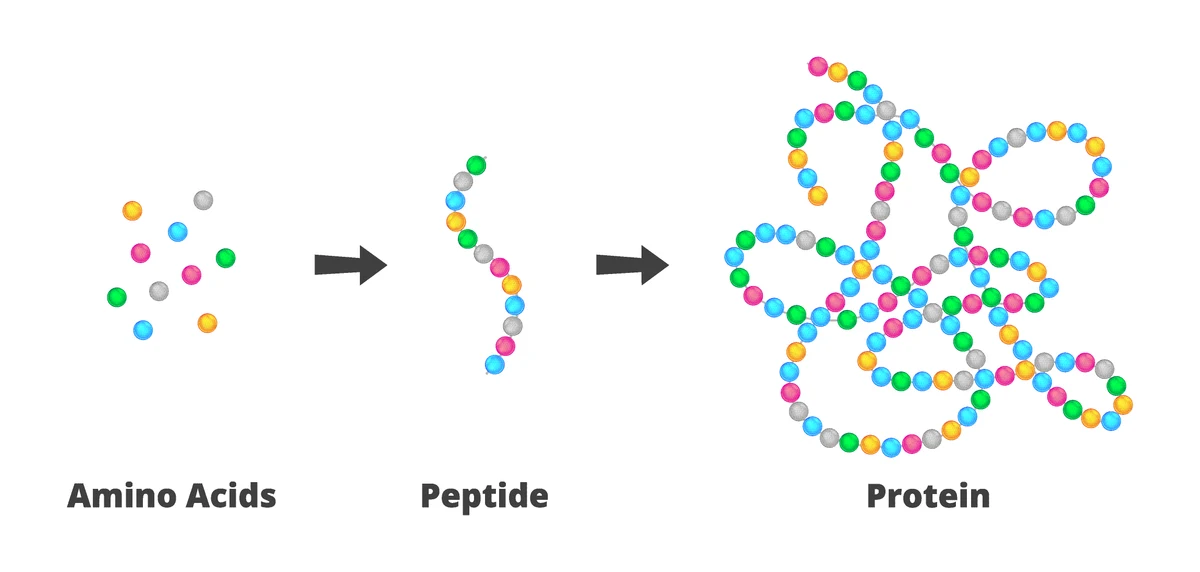
So when people ask “what is peptide?” or “what is peptides?”, they are usually asking about the same basic idea: amino acids connected into a short, useful chain.
What do peptides do?
Peptides do not all perform one job. Their sequence gives each peptide its own shape and purpose.
Many peptides act like messengers. They can tell a cell that it is time to start, stop, build, release, repair, or respond. Other peptides become part of a larger protein or help with processes that happen every day inside the body.
Think of your phone contacts. Every contact is made from the same kinds of numbers, but changing the order connects you to a completely different person. Peptides work in a similar way: the amino acids may be familiar, but their order changes the message.
This is why a skincare peptide, a collagen peptide, and a peptide used in a prescription medicine can have very different purposes even though all three belong to the same broad family.
What are peptides used for?
Peptides show up in more places than most people realize.
Skincare and hair care
Cosmetic peptides are popular in serums, creams, and scalp products. Formulators choose particular peptides to support a product concept, such as smoother-looking skin, a firmer feel, or a healthier-looking scalp. For example, GHK-Cu (Copper Tripeptide-1) is used as a professional cosmetic active, and our guide explains what researchers have found about copper peptides for hair growth.
Collagen powders and supplements
Collagen peptides are pieces of collagen protein that have been broken into shorter chains. That makes them easier to mix into drinks and foods. A tub labeled “collagen peptides” belongs to the nutrition category—not the same category as a cosmetic raw material or prescription product.
Medicines
Peptides can be designed to deliver a very specific message in the body. That makes them useful starting points for medicines. The FDA has published guidance for peptide drug products, and peptide-based medicines are used across several areas of healthcare.
Research and product development
Scientists use peptides to study how cells communicate, how receptors respond, and how a particular amino-acid sequence behaves. Manufacturers also use peptide raw materials to develop skincare, hair-care, diagnostic, and other specialized products.
Three easy examples show how different those research questions can be: CJC-1295 vs Ipamorelin compares two receptor paths connected to growth-hormone release; Semax vs Selank compares cognition-first and calm-first neuropeptide research; and MOTS-c vs SS-31 compares mitochondrial signaling with direct inner-membrane targeting.
Structure can matter just as much as the research category. See how one added amino acid separates AOD-9604 from HGH Fragment 176-191, then compare the linear and cyclic designs of Melanotan 1 and 2.
This is where identity and purity documentation matter. The name on a vial tells you what it is supposed to be; a batch-linked Certificate of Analysis helps show what was actually tested.
What is a peptide bond?
A peptide bond is the link that joins one amino acid to the next.
Go back to the bracelet picture. The amino acids are the beads. Peptide bonds are the small connectors holding the beads in order.
Chemists call this a strong covalent bond. Everyone else can simply remember: no peptide bonds, no peptide chain. The National Library of Medicine explains that peptide bonds connect neighboring amino acids to build the chain.
The sequence matters just as much as the connection. Change the order of the beads and you create a different peptide with a different shape and potentially a different job.
Are peptides safe?
Yes—many peptide products can be used safely when they are the right product for the right purpose and are used as labeled.
The word “peptide” describes a huge family, not one single product. The easiest way to make a smart choice is to identify which category is in front of you:
- A cosmetic serum or cream should have a clear ingredient list and directions.
- A dietary supplement should be evaluated as a food or supplement product.
- A prescription peptide medicine should be used according to its approved label and a licensed healthcare professional’s instructions.
- A research material should stay within its labeled laboratory or professional use.
In other words, a face serum, collagen powder, prescription medicine, and research reference are not interchangeable versions of the same thing. Each can be useful when it is made, documented, and used for its intended purpose.
For cosmetics, the FDA says products and ingredients must be safe under labeled or customary conditions of use. For any peptide product, the label, supplier transparency, lot information, and quality documents help you understand exactly what you are looking at.
How do you compare peptide products?
Start with four simple questions:
- What is the exact peptide name? “Peptide blend” is less useful than a named ingredient such as Copper Tripeptide-1.
- What type of product is it? Cosmetic, supplement, prescription medicine, or research material?
- What is it made for? The label should make the intended use clear.
- Is the batch documented? For professional and research materials, ask for a batch-linked COA with identity and purity information. Our plain-English COA guide shows what to check.
A trustworthy peptide product does not rely on the word “peptide” alone. It tells you the sequence or ingredient, intended use, specifications, and quality story.
Peptides are defined by sequence and function
Peptides are short chains of amino acids that help carry messages and perform specific jobs. They are already part of your body, and they also appear in skincare, hair care, collagen products, medicines, scientific research, and product development.
Remember the bracelet: amino acids are the beads, peptide bonds are the connectors, and the finished peptide is the message. Once you understand that, the word “peptide” stops sounding like a chemistry exam and starts making sense.
Looking for a specific peptide?
Certiva supplies documented peptide research materials and professional cosmetic actives across multiple categories. Browse the peptide product catalog, review our quality and COA process, or start an inquiry for current specifications, batch documents, bulk supply, or OEM requirements.
Sources and further reading
- National Library of Medicine: peptide basics
- National Library of Medicine: amino acids and peptide bonds
- FDA: clinical pharmacology considerations for peptide drug products
- FDA: cosmetic ingredient responsibilities
Frequently asked questions
What are peptides?
Peptides are short chains of amino acids that act like messengers and helpers. Your body makes many peptides naturally, and different peptides perform different jobs.
What do peptides do?
Many peptides carry messages between cells. Depending on their amino-acid sequence, they may help guide hormone signals, skin and tissue processes, digestion, immune activity, or other everyday body functions.
What are peptides used for?
Peptides are used in skincare and hair-care formulas, collagen supplements, prescription medicines, laboratory research, and professional product development. Each product category has its own purpose and instructions.
Are peptides safe?
Yes—many peptide products can be used safely when they are the right product for the right purpose and are used as labeled. Check the specific peptide, product category, quality documentation, and directions rather than judging every peptide as if it were the same.
What is a peptide bond?
A peptide bond is the strong chemical link that joins one amino acid to the next. Think of amino acids as beads and peptide bonds as the small connectors that turn those beads into a chain.
What is the difference between a peptide and a protein?
Both are made from amino acids. A peptide is a shorter chain, while a protein is usually longer and folded into a more complex shape. Think short bracelet versus long, carefully folded necklace.
For research use only. Not for human consumption. This article is educational and makes no medical, therapeutic, or dosing claims.
← More peptide basics guides · Have a question? Start an inquiry →