


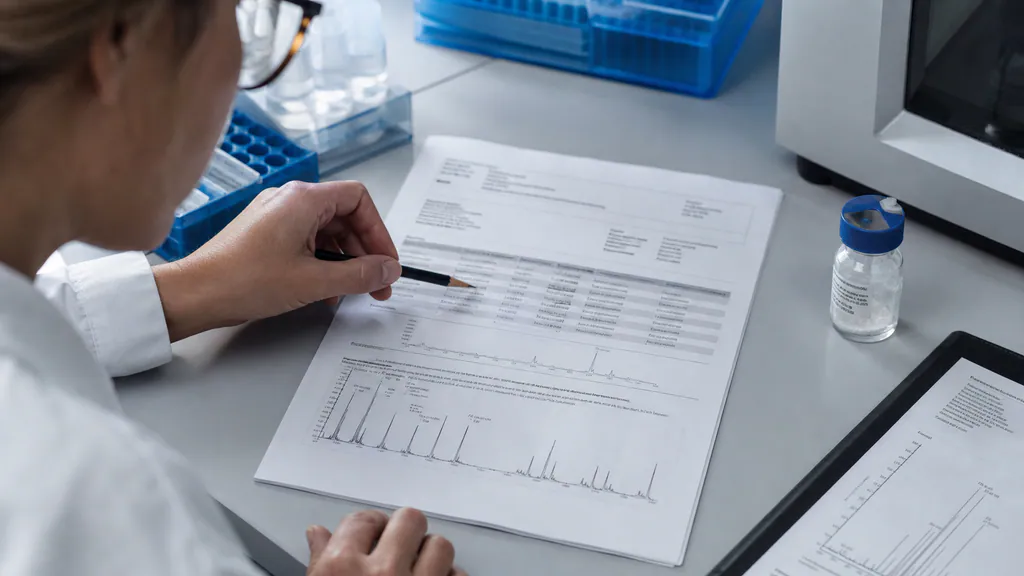
To read a peptide COA, resist the urge to begin with the largest percentage on the page. Start with the peptide name and lot number. If they do not match the material being offered, the rest of the report is beside the point.
Only then should you read the test results. HPLC purity, molecular identity, peptide content, water and microbiological attributes answer different questions. A “99%” result may be valid, but it cannot stand in for tests that were never performed. In practice, five minutes spent reading the whole document is more useful than staring at its headline number.
What a peptide Certificate of Analysis actually is
A Certificate of Analysis, usually shortened to COA, is a summary of analytical results for a particular batch. The batch relationship is the heart of the document. A report for Lot A may show that Lot A met its specification; it says nothing by itself about Lot B.
FDA’s Q7 quality guidance describes the same evidence chain for active pharmaceutical ingredients: the certificate identifies the material and batch, states the tests and acceptance limits, reports numerical results, and is dated and authorized. Research peptides are not automatically pharmaceutical ingredients, but the documentation logic remains useful. A trustworthy report should let another person trace a result back to a named sample and a specific lot.
The quickest way to read one is to move from left to right through four questions:
| Question | Where to look | What a good answer looks like |
|---|---|---|
| What was tested? | Sample or product description | Full peptide name and relevant form |
| Which material does it describe? | Batch or lot field | A number that matches the quote and delivered label |
| How was it evaluated? | Test and method columns | Named methods or controlled method references |
| What was found? | Specification and result columns | Actual results compared with stated acceptance criteria |
Start at the top: does the COA belong to this batch?
Start at the top of the report. The sample should be identified by its full peptide name rather than a vague phrase such as “research sample.” If the form matters to the project, the document should also make clear whether the sample was raw material, a finished vial, a solution, or another defined preparation. These are not necessarily interchangeable.
Next, find the batch or lot number. Ask the supplier which lot it intends to ship and compare that number with the COA. When the order arrives, compare it again with the label. An older report can still be a legitimate historical record, but it is not evidence for a newly offered lot.
This simple check catches a surprising number of problems. A polished PDF may feel more reassuring than a plain laboratory report, but design quality tells you nothing about whether the document belongs to the vial in front of you.
Next, read HPLC and mass spectrometry as separate answers
HPLC and mass spectrometry are often shown together because they provide different, complementary evidence.
HPLC describes a chromatographic profile under a particular method. The instrument separates detected components into peaks, and the integrated area of the main peak may be reported as a percentage of the total detected peak area. Method conditions matter: column, mobile phase, gradient, wavelength, integration rules, and sample preparation can all affect what is separated and detected.
That is why “99% HPLC purity” should not be translated into “the vial is 99% peptide by weight.” HPLC area percentage is not automatically peptide content or assay. It also does not establish the amount in a vial, the material’s water content, sterility, endotoxin level, or suitability for a particular use.
Mass spectrometry supplies identity evidence. The measured mass or mass-to-charge pattern can be compared with what is expected for the named molecule. On a report, this may appear as MS, LC-MS, ESI-MS, or another specified method. A matching mass is stronger when it is tied to the same sample and batch as the HPLC result.
Neither result makes the other redundant. A clean-looking chromatogram does not by itself prove that the main peak is the intended peptide, while a matching mass does not by itself describe the complete purity profile. Our HPLC versus mass spectrometry guide explains the distinction in more detail.
Do not confuse purity, identity, and content
These terms often sit close together on a COA, which makes them easy to blur. Reading them as three separate sentences helps:
| Result | The question it addresses | What it does not prove alone |
|---|---|---|
| HPLC purity | What does the chromatographic profile look like? | Molecular identity or amount per vial |
| MS identity | Does the observed mass support the expected molecule? | Chromatographic purity or total content |
| Content or assay | How much target material is measured by the stated method? | Every possible impurity or safety attribute |
Projects may require additional tests such as water, residual solvents, counterion, endotoxin, bioburden, or sterility. Those results should be requested and specified explicitly. They cannot be inferred from a purity percentage that measured something else.
The specification column also deserves attention. A result tells you what the test found; an acceptance criterion tells you what was agreed to be acceptable. ICH Q6A defines a specification as the combination of tests, analytical procedure references, and acceptance criteria. A COA is easier to evaluate when it shows both the target and the measured result instead of a floating “pass” with no context.
Can you follow the result back to the laboratory?
After interpreting the science, look at the document trail. A complete report should name the testing laboratory or quality unit and carry a report, task, or reference number. The dates should form a sensible sequence from sample receipt or test request through analysis and release. An authorized signature or electronic approval should show that someone reviewed the result.
Third-party testing can add useful independence, but “third-party tested” is not a substitute for the report itself. The laboratory still needs to show which sample it received, which batch was represented, what it did, and what it found. Our guide to what third-party tested means applies that four-part check.
Be especially cautious when you receive only a cropped screenshot. Cropping can hide the sample description, dates, method, page count, or approval. Ask for the complete report and, where the project’s risk warrants it, the associated chromatogram or instrument pages. You are not looking for a particular visual template; you are looking for an unbroken connection between sample, batch, method, and result.
Reading one COA from top to bottom
The Certiva example below identifies Tirzepatide as the sample, shows Batch 2026, names the requested LC-MS and RP-HPLC work, and reports identity, content, and peptide purity results. It is useful as an example of reading order, not as evidence for any other product or lot.
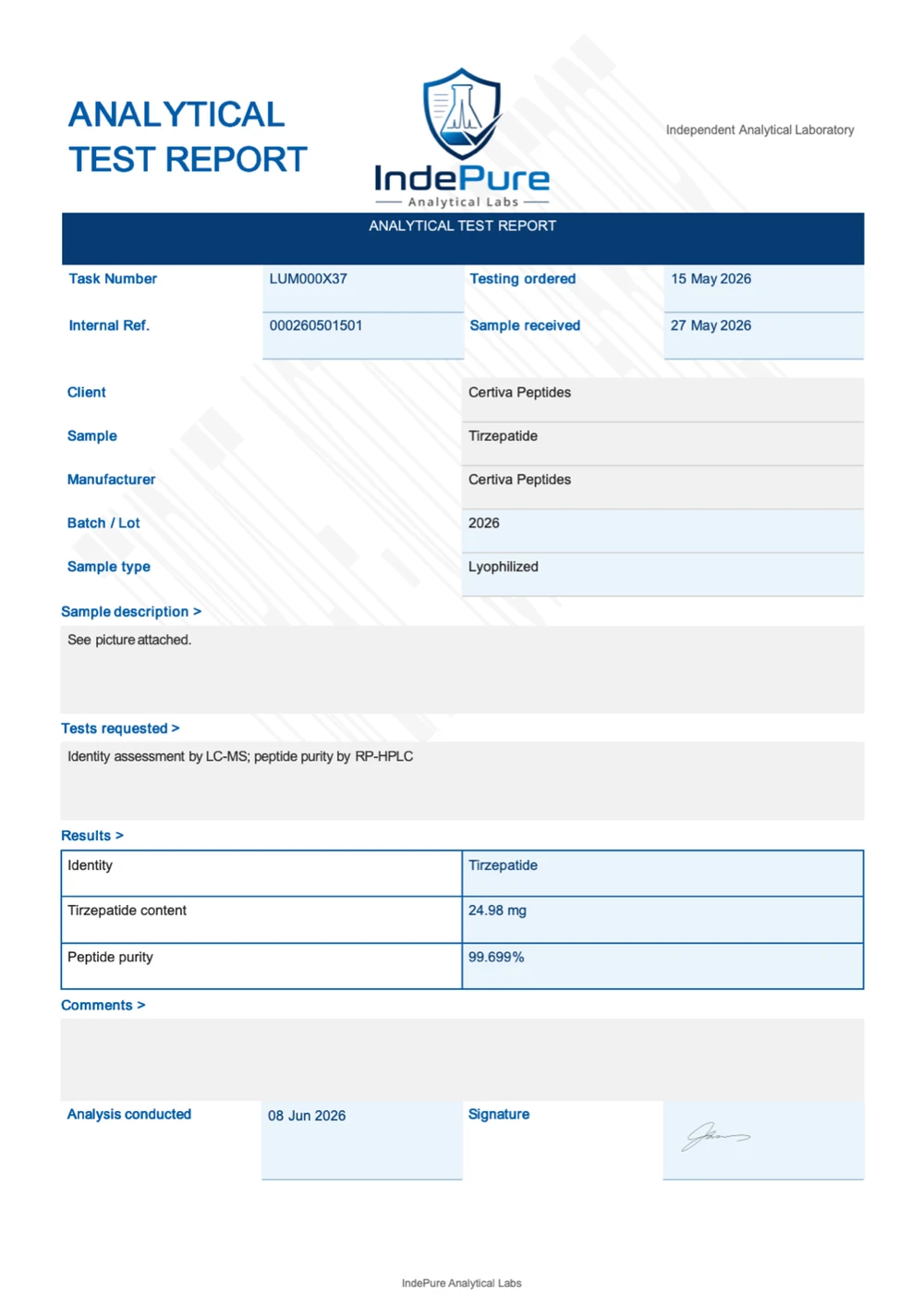
Reading this example takes less than a minute. “Tirzepatide” and “Batch 2026” tell us which sample the report describes. The laboratory and task references show where the work was recorded. The dates establish when it happened. Only after those checks do the LC-MS and RP-HPLC rows become meaningful, and each result still needs to be compared with its own specification. Certiva’s other published peptide COAs can be reviewed the same way, while current-lot documents should always be requested for an actual order.
Before ordering, ask for the COA of the lot that will ship
Ask the supplier: “Can you send the complete COA for the lot you plan to ship?”
A useful answer should make the sample name, lot, methods, dates, specifications, and results easy to compare. If the offered lot changes, the document should change with it. Once the material arrives, keep the label and report together in the receiving record.
A COA is evidence, not a universal safety certificate. It reports the attributes that were tested; it cannot establish tests that were omitted or turn a research material into an approved medicine. For a broader supplier review, use the peptide supplier audit checklist alongside the batch document.
For a legitimate laboratory or institutional inquiry, send the peptide, specification, quantity and destination. That gives Certiva enough context to attach the applicable current-lot information rather than an unrelated example report.
Request a current batch COA and quote →
Sources and further reading
- FDA: Q7 Good Manufacturing Practice Guidance for Active Pharmaceutical Ingredients
- ICH: Q6A Specifications—Test Procedures and Acceptance Criteria
- FDA: Guidance for Industry—Synthetic Peptides
Frequently asked questions
What is a peptide Certificate of Analysis?
A peptide Certificate of Analysis, or COA, is a batch-specific summary of the tests performed, the methods or method references, the acceptance criteria, and the actual results. It should identify the material and the lot it describes.
What should I check first on a peptide COA?
Match the full peptide name and batch or lot number to the material being offered. If the report belongs to another batch, its results do not describe the material you will receive.
Does 99% HPLC purity mean the vial contains 99% peptide by weight?
Not necessarily. HPLC area percentage describes a chromatographic purity profile under the stated method. It is not automatically the same as peptide content, assay, vial fill, identity, sterility, or endotoxin status.
Why should a peptide COA include mass spectrometry?
HPLC and mass spectrometry answer different questions. HPLC separates detected components, while mass spectrometry can support identity by comparing the observed molecular mass with the expected peptide.
How can I tell whether a peptide COA is credible?
Look for a clearly named sample, matching lot number, laboratory or quality unit, report reference, test and report dates, methods, acceptance criteria, numerical results, and authorization. Ask for the complete current-lot report rather than a cropped image.
Does a COA prove that a peptide is safe for human use?
No. A COA reports only the attributes that were tested for that batch. It does not turn a research material into an approved medicine or prove suitability for human use.
For research use only. Not for human consumption. This article is educational and makes no medical, therapeutic, or dosing claims.
← More quality testing & COAs guides · Have a question? Start an inquiry →