


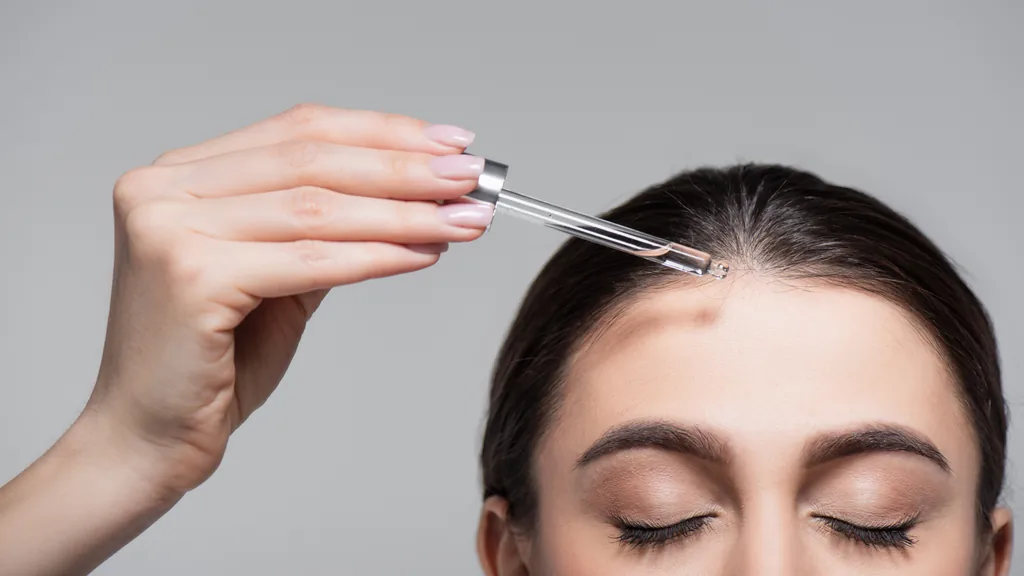
TikTok says GHK-Cu can give you fuller-looking hair, better skin, and nails that grow so fast your manicure cannot keep up.
Yes—copper peptides can support hair growth.
That is the short answer. The manicure story may be the fun part, but researchers have also reported longer-growing follicles, increased hair count, and less hair fall when copper peptides were included. That makes GHK-Cu an interesting ingredient for modern scalp and hair-density formulas.
What is GHK-Cu?
GHK-Cu is a tiny peptide made from three amino acids carrying copper. On a cosmetic ingredient list, it is usually called Copper Tripeptide-1.
Think of it as a small messenger. Instead of coating the hair like a conditioner, copper peptides are studied for the way they communicate with cells involved in skin repair and the environment around the hair follicle.
You may also see AHK-Cu in hair research. It is another copper peptide in the same family, but it is not exactly the same molecule as GHK-Cu. Both help explain why scientists and formulators are interested in copper peptides for hair loss and scalp care.
What have studies found about copper peptides for hair growth?
Here are the useful discoveries without the science lecture.
Copper peptides helped hair follicles grow longer in the lab
In a 2007 study, researchers tested AHK-Cu on isolated human hair follicles. The copper peptide helped the follicles grow longer and encouraged the growth of dermal papilla cells—the important cells at the base of a hair follicle.
That gave researchers a clear clue: copper peptides can interact with the part of the follicle that helps control hair growth.
Hair count increased in a six-month human study
A 2016 study followed 45 men using a daily scalp spray. The active formulas contained GHK plus another ingredient called 5-ALA. After six months, the groups using the active formulas had a much larger increase in hair count than the placebo group. One active group also clearly outperformed placebo in the study’s analysis. You can read the human hair-growth study on PubMed.
For everyday readers, the important point is simple: a GHK-containing scalp formula produced a measurable improvement in hair count over time.
A large scalp study reported less hair fall
In 2018, researchers followed 1,000 people who received a scalp formula containing Copper Tripeptide-1 and several growth factors. The study reported less hair fall in 83% of participants, along with increases in thicker terminal hairs and hair-shaft diameter for many participants.
These studies used different formulas, but they point in the same useful direction: copper peptides deserve a place in the conversation about hair-density and scalp-care ingredients.

How may copper peptides help hair?
A hair follicle is a tiny living structure. At its base are dermal papilla cells, which help send the signals that guide the hair-growth cycle.
Copper-peptide research suggests three simple ways these ingredients may help:
- supporting dermal papilla cells around the base of the follicle;
- encouraging growth and repair signals in the surrounding skin; and
- supporting a healthier scalp environment for growing hair.
This is why GHK-Cu appears in more scalp serums, hair-density products, and professional formulation concepts. It brings together skin-care science and hair-follicle research in one ingredient.
What should you look for in a GHK-Cu hair serum?
The front of the bottle may say “peptide complex,” but the ingredient details tell you more.
- Look for the right name. GHK-Cu is commonly listed as Copper Tripeptide-1.
- Check the whole formula. A good serum also needs suitable packaging, pH, stability, and ingredients that feel comfortable on the scalp.
- Give it time. Hair grows in cycles. The human GHK study measured results over six months, so gradual progress is more realistic than an overnight change.
- Track consistently. Take a photograph once a month in the same light, from the same angle, with a similar hair length and style.
For professional formulators, raw-material identity matters too. A batch-linked Certificate of Analysis helps confirm that the ingredient supplied matches the material ordered. Our plain-English COA guide explains what to check.
And what about the viral nail-growth story?
This is where the internet gets entertaining.

Hair and nails both grow slowly, so stories about a manicure suddenly growing out after GHK-Cu sound believable. They have also helped turn copper peptides into a viral beauty topic.
For now, think of the nail story as a fun anecdote. The stronger reason to pay attention is the hair research: follicle growth in the lab, increased hair count in a human scalp study, and reduced hair fall in a larger treatment study.
How strong is the hair-growth evidence?
Copper peptides have shown several encouraging signs for hair growth. Research has found support for hair-follicle growth, dermal papilla cells, hair count, and reduced hair fall. GHK-Cu—usually listed as Copper Tripeptide-1—has therefore become an exciting ingredient for scalp serums and hair-density formulations.
The science is still developing, but the interest is not based on social-media hype alone. There is a real biological signal behind the trend—and plenty of room for better-formulated, well-documented copper-peptide hair products.
A small randomized 2026 study has now tested the question directly on brows. See what the 2% GHK-Cu eyebrow trial found after 12 weeks.
Formulating with Copper Tripeptide-1?
Certiva supplies GHK-Cu (Copper Tripeptide-1) and AHK-Cu cosmetic active as raw materials for professional formulation, OEM, and private-label development. Batch identity and purity documentation is available on request.
Compare GHK-Cu, Matrixyl, SNAP-8, and AHK-Cu in our peptides-in-skincare guide. For the direct copper-peptide choice, read GHK-Cu vs AHK-Cu.
Start an inquiry to compare specifications and supply options for a copper-peptide scalp-care or hair-density concept.
Sources and further reading
- Laboratory study: AHK-Cu and human hair follicles
- Human study: a topical 5-ALA and GHK complex
- Large scalp study: a formula containing Copper Tripeptide-1
Frequently asked questions
Do copper peptides work for hair growth?
Yes—copper peptides can support hair growth. A related copper peptide helped human hair follicles grow longer in a laboratory study, and a six-month human study of a scalp spray containing GHK plus 5-ALA increased hair count.
Does GHK-Cu help with hair loss?
GHK-Cu is being studied for its ability to support the cells and signals around the hair follicle. Human and laboratory research has found positive hair-growth signals, which is why Copper Tripeptide-1 is increasingly used in scalp and hair-density formulas.
How long does GHK-Cu take to work for hair growth?
Hair changes take time. The human GHK study measured results over six months, so a copper-peptide hair serum is better judged over months than days. Consistent photographs can make gradual changes easier to track.
Is GHK-Cu the same as Copper Tripeptide-1?
Yes. GHK-Cu is commonly listed as Copper Tripeptide-1 in cosmetic ingredient lists and raw-material documents. AHK-Cu is a related but different copper peptide.
Will GHK-Cu make my nails grow faster?
Fast-growing manicure stories have helped make GHK-Cu popular online, but they are personal anecdotes rather than a typical result established by human studies. They are a fun trend, not the main reason copper peptides are used in hair formulas.
Educational content only. Cosmetic ingredients and finished products are not interchangeable, and this article does not diagnose or treat hair or skin conditions. Follow the finished-product label and ask a qualified healthcare professional about persistent concerns.
← More skin & hair peptides guides · Have a question? Start an inquiry →