


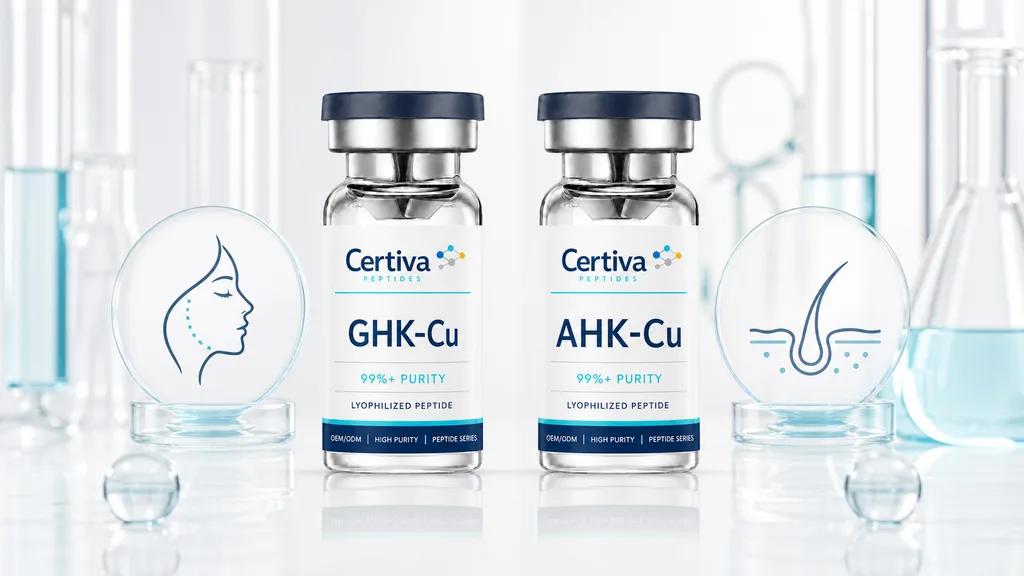
They are only one amino acid apart—but that one letter can change the whole product story.
GHK-Cu is the better-known choice for face-first skin renewal; AHK-Cu is the more focused choice for scalp and hair-density formulas.
Both are copper peptides. Both have three amino acids. Both can give a beauty brand a premium, science-led ingredient story. The easiest way to choose is to start with the customer’s goal: face or scalp?
Compare GHK-Cu and AHK-Cu specifications →
Which copper peptide fits your product?
Choose the ingredient with the clearest story for the product you want to build.
Face serum
Choose GHK-Cu
The recognizable blue copper peptide for premium skin-renewal positioning.
Scalp serum
Choose AHK-Cu
A focused copper-peptide story supported by human hair-follicle research.
Complete line
Use both strategically
Give the face and scalp products distinct hero ingredients instead of one vague peptide claim.
GHK-Cu vs AHK-Cu at a glance
| Comparison | GHK-Cu | AHK-Cu |
|---|---|---|
| Full peptide sequence | Gly-His-Lys-Cu | Ala-His-Lys-Cu |
| First amino acid | Glycine | Alanine |
| Best-known consumer story | Skin renewal and visible skin quality | Scalp environment and hair-density care |
| Popular formats | Face serum, cream, ampoule, scalp serum | Scalp serum, hair-density treatment, face serum |
| Certiva specifications | 50 mg and 100 mg | 50 mg and 100 mg |
| Standard box | 10 vials | 10 vials |
The table shows why this is not a good-versus-bad comparison. It is a recognizable skin-renewal ingredient versus a more focused scalp-care ingredient.
What are GHK-Cu and AHK-Cu?
GHK-Cu and AHK-Cu are tiny peptides that carry copper.
A peptide is a short chain of amino acids. In these two ingredients, the chain contains only three:
- GHK-Cu: glycine, histidine, lysine, and copper;
- AHK-Cu: alanine, histidine, lysine, and copper.
Only the first amino acid changes. GHK-Cu starts with glycine. AHK-Cu starts with alanine.
That sounds like a small difference because it is a small difference. But in peptide science, the exact order of amino acids gives a molecule its identity. That is why buyers should request the exact name, specification, and batch documents instead of ordering a generic “copper peptide.”
Why is GHK-Cu so popular in skincare?
GHK-Cu is the copper peptide most beauty shoppers already recognize. Cosmetic labels commonly call it Copper Tripeptide-1.
Its natural blue color is immediately memorable. A blue serum can show the ingredient story before a shopper reads the back of the box.
The research story is also easy to communicate. GHK-Cu has been connected with:
- collagen production;
- skin-supporting fibroblasts;
- extracellular-matrix remodeling;
- visible skin quality; and
- the environment around hair follicles.
One published study found that GHK-Cu increased collagen synthesis in human skin fibroblasts. For ordinary shoppers, that supports a simple position:
GHK-Cu is the copper peptide for a premium skin-renewal story.
That makes it a natural hero ingredient for:
- blue copper-peptide serums;
- firming face creams;
- post-stress skin formulas;
- premium ampoules; and
- face-and-scalp product lines.
Read our broader guide to how peptides work in skincare.
Why does AHK-Cu stand out for scalp care?
AHK-Cu is a related copper tripeptide with a more focused hair-research story.
In a laboratory study, researchers placed AHK-Cu around isolated human hair follicles. The treated follicles grew longer, and the peptide supported the growth of dermal papilla cells.
Dermal papilla cells sit at the base of the hair follicle. They help control the signals involved in the hair-growth cycle.
That creates a clear commercial position:
AHK-Cu is the copper peptide to highlight in a scalp-first or hair-density formula.
Popular concepts include:
- leave-on scalp serums;
- hair-density treatments;
- premium hairline products;
- copper-peptide scalp systems; and
- professional haircare formulas.
The study used isolated follicles, not a finished retail serum. The valuable part for a cosmetic brand is the ingredient’s focused biological story and the chance to build a well-tested topical product around it.
See the study in PubMed’s AHK-Cu hair-follicle record.
Which is better for the face?
GHK-Cu is the easier face-first choice.
It has stronger consumer name recognition, a familiar INCI name, a visible blue identity, and a broad skin-renewal story.
A shopper looking at a face serum can quickly understand:
- copper peptide;
- collagen-support story;
- smoother-looking skin;
- premium blue active.
AHK-Cu can also appear in skincare, but it needs more explanation. Its clearest advantage is the specialized scalp and hair story.
For a face product that needs one hero copper peptide, GHK-Cu gives the brand the shorter path from ingredient to understandable benefit.
Which is better for hair?
AHK-Cu gives a hair product the more focused story.
Its published human-follicle research makes it easy to connect the ingredient with the scalp environment and dermal papilla cells.
GHK-Cu still belongs in the hair conversation. GHK-containing scalp formulas and Copper Tripeptide-1 products have reported encouraging hair-count and hair-fall results.
That means a brand has two strong options:
- choose AHK-Cu for a specialist hair-follicle message; or
- choose GHK-Cu for a more recognizable copper-peptide name that can connect face, scalp, and hair products.
Read the consumer evidence in our copper peptides for hair growth guide.
Can a brand use both?
Yes. The smartest use may be across a product line rather than forcing both ingredients into one bottle.
For example:
| Product | Hero ingredient | Simple consumer message |
|---|---|---|
| Blue face serum | GHK-Cu | Premium copper-peptide skin renewal |
| Scalp-density serum | AHK-Cu | Focused follicle and scalp support |
| Eye or wrinkle serum | Matrixyl or SNAP-8 | Fine-line or expression-line care |
This approach gives each product a reason to exist. It also makes bundles easier to understand.
If both copper peptides go into one formula, the formulator should confirm compatibility, pH, stability, color, packaging, preservative performance, and finished-product results.
What should a cosmetic peptide buyer compare?
Do not let the blue color do all the quality control.
Before ordering GHK-Cu or AHK-Cu, request:
- the full peptide name and sequence;
- the cosmetic or raw-material specification;
- the current batch COA;
- identity and HPLC purity information;
- copper and appearance specifications where applicable;
- storage and packaging guidance;
- minimum order quantity and lead time; and
- bulk, OEM, private-label, or custom-formulation options.
For a finished blue serum or private-label launch, follow the copper peptide OEM checklist for 2026 so the ingredient, formula, package, claims, and scale-up quote stay connected.
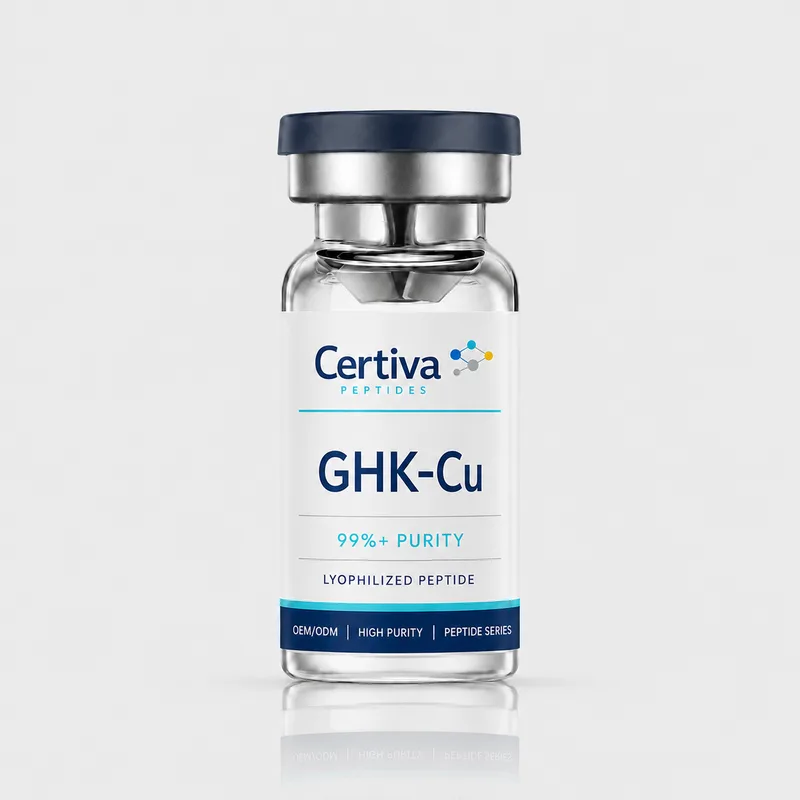
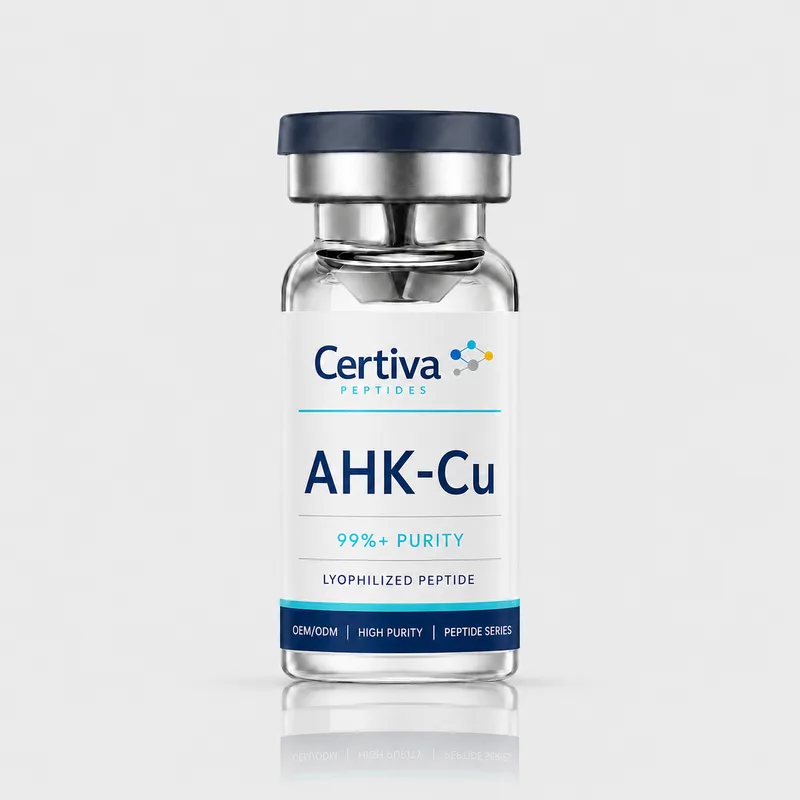
Certiva supplies both GHK-Cu and AHK-Cu in 50 mg and 100 mg vial specifications, with 10 vials per standard box. Larger cosmetic manufacturing quantities are available by inquiry.
Which copper peptide fits the formulation?
GHK-Cu is the better-known choice for face-first skin renewal; AHK-Cu is the more focused choice for scalp and hair-density formulas.
Choose GHK-Cu when the product needs a famous blue hero ingredient and a broad premium skincare story.
Choose AHK-Cu when the product needs a more specialized connection to scalp and hair-follicle research.
Both can earn a place in the same cosmetic line—as long as each product has a clear job and the finished formula is properly tested.
Request both cosmetic-active specifications and a quote
For a GHK-Cu or AHK-Cu formulation review, describe the market, finished-product format, concentration target, quantity, and documents needed. Certiva can then compare the relevant active specifications and available bulk or OEM routes.
View GHK-Cu specifications · View AHK-Cu specifications · See Certiva quality standards
Request GHK-Cu and AHK-Cu specifications + a quote →
Sources and further reading
- PubMed: GHK-Cu and collagen synthesis
- PubMed: AHK-Cu and human hair follicles
- PubMed: GHK-Cu skin-permeation review
Frequently asked questions
Which is better, GHK-Cu or AHK-Cu?
GHK-Cu is the better-known choice for face-first skin renewal; AHK-Cu is the more focused choice for scalp and hair-density formulas.
What is the main difference between GHK-Cu and AHK-Cu?
Both are copper-carrying tripeptides, but their first amino acid is different. GHK-Cu begins with glycine, while AHK-Cu begins with alanine. That small structural change gives each ingredient its own research and formulation story.
Is GHK-Cu the same as Copper Tripeptide-1?
Yes. GHK-Cu is commonly listed as Copper Tripeptide-1 on cosmetic ingredient lists and raw-material documents.
Is AHK-Cu good for hair formulas?
AHK-Cu has a strong scalp and hair-density story. A laboratory study using human hair follicles reported longer follicle growth and increased dermal papilla cell growth.
Can GHK-Cu and AHK-Cu be used in the same product line?
Yes. A brand can position GHK-Cu in face-first skin-renewal products and AHK-Cu in scalp-first hair-density products. The finished formulas still need compatibility, stability, safety, and performance testing.
Does Certiva supply GHK-Cu and AHK-Cu for cosmetic formulation?
Yes. Certiva supplies both cosmetic actives in 50 mg and 100 mg vial specifications, with 10 vials per standard box. Bulk, OEM, and private-label quantities are available by inquiry.
Educational content only. Cosmetic ingredients and finished products are not interchangeable, and this article does not diagnose or treat hair or skin conditions. Follow the finished-product label and ask a qualified healthcare professional about persistent concerns.
← More skin & hair peptides guides · Have a question? Start an inquiry →