


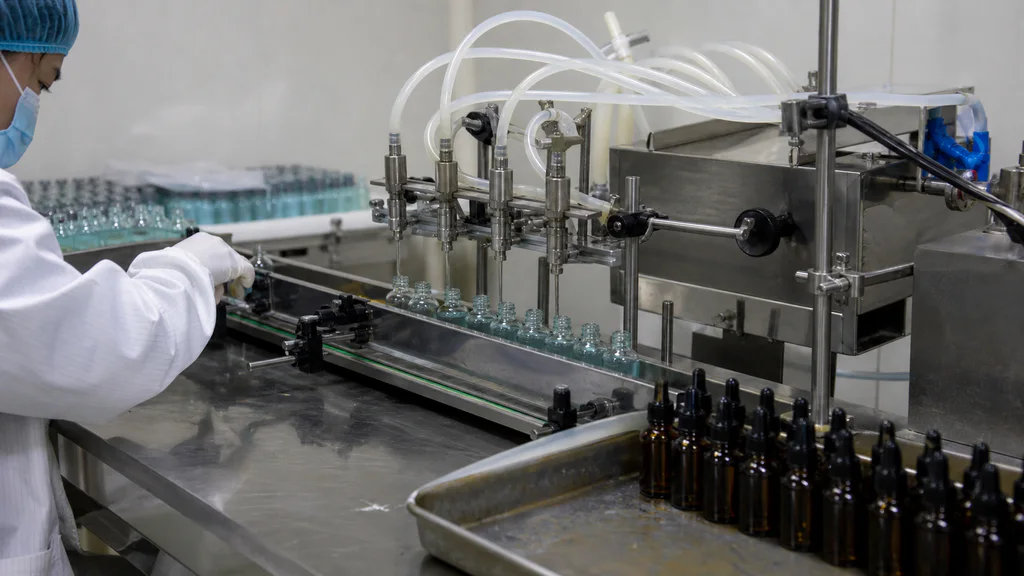
The blue color can sell the first bottle. A weak production brief can lose the second order. A viral injection claim can put the whole brand at risk.
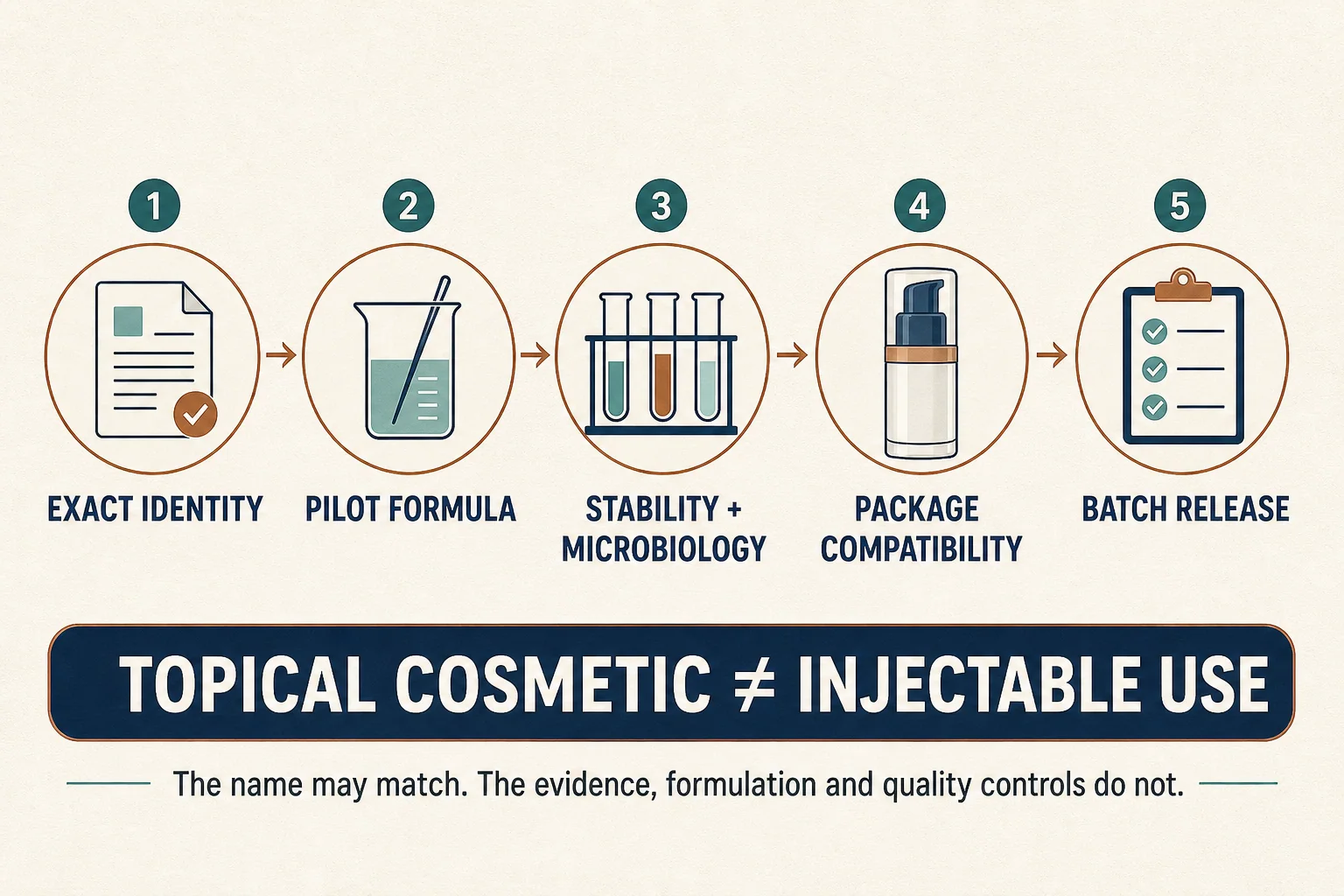
Topical GHK-Cu belongs in cosmetic formulation; injectable GHK-Cu is a different, unapproved use. Evidence and quality controls for a skin product cannot be transferred to an injectable product. A copper peptide OEM should lock the identity, formula, testing, packaging, claims, MOQ, and scale-up plan before making a serum.
This guide is for skincare brands, distributors, formulators, and private-label buyers evaluating a copper peptide manufacturer or OEM partner.
Why copper peptide OEM is a strong 2026 opportunity
Copper peptides sit where consumer interest and B2B product development meet. People recognize the blue serum. Brands can build several clear formats around it, including face serums, scalp serums, gels, and professional cosmetic products.
The commercial opportunity is real, but the ingredient still needs a disciplined brief. A 2025 scientific review described GHK-Cu as hydrophilic and noted that skin-permeation research for liposomal GHK-Cu remains limited. That is a useful product-development lesson: delivery systems can be interesting, but a supplier should not turn an early formulation idea into a guaranteed performance claim.
For a simple consumer explanation, read what copper peptides are used for. For purchasing, keep reading.
What is GHK-Cu?
GHK is a short peptide made from three amino acids: glycine, histidine, and lysine. When it forms a complex with copper, the material is commonly called GHK-Cu.
In cosmetic ingredient language, the name is Copper Tripeptide-1. The Cosmetic Ingredient Review defines it as a complex formed by copper and Tripeptide-1 and lists it as a skin-conditioning agent. Its safety assessment concluded that the reviewed peptide ingredients, including Copper Tripeptide-1, were safe in the reported practices and concentrations of use.
That does not make every finished serum automatically safe or effective. The finished formula, concentration, preservation, package, directions, and claims still matter.
If your team is comparing copper-peptide options, use our GHK-Cu vs AHK-Cu guide before requesting samples. For a new format with direct consumer interest, review the 2026 GHK-Cu eyebrow trial and its 12-week topical result before writing the product brief.
GHK-Cu topical vs injectable: what is actually different?
The name can be the same while the product is completely different. A leave-on serum is designed for the skin surface. An injectable product enters tissue and creates a different exposure, sterility requirement, safety question, and legal category. One cannot borrow the other’s evidence.
| Question | Topical GHK-Cu cosmetic | Injectable GHK-Cu claim |
|---|---|---|
| Intended route | Applied to intact skin, scalp, or brows | Introduced through the skin |
| Evidence to review | Cosmetic safety, topical studies, finished-formula tests, claim support | Route-specific clinical safety and effectiveness evidence |
| Core quality work | Ingredient identity, formula compatibility, preservation, stability, package compatibility, release tests | Sterility, endotoxin, particulate, dose, administration, and drug-level controls would be central |
| U.S. marketing lane | Cosmetic when claims concern cleansing, beautifying, or appearance | Not an approved cosmetic use; treatment or structure/function claims can place a product in the drug lane |
| Honest conclusion | A practical cosmetic product category with a defined OEM path | Topical research does not prove injectable benefit or safety |
This is not wordplay. The FDA’s explanation of cosmetic and drug claims focuses on intended use. A product promoted to treat disease or affect the structure or function of the body may be regulated as a drug even if the front label says “serum” or “cosmetic.” FDA also says cosmetic claims must be truthful and not misleading in its cosmetic labeling guidance.
For a skincare buyer, the clean commercial choice is to build the topical product well and sell the consumer experience it can honestly support. Do not use a cosmetic page to suggest injection, dosing, wound treatment, systemic repair, or another medical result.
What does the topical GHK-Cu evidence support?
The strongest simple answer is that topical GHK-Cu has a cosmetic research story, but every ambitious claim still needs the right evidence. Laboratory work can help explain why an ingredient is interesting. Human studies are more useful for what a consumer may see. A study of one finished formula is not automatic proof for every other serum using the ingredient name.
The Cosmetic Ingredient Review assessed Copper Tripeptide-1 with related peptide ingredients and concluded they were safe in the reported cosmetic practices and concentrations of use. That is a safety assessment, not a promise that every formula will deliver the same visible result. Preservation, concentration, other ingredients, packaging, and use directions can all change the finished product.
A small 2026 randomized split-face trial gives brands a more direct topical example. Eighteen adults used a serum described as 2% GHK-Cu on one eyebrow and a matching vehicle on the other for 12 weeks. The treated side improved in hair count and thickness. That is useful evidence for a brow-serum concept. It is not proof of an injectable effect, and it did not show that GHK-Cu beats minoxidil, bimatoprost, or every cosmetic brow product.
A 2025 review of liposomal GHK-Cu also found that skin-permeation research remains limited. The practical takeaway is not “delivery does not matter.” It is that a brand should test the delivery system it actually sells and avoid turning a technical word such as liposomal into an unsupported performance guarantee.
A usable evidence ladder for brand copy
Before writing the product page, sort each statement into one of four levels:
- Ingredient identity: “Made with Copper Tripeptide-1” can be checked against the formula and raw-material documents.
- Product experience: texture, absorption, appearance, and routine position can be checked on the finished product.
- Cosmetic performance: a visible claim needs suitable finished-product or well-matched evidence and careful wording.
- Medical or body-function claim: stop and obtain regulatory review; cosmetic marketing is not the place to improvise it.
This ladder keeps the copy commercial without making it fragile. A clear promise that the evidence supports usually sells better over time than a spectacular claim that a marketplace, regulator, or informed customer can quickly challenge.
The seven decisions to make before requesting a quote
1. Name the exact ingredient
“Copper peptide” is too broad for a purchase order.
The brief should state:
- Copper Tripeptide-1 or another exact ingredient;
- common name, such as GHK-Cu, for reference;
- raw-material format and concentration;
- carrier or solvent, if supplied as a solution;
- required identity and quality documents;
- storage statement; and
- the revision date of the approved specification.
The name on the quote, raw-material document, formula, and label file should point to the same ingredient.
2. Define the product format
A serum is not a complete formula brief. Tell the OEM what the consumer will actually receive.
Include:
- face, eye-area, scalp, or another intended cosmetic area;
- watery serum, gel serum, cream, or spray;
- target look, feel, and color;
- fragrance-free or fragranced direction;
- package size and application method;
- target market and sales channel; and
- desired launch date.
A private-label stock formula may be the fastest route. A custom formula gives the brand more control but adds development, testing, and approval work. Our peptide OEM vs ODM guide explains the difference.
3. Build a formula compatibility brief
GHK-Cu is not the only ingredient in a serum. The full system can include water, humectants, thickeners, preservatives, chelating agents, botanical extracts, fragrance, and other actives.
Ask the formulator to review:
- target pH range;
- ingredient addition order;
- mixing temperature;
- color and odor expectations;
- possible interactions with the preservative system;
- whether another ingredient could bind or disturb copper;
- processing and hold times; and
- the final package material.
Do not copy a compatibility rule from a social post and treat it as universal. Test the actual formula.
4. Agree on the test plan
The raw ingredient and finished serum answer different quality questions.
| Stage | Useful questions |
|---|---|
| Raw material | Is it the agreed ingredient and does it meet the purchased specification? |
| Pilot batch | Does the formula have the expected pH, color, odor, feel, and uniformity? |
| Stability | Does the product remain acceptable under the agreed conditions and timepoints? |
| Microbiology | Does the finished system meet the applicable microbial and preservation plan? |
| Packaging | Does the serum remain compatible with the actual bottle and closure? |
| Release | Does the production batch match the approved specification and artwork? |
Color alone is not proof. A blue liquid does not independently prove the correct peptide, concentration, purity, stability, or safety.
Read our dedicated peptide OEM stability-testing guide before approving a pilot.
5. Test the real package
The package is part of the product.
Compare:
- dropper, treatment pump, airless pump, or spray;
- clear, amber, opaque, or coated container;
- glass or compatible plastic;
- closure seal and leak performance;
- dose consistency or dropper usability;
- label adhesion; and
- shipping protection.
A beautiful bottle that leaks, clogs, changes color, or delivers inconsistent amounts is not a premium product. Use the final formula and final components in compatibility checks.
Our peptide OEM packaging guide helps buyers separate the primary container, printed components, and shipping carton.
6. Write claims the evidence can support
Commercial does not mean careless.
Consumer copy can explain what the product is, how it feels, how it fits a routine, and the cosmetic appearance benefit supported by the brand’s evidence. Avoid turning a cosmetic serum into a treatment promise.
The 2025 GHK-Cu review is also a reminder not to overstate a delivery system. Liposomes may be worth evaluating, but the authors said transport research for liposomal GHK-Cu had received limited attention. “Advanced delivery” should not become “proven deeper delivery” without product-specific support.
7. Separate pilot quantity from repeat-order demand
Ask for three numbers:
- development or sample quantity;
- first commercial order; and
- expected repeat-order range.
Then confirm whether the MOQ belongs to the formula, bottle, pump, printed label, or carton. These minimums may be different.
Use our peptide MOQ guide to compare quotes on the same basis.
What should go in a copper peptide OEM RFQ?
Send one clear brief:
- ingredient: Copper Tripeptide-1 / GHK-Cu;
- finished format and target texture;
- target unit size;
- raw-material or finished-product specification;
- requested quality documents;
- stability, microbiology, and compatibility expectations;
- bottle, closure, label, carton, and insert needs;
- sample, first-order, and forecast quantities;
- destination country;
- target launch or arrival date; and
- claims or channel requirements that affect the project.
If the brand only needs a cosmetic active rather than a finished formula, request the GHK-Cu product specification and quote the required bulk quantity directly.
How should brands compare copper peptide OEM quotes?
Compare the same scope, not just the price per bottle.
| Quote item | What to verify |
|---|---|
| Ingredient | Exact identity, grade, concentration, carrier, and documents |
| Formula | Stock or custom, included development rounds, and approved revision |
| Testing | Raw-material, pilot, stability, microbial, packaging, and release scope |
| Components | Bottle, closure, label, carton, insert, and unused component ownership |
| Commercials | Formula MOQ, component MOQ, setup fees, unit price, and payment basis |
| Timing | Approval gates, production basis, test timing, transit, and destination |
| Repeat supply | Forecast process, change notice, retained records, and reorder basis |
A lower unit price can become more expensive if testing, component storage, or artwork setup is missing.
Why discuss copper peptide supply with Certiva?
Certiva can review bulk, wholesale, and appropriate OEM inquiries based on the actual product scope. Buyers can discuss:
- GHK-Cu and AHK-Cu cosmetic actives;
- Matrixyl and SNAP-8 options for broader peptide skincare lines;
- specification and batch-document needs;
- bulk or packaged quantities;
- private-label and custom packaging requirements; and
- destination-based quotes.
Review our factory and quality documentation process, then send the ingredient, quantity, package, destination, and target date.
Start with one repeatable brief
A strong copper peptide OEM project makes the ingredient, formula, test plan, package, claim, and reorder path visible before production begins.
The goal is not one attractive blue sample. It is a product the brand can approve, launch, and order again with fewer surprises.
Request GHK-Cu bulk or OEM options →
Sources and further reading
- Cosmetic Ingredient Review: Safety Assessment of Tripeptide-1 and related ingredients
- FDA: Is it a cosmetic, a drug, or both?
- FDA: cosmetic labeling claims must be truthful and not misleading
- 2026 randomized study: 2% topical GHK-Cu serum for eyebrow hypotrichosis
- 2025 review: measuring skin permeation of liposomal GHK-Cu
- ISO 22716: cosmetic GMP guidelines
Frequently asked questions
Is topical GHK-Cu the same as injectable GHK-Cu?
Topical GHK-Cu belongs in cosmetic formulation; injectable GHK-Cu is a different, unapproved use. Evidence and quality controls for a skin product cannot be transferred to an injectable product.
What should a copper peptide OEM project include?
A copper peptide OEM project should include the exact ingredient identity, target formula, quality and stability tests, packaging, artwork, claims, MOQ, lead time, scale-up plan, and final approval owners.
Is GHK-Cu the same as Copper Tripeptide-1?
In cosmetic ingredient language, Copper Tripeptide-1 is the copper complex of Tripeptide-1 and is commonly called GHK-Cu. The purchase specification should still state the exact material, form, concentration, and document requirements.
Does a blue serum prove that it contains the correct copper peptide?
No. Color can be a useful appearance check, but it does not prove ingredient identity, concentration, purity, stability, or finished-product safety. Use the agreed specification and test package.
What packaging works for a GHK-Cu serum?
The right package depends on the finished formula. Brands should test the actual serum in the actual bottle, closure, pump, or dropper for compatibility, leakage, appearance, and performance before approving scale-up.
Can Certiva review a GHK-Cu bulk or OEM inquiry?
Yes. Certiva can review the ingredient, quantity, specification, test documents, packaging brief, destination, and target date, then confirm the suitable bulk, wholesale, or OEM route.
Educational content only. Cosmetic ingredients and finished products are not interchangeable, and this article does not diagnose or treat hair or skin conditions. Follow the finished-product label and ask a qualified healthcare professional about persistent concerns.
← More sourcing & supply guides · Have a question? Start an inquiry →