


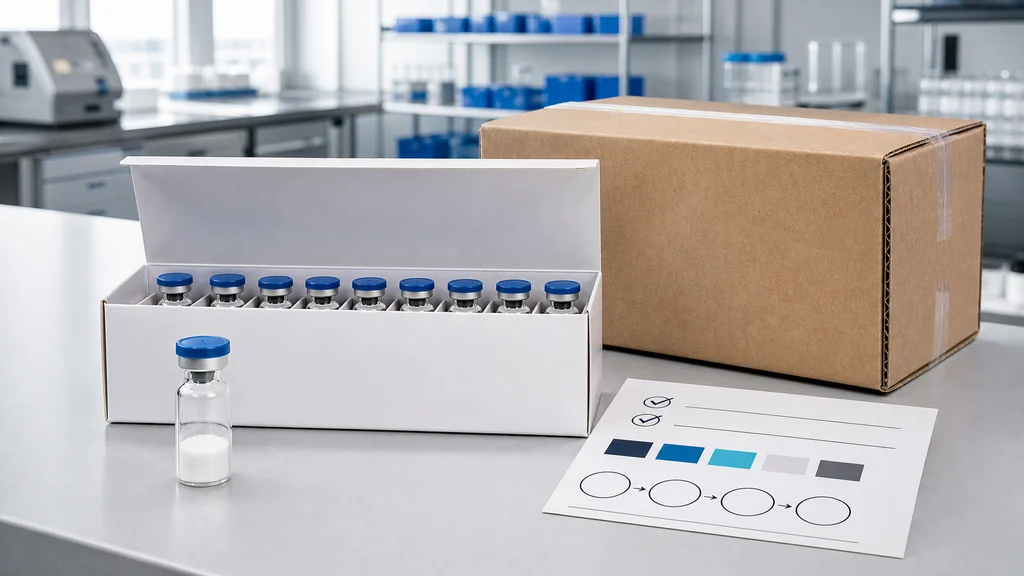
A vial can pass testing and still fail the customer because the label, box, or carton is wrong.
Wrong strength on one label. Old artwork on one side panel. Ten boxes missing from one carton. These are packaging problems, but they quickly become sales, inventory, and trust problems.
Peptide packaging must protect the product, identify the batch, support shipping, and match the buyer’s approved label and carton specification.
Good packaging is not decoration added at the end. It is part of the order.
The three levels of peptide packaging
| Level | Typical parts | Main job |
|---|---|---|
| Primary | Vial, stopper, seal, direct label | Contain and identify the product |
| Secondary | Individual carton or multi-vial box, divider, insert | Group, protect, and present units |
| Tertiary | Inner carton, shipping carton, cushioning, shipping label | Protect and count goods in transit |
Each level answers a different question. Is the product contained? Can the buyer identify and sell the correct unit? Can the shipment survive the route?
What belongs in a peptide packaging brief?
Give the supplier one document that defines:
- exact product and strength;
- vial size and closure requirement;
- number of vials per box;
- box dimensions and material;
- divider, tray, or insert;
- label size and placement;
- approved artwork file;
- batch and date fields;
- required use and storage statements;
- barcode or inventory code;
- number of boxes per shipping carton;
- carton marks;
- destination country; and
- required temperature or transit protection.
For many Certiva standard research peptide products, the listed commercial format is a 10-vial box. A private-label or custom request should state whether that format remains acceptable.
Standard packaging vs private label vs custom OEM
Standard wholesale packaging
The buyer uses an available product specification and the supplier’s standard package. This route usually has fewer artwork and component decisions.
It can fit buyers who value speed, current availability, and a simple first order.
Private-label packaging
The product may stay the same while the approved brand, label, and box change. The buyer should define who supplies artwork and who checks the final market label.
Private label is not “just put our logo on it.” Strength, contents, use statement, batch fields, company information, and destination requirements still need review.
Custom OEM packaging
OEM work may change the product specification, vial, closure, box, insert, carton, or testing package. More changes mean more sampling, proofing, sourcing, and approval.
Read peptide OEM vs ODM to choose the right starting model.
What should appear on the label?
There is no single label template for every product category and country. The approved brief should at least decide whether the following information is needed:
- product name;
- peptide, blend, or ingredient identity;
- amount or strength;
- net contents;
- lot or batch number;
- manufacture or expiry-related date fields where applicable;
- storage information;
- intended-use statement;
- warnings;
- manufacturer, packer, distributor, or responsible-company details;
- country-of-origin information;
- barcode or SKU; and
- contact information.
Research-use-only material should not be packaged with consumer treatment claims. Finished cosmetics have a different label and compliance path.
Why does artwork version control matter?
Packaging mistakes often begin with filenames.
Use one artwork log:
| Field | Example format |
|---|---|
| Product | Exact commercial name |
| Component | Vial label / box / carton |
| Version | V1, V2, V3 |
| Date | YYYY-MM-DD |
| Owner | Buyer approver |
| Status | Draft / approved / obsolete |
The buyer should approve a final proof with dimensions, colors, copy, and barcode placement. The supplier should archive obsolete files so an old version does not return during a repeat order.
What should buyers inspect in a packaging sample?
If a packaging sample or proof is part of the project, check:
- vial fits securely without excess movement;
- label is straight and readable;
- cap, seal, and label do not interfere;
- product and strength match the approved brief;
- batch and date fields have enough space;
- box count is correct;
- insert or divider protects each vial;
- barcode scans where required;
- colors and finish match the approved tolerance; and
- the shipping carton fits the planned box count.
Then repeat the check on the bulk shipment. A beautiful sample does not replace bulk receiving inspection.
See our sample order vs bulk order checklist.
How does packaging change MOQ and lead time?
Custom packaging can create its own minimums.
The peptide, vial label, printed box, foam or paper divider, insert, and shipping carton may come from different production steps. A buyer may meet the product MOQ but not the printed-box minimum.
Ask the quote to separate:
- product MOQ;
- packaging-component MOQ;
- setup or printing cost;
- unused packaging ownership;
- packaging production time;
- assembly time; and
- repeat-order rules.
Plan the full timeline with our peptide lead-time guide.
What matters for shipping cartons?
The tertiary package should support counting, handling, and the expected route. Confirm:
- boxes per inner and outer carton;
- carton dimensions and gross weight;
- cushioning and empty-space control;
- seal method;
- carton numbering;
- product and quantity description;
- handling or temperature marks where required;
- destination label; and
- packing-list match.
For U.S. imports, country-of-origin marking deserves early review. U.S. Customs and Border Protection says imported articles generally require origin marking, subject to applicable rules and exceptions. See the CBP importer guidance.
Certiva manufactures at its own facility in China and makes no false country-of-origin claim.
What changes for finished cosmetic packaging?
Finished cosmetics are not the same category as research peptides.
FDA states that cosmetic companies are responsible for product safety and proper labeling. For U.S. cosmetic products, the company named on the label may also have responsibilities under the Modernization of Cosmetics Regulation Act. Read the FDA cosmetics fact sheet and FDA registration and listing guidance.
A cosmetic private-label buyer should decide who owns the final label review, safety substantiation, required listing, contact details, and post-market duties.
Approve packaging as one connected system
Approve the vial, label, box, carton, and artwork version as one packaging system.
The package must protect the goods and protect the order from confusion. Both jobs matter when one sample becomes hundreds of boxes.
Research peptides are supplied for laboratory research use only and are not for human consumption.
Request a packaging quote
Certiva supports standard wholesale packaging and evaluates private-label or custom OEM packaging through its own manufacturing facility. Send the product, strength, quantity, destination, target date, and packaging brief. We will confirm the applicable MOQ, component options, documents, and lead-time basis.
Start with the bulk peptide supply overview if the project combines product sourcing, filled vials, branded boxes, or custom production.
Discuss wholesale or OEM packaging →
Sources and further reading
- U.S. Customs and Border Protection: importer and origin-marking guidance
- FDA: cosmetics small-business fact sheet
- FDA: cosmetic facility registration and product listing guidance
Frequently asked questions
What should peptide packaging do?
Peptide packaging must protect the product, identify the batch, support shipping, and match the buyer's approved label and carton specification.
What are the three levels of peptide packaging?
Primary packaging directly contains the product, secondary packaging groups and presents units, and tertiary packaging protects cartons during storage and shipping.
Is private-label peptide packaging the same as custom OEM packaging?
Not always. Private label may place buyer-approved branding on an existing product and package. Custom OEM can also change the specification, vial strength, components, box, insert, or carton configuration.
What should a buyer approve before peptide packaging is printed?
Approve the product name, strength, use statement, net contents, batch and date fields, company details, origin language where applicable, barcode needs, colors, dimensions, file version, and print proof.
Does Certiva support standard and custom peptide packaging?
Yes. Certiva supports standard wholesale packaging and evaluates private-label or custom OEM packaging after the buyer provides the product, quantity, destination, and approved packaging brief.
For research use only. Not for human consumption. This article is educational and makes no medical, therapeutic, or dosing claims.
← More sourcing & supply guides · Have a question? Start an inquiry →