


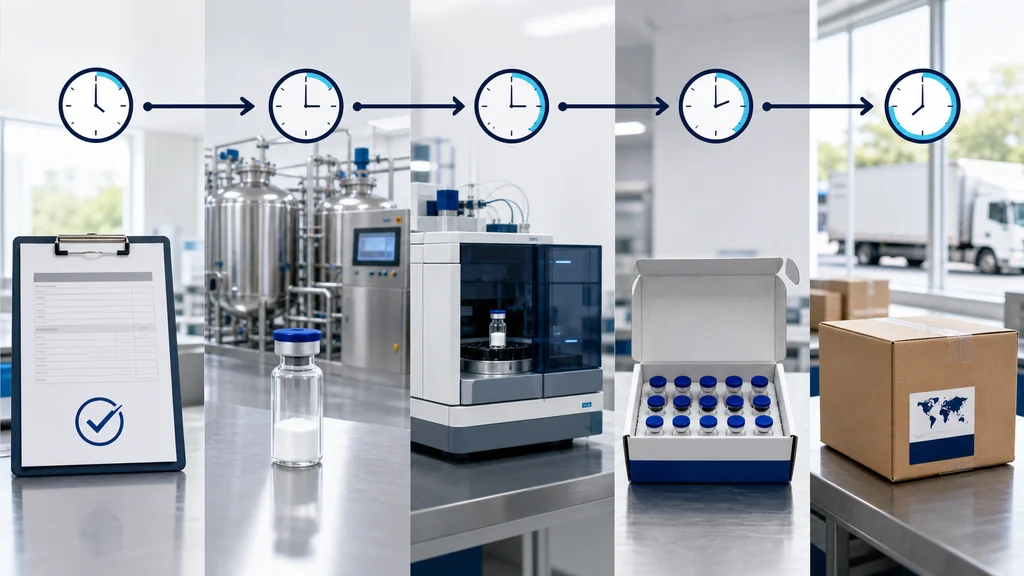
Delivery day is not one clock. It is several clocks standing in a line.
A buyer may hear “four weeks” and think the order arrives four weeks from today. The supplier may mean four weeks of production after payment, artwork, and specification approval. That gap can destroy a launch date.
Peptide lead time is the total time from an approved order to production, testing, packaging, release, and delivery.
The quote should say which stages are included and when the clock starts.
What is peptide lead time?
Lead time is the time needed to move an order from commercial approval to the agreed delivery point.
For a peptide order, that path can include:
- order and specification approval;
- inventory allocation or production;
- quality testing and document review;
- label, box, and carton preparation;
- final release;
- export and carrier pickup;
- customs clearance; and
- final delivery.
Not every order uses every stage. A standard stocked order is different from a new blend with custom packaging.
Stock, custom, and repeat order lead times
| Order type | What may already be ready | What can add time |
|---|---|---|
| Stocked | Product specification, material, standard package | Allocation, release check, packing, freight |
| Private label | Existing product specification | Label approval, printing, packaging setup |
| Custom OEM | Buyer brief | Feasibility, production, testing, components, artwork |
| Repeat order | Approved product and package | Forecast, material availability, new batch, artwork changes |
“Repeat” does not always mean “immediate.” The previous batch may be sold, a new production run may be needed, or the buyer may have changed the forecast.
For GLP-1 and related metabolic research products, the 2026 bulk GLP-1 supplier guide explains how to connect first-order timing to batch allocation and the next reorder.
When does the lead-time clock start?
Ask this exact question: What must be complete before quoted lead time begins?
The starting point may require:
- final product specification;
- confirmed quantity;
- approved quotation or pro forma invoice;
- deposit or full payment under agreed terms;
- final artwork file;
- approved label and carton proof;
- confirmed documents; and
- destination and shipping instructions.
If one item remains open, production or packaging may not be able to start.
A useful quote says, for example, “estimated production lead time begins after payment and final artwork approval.” It should also separate production time from international transit.
The five lead-time stages buyers should track
1. Commercial approval
The buyer and supplier agree on product, quantity, price, packaging, documents, payment, and destination.
Start with a complete peptide RFQ. A vague inquiry creates a vague timeline.
2. Material allocation or production
Stock may be allocated to the order. Custom work may require raw materials, manufacturing, lyophilization, filling, or another agreed production step.
The supplier should identify whether the quote is based on available stock or a new production run.
3. Testing and release
The applicable batch needs the agreed quality review and documents. Testing can finish on a different date from physical production.
Do not ask a supplier to skip the agreed release work just to protect a launch date. Build that time into the buying plan.
4. Packaging
Standard boxes may be available. Private-label work can add label proofing, printing, carton components, assembly, and final inspection.
One artwork correction near the end can move the entire shipment.
5. Freight and delivery
Carrier pickup is not customer delivery. Export handling, flight schedules, customs review, duties, and last-mile service can add time outside the factory.
What causes peptide order delays?
Common causes include:
- incomplete or changing specifications;
- quantity changes after quotation;
- late payment confirmation;
- slow artwork approval;
- packaging components with separate production schedules;
- additional buyer-requested testing;
- stock sold before the order is confirmed;
- customs or import-document questions;
- carrier disruption; and
- public holidays in the origin or destination country.
Some delays are controllable. Some are not. A good timeline shows both.
How can a buyer shorten lead time?
Speed comes from earlier decisions, not lower standards.
Use these actions:
- send the complete specification in the first RFQ;
- state the required arrival date, not only the order date;
- ask for stock and custom options when both could work;
- approve one artwork owner and one final file;
- answer supplier questions quickly;
- confirm the test and document package before production;
- lock the destination and shipping term;
- forecast repeat demand; and
- reorder before current inventory becomes emergency inventory.
Our sample vs bulk order checklist helps buyers set approval gates before scale.
How much buffer should a buyer keep?
There is no honest universal number.
Buffer should reflect:
- whether material is stocked or custom;
- number of approval steps;
- packaging complexity;
- testing requirements;
- destination and import process;
- seasonal carrier pressure; and
- the cost of missing the target date.
A launch-critical order needs more protection than a routine replenishment. Ask for the best current estimate, the assumptions behind it, and the date by which each approval must be complete.
How do shipping terms affect delivery timing?
The sales contract should name the selected shipping term and place.
The International Chamber of Commerce explains that Incoterms allocate certain obligations, costs, and risk between buyer and seller. They do not guarantee a customs-clearance date.
Buyers should confirm:
- who books the carrier;
- when risk transfers;
- who prepares import information;
- who pays duties and taxes;
- whether temperature controls are required; and
- which event counts as delivery.
For temperature planning, read do peptides need cold chain shipping?.
What should the purchase order say?
Put the timeline in writing:
- lead-time starting event;
- estimated allocation or production window;
- artwork approval deadline;
- testing and release basis;
- estimated ship date;
- shipping term and named place;
- target arrival window; and
- process for notifying the buyer about a delay.
Do not turn an estimate into a guarantee unless the contract clearly says it is one.
For repeat or higher-volume orders, connect these dates to the 2026 peptide contract-manufacturing capacity plan, including the rolling forecast, material readiness, reserved slot, and backup route.
A delivery date is a chain of dates
A peptide delivery date is a chain of approval, production, testing, packaging, and shipping dates.
Track the chain. If one stage moves, update the arrival plan before it becomes a surprise.
Research peptides are supplied for laboratory research use only and are not for human consumption.
Request a current lead-time quote
Certiva manufactures at its own facility and supports stocked wholesale, private-label, and custom OEM inquiries. Send the product, strength, quantity, packaging, documents, destination, and target date. We will confirm current availability, the applicable lead-time basis, and a destination-based quote.
Request current availability + lead time →
Sources and further reading
Frequently asked questions
What does peptide lead time include?
Peptide lead time is the total time from an approved order to production, testing, packaging, release, and delivery.
Is a stocked peptide order faster than a custom order?
Usually. A stocked order may begin with available material and standard packaging. A custom order can add development, production, testing, artwork, component sourcing, and approval time.
When does the lead-time clock start?
The quote should define the starting point. It may begin after the final specification, artwork, payment, and other required approvals are complete, not when the buyer first asks for a price.
How can a buyer shorten peptide lead time?
Send a complete RFQ, approve one specification, use available formats where practical, finalize artwork early, answer questions quickly, forecast repeat demand, and confirm the shipping plan before production ends.
Does Certiva publish one fixed peptide lead time?
No. Certiva confirms lead time for the specific product, quantity, packaging, document set, destination, current availability, and production schedule.
For research use only. Not for human consumption. This article is educational and makes no medical, therapeutic, or dosing claims.
← More sourcing & supply guides · Have a question? Start an inquiry →