


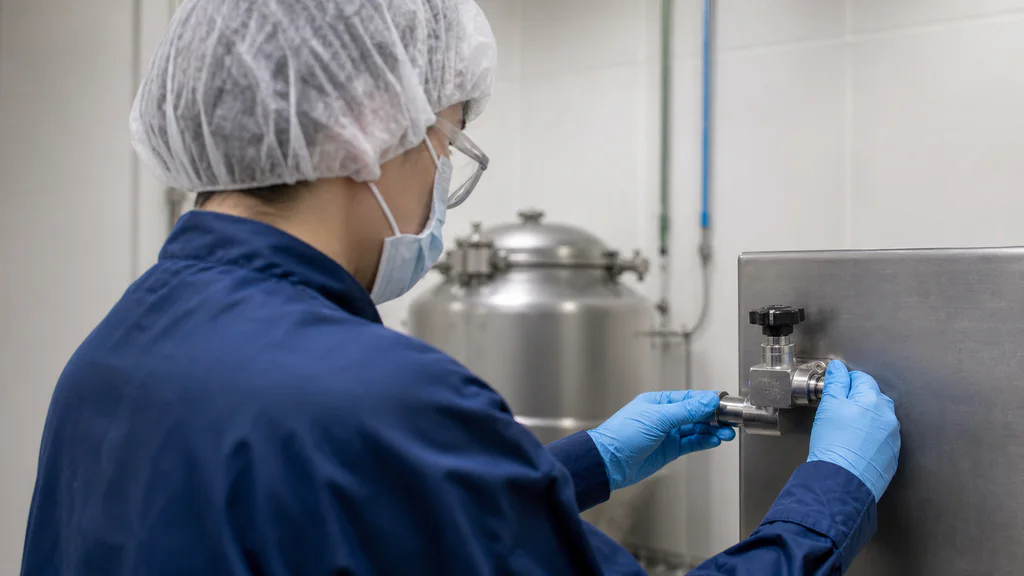
The next peptide shortage may begin months before the “out of stock” email. It can also hide inside an impressive factory announcement that will not deliver material for several years.
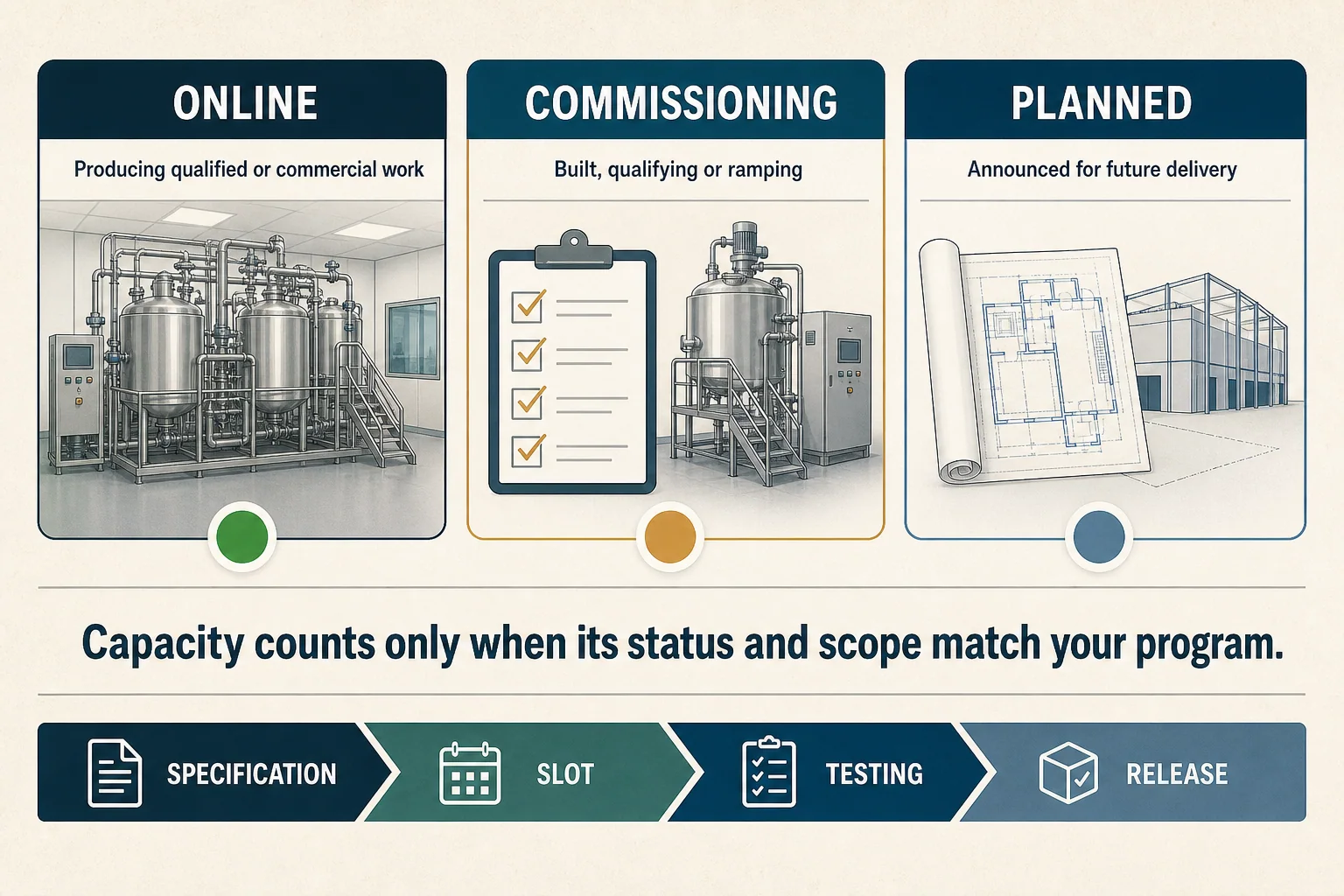
Peptide CDMO capacity is not one number. Buyers must separate online, commissioning, and planned facilities, then verify the slot, scope, testing, and release path. Capacity is useful only when it matches your peptide, scale, quality category, and delivery date.
This 2026 guide is for research brands, distributors, laboratories, and OEM buyers planning repeat peptide orders. It also explains why clinical CDMO capacity news matters without pretending every project belongs in the same regulatory lane.
What changed in peptide manufacturing in 2026?
Three recent industry signals point in the same direction.
First, PolyPeptide reported first-half 2026 revenue of EUR 236.6 million, up 41.6% from the prior-year period. Revenue from metabolic therapeutics rose 72.7% and represented 68.4% of total revenue. Its H1 business review also gives buyers a rare status-by-site view: the Braine-l’Alleud large-scale SPPS facility reached target utilization, Malmö construction was complete and in commissioning, Strasbourg was moving toward a second-half ramp-up, and Ambernath and Torrance were still being expanded.
Second, Samsung Biologics announced an all-cash offer for PolyPeptide in July 2026. The offer had been announced but was not a completed acquisition as of August 27. That distinction matters. An offer is evidence of strategic interest in peptide manufacturing; it does not give a buyer access to a newly integrated network today.
Third, CordenPharma completed its acquisition of AmbioPharm on August 3. The deal added sites in South Carolina and Shanghai, with downstream purification and expanded lyophilization plus planned upstream capacity. The commercial idea is end-to-end coverage from peptide API work to sterile fill-finish. The buyer still has to confirm which site and operation fit the actual program.
Bachem offers the clearest reminder that current and future capacity belong in separate columns. It says Building K at Sisslerfeld is operating and has produced commercial GMP products. A different Sisslerfeld project, backed by more than CHF 500 million in planned investment, is expected to begin commercial production in 2030. That is a serious long-range commitment, not 2026 available capacity.
The buyer lesson is simple: do not wait for a shortage headline to start planning.
What is online, commissioning, or still planned?
“New capacity” can mean a room that is releasing commercial batches, equipment that is still being qualified, or a facility that exists only in a capital plan. Put every announcement into a status table before using it in a sourcing decision.
| Company or site | Status as of August 27, 2026 | What the public source supports | What it does not prove |
|---|---|---|---|
| PolyPeptide, Braine-l’Alleud | Online | Large-scale SPPS facility at target utilization | An open slot for every sequence or scale |
| Bachem, Building K | Online | Operational and manufacturing commercial GMP products | Fit, timing, or price for a new buyer |
| PolyPeptide, Malmö | Commissioning | Construction complete; qualification and commissioning underway | Routine released commercial supply today |
| PolyPeptide, Strasbourg | Ramping | Ramp-up expected in the second half of 2026 | Full steady-state output immediately |
| Bachem, new Sisslerfeld project | Planned | More than CHF 500 million planned; commercial production expected in 2030 | Capacity available in 2026 |
| Samsung–PolyPeptide | Offer announced | Public acquisition offer and strategic intent | A completed, integrated CDMO network |
| CordenPharma–AmbioPharm | Acquisition completed | Ownership transfer completed; integration can proceed | Automatic qualification of every site for every customer |
Why commissioning deserves its own column
Commissioning is not a polite word for failure. It is the work that turns installed equipment into a controlled process environment. Utilities, equipment, methods, cleaning, computerized systems, staff training, and quality procedures may all need to be tested or qualified. That work protects future batches, but it takes time.
A buyer should ask what the announced date means. Is it mechanical completion, engineering runs, qualification, the first GMP batch, or routine release? Those dates can be months apart. A project that needs material next quarter cannot rely on a capacity headline that only promises construction completion.
What is peptide contract manufacturing?
Contract manufacturing means an outside organization performs agreed production work for a buyer. The scope can be very different from one project to another.
It may include:
- custom peptide synthesis;
- purification and isolation;
- lyophilization;
- bulk release and documentation;
- research-vial preparation;
- private-label packaging;
- finished cosmetic production; or
- regulated clinical or commercial drug work.
These are not interchangeable services.
A research-use material does not become a clinical API because it came from a factory. A finished cosmetic needs a formula, safety, packaging, and market path that a raw research peptide does not. State the category at the first inquiry.
Read peptide supplier vs manufacturer to map who actually performs each step.
Capacity is not one number
A supplier may have open space in one area and a bottleneck in another.
| Capacity layer | Buyer question |
|---|---|
| Synthesis | Can the equipment and process fit this sequence, modification, and scale? |
| Raw materials | Are the needed amino acids, resin, solvents, modifiers, and components available? |
| Purification | Can the process reach the agreed impurity and purity targets at scale? |
| Lyophilization | Is freeze-drying capacity available for the required batch and format? |
| Testing | Can the laboratory complete the agreed release panel on time? |
| Filling / packaging | Are the vial, closure, label, carton, and line slot available? |
| Quality review | Who approves records, deviations, and batch release? |
| Shipping | Can the order move to the destination with the right documents and conditions? |
That is why “we have capacity” is only the start of a useful answer.
The seven-part peptide supply continuity plan
1. Freeze the exact specification
Capacity must be reserved for a defined material.
State:
- peptide name and sequence where appropriate;
- chemical form and modifications;
- bulk, vial, blend, or cosmetic-active format;
- purity, identity, content, and other agreed requirements;
- packaging and documents;
- research, cosmetic, or another product category; and
- approved revision number.
A change from free base to acetate, from bulk to finished vials, or from standard to custom packaging can change the process and schedule.
Use our peptide sourcing guide to build the full specification.
2. Send a rolling forecast
A forecast gives the manufacturer time to plan materials, equipment, people, testing, and packaging.
A simple 12-month view can show:
| Period | Forecast range | Firm order status | Required arrival window |
|---|---|---|---|
| Month 1–3 | Near-term quantity | Confirmed or pending | Specific date range |
| Month 4–6 | Most likely demand | Forecast | Planning window |
| Month 7–12 | Low / expected / high case | Forecast | Capacity signal |
Do not present a hopeful sales target as a firm order. Define what is non-binding, what is reserved, and what requires a purchase order or deposit.
3. Reserve the capacity window early
Ask:
- What approvals are required before scheduling?
- Is the slot tentative or firm?
- Which payment or purchase event holds it?
- What can cause the slot to move?
- When must materials and artwork be ready?
- How will the supplier notify the buyer about a delay?
Tie the answers to the peptide lead-time map. One unexplained “six-week lead time” is not enough for a launch or replenishment plan.
4. Confirm long-lead materials and components
The peptide synthesis step may not be the first bottleneck.
Review:
- protected amino acids and special building blocks;
- resin and solvents;
- side chains or other modifications;
- reference standards or test materials;
- vials, stoppers, seals, droppers, or pumps;
- printed labels and cartons; and
- temperature-control or shipping materials.
For OEM work, separate the product MOQ from each component MOQ. Decide who owns unused printed components and how long they are stored.
5. Put quality and change control in the schedule
Manufacturing completion is not batch release.
The timeline should include:
- in-process controls;
- agreed analytical testing;
- review of deviations or unexpected results;
- COA and batch-document preparation;
- buyer review when required;
- packaging inspection; and
- final release.
Define which changes require notice or approval, including source, site, process, method, specification, package, and artwork changes.
Our batch traceability guide explains how to keep the physical order connected to its documents.
6. Decide whether a backup route is worth it
A second source can reduce dependence, but it is not free insurance.
It can add:
- supplier qualification work;
- method and specification comparison;
- sample and batch testing;
- separate minimum orders;
- packaging differences;
- more inventory; and
- change-control complexity.
Use a backup when the cost of interruption is higher than the cost of maintaining it. For some programs, a second qualified manufacturer is appropriate. For others, reserved material, safety stock, or approved alternate packaging may be the better control.
7. Track the dates that predict a delay
Do not track only the final ship date.
Monitor:
- specification approval;
- purchase commitment;
- material readiness;
- production start and completion;
- sample submission to testing;
- test completion;
- quality release;
- packaging completion;
- carrier booking; and
- destination delivery.
If one milestone moves, update the inventory and customer plan immediately.
Questions to ask a peptide contract manufacturer
Send these with the RFQ:
- Which steps are performed at your facility?
- Which steps use qualified outside partners?
- What scale and product formats fit the available equipment?
- Which inputs have the longest lead time?
- What forecast horizon helps you plan capacity?
- What makes a production slot firm?
- Which tests and documents are included?
- What changes require buyer notice or approval?
- What happens if a batch or component is delayed?
- What repeat-order information should the buyer update each month or quarter?
Use the answers with our peptide supplier audit checklist.
What should a capacity-ready RFQ include?
A supplier can plan faster when the buyer sends:
- exact product and category;
- current specification;
- sample quantity;
- first firm order quantity;
- 12-month low, expected, and high forecast;
- packaging and artwork scope;
- test and document package;
- destination and shipping needs;
- requested arrival window; and
- acceptable backup or alternate options.
This is more useful than “What is your maximum capacity?” Maximum capacity does not tell the buyer whether the correct slot is available.
Where Certiva fits
Certiva reviews bulk, wholesale, private-label, and suitable OEM inquiries for research-use peptide materials and appropriate cosmetic-active projects. Buyers can review our manufacturing facility, quality and COA process, and bulk peptide supplier page before requesting a quote.
Clinical and commercial drug API programs require a different regulatory, technical, and quality scope. Tell us the intended category clearly so the inquiry is evaluated in the right lane.
Research peptides are supplied for laboratory research use only and are not for human consumption.
Protect supply before demand becomes urgent
The best peptide capacity plan connects specification, forecast, materials, production, testing, packaging, and delivery before inventory becomes an emergency.
Send Certiva the product, format, first quantity, forecast range, documents, package, destination, and target date. We will confirm current scope, availability, and the applicable supply route.
The 2026 GLP-1 peptide manufacturing guide shows why a facility headline must be translated into sequence fit, purification capacity, isolation and batch release.
Request capacity + repeat-supply options →
Sources and further reading
- PolyPeptide: H1 2026 business review and site-by-site capacity progress
- Samsung Biologics: all-cash offer to acquire PolyPeptide
- Swiss Takeover Board: public status of the PolyPeptide transaction
- CordenPharma: acquisition of AmbioPharm completed August 3, 2026
- Bachem: Building K online and manufacturing commercial GMP products
- Bachem: planned Sisslerfeld facility and expected 2030 commercial production
- Bachem: GLP-1 demand and peptide manufacturing capacity
Frequently asked questions
What peptide CDMO capacity is actually available in 2026?
Peptide CDMO capacity is not one number. Buyers must separate online, commissioning and planned facilities, then verify the slot, scope, testing and release path for their program.
How can buyers protect peptide contract manufacturing supply?
Buyers should provide an exact specification, separate forecast from firm orders, reserve capacity early, confirm raw materials and testing, define change control, track delivery milestones, and keep a qualified backup route where risk justifies it.
Why is peptide manufacturing capacity under pressure in 2026?
Demand for metabolic and other peptide programs is growing while longer, modified peptides require specialized synthesis, purification, lyophilization, testing, and skilled operations. Recent manufacturer results and investments show the market is expanding capacity to respond.
Is a forecast the same as a purchase order?
No. A forecast helps the manufacturer plan possible demand, while a purchase order or other written commitment confirms the commercial quantity and timing under the agreed terms. The contract should define both.
Should every buyer use two peptide manufacturers?
Not always. Dual sourcing adds cost, qualification work, comparability questions, and minimum orders. Use it when the interruption risk justifies the extra control, and define how the two sources will be compared.
Does Certiva provide clinical peptide CDMO services?
Certiva reviews research-use bulk, wholesale, private-label, and suitable OEM inquiries. Clinical or commercial drug API programs require a different regulatory and quality scope, so buyers should state the intended category clearly.
For research use only. Not for human consumption. This article is educational and makes no medical, therapeutic, or dosing claims.
← More sourcing & supply guides · Have a question? Start an inquiry →