


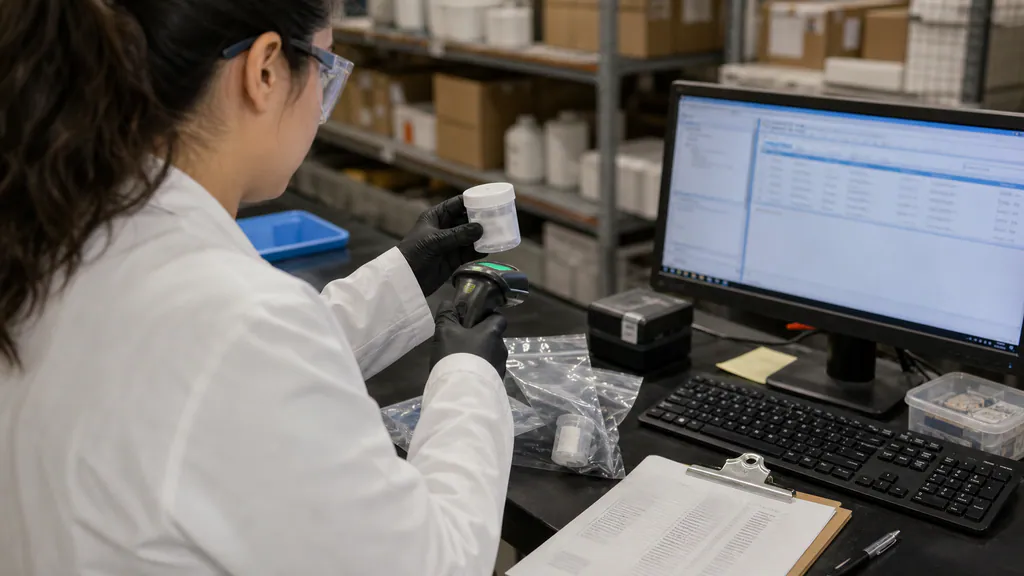
Peptide batch traceability is the documented connection between one lot and its production, testing, packaging and delivery records. For a buyer, the practical test is whether the Certificate of Analysis and laboratory report can be matched to the vial or bulk material that actually arrived.
The lot number printed on the label is only the visible key. A credible system can use that key to show what was made, which sample was tested, which results were approved, how the material was packed and which order received it.
What is peptide batch traceability?
Peptide batch traceability is the ability to follow an identified quantity of material backward and forward through its documented lifecycle.
Backward traceability starts with a delivered container and follows the identifier through the label, release decision, laboratory sample, filling or packaging batch, purified bulk and production record. Where relevant, it can continue to critical incoming materials and their approved suppliers.
Forward traceability starts with production and identifies the finished lots, label versions, released and retained quantities, destination orders and any later complaints, deviations or returns connected to that material.
This two-way view matters when a test question, labeling error, temperature event or other investigation affects only one batch rather than every product ever made.
The peptide traceability chain
| Lifecycle point | Identifier or record | Buyer-facing connection |
|---|---|---|
| Incoming material | Supplier lot and receipt code | Usually reviewed during qualification or audit |
| Synthesis or production | Unique production batch | Links process steps and yields |
| Purification and isolation | Fraction, pool or bulk lot | Links target material to the production batch |
| Filling or packaging | Finished-batch and component records | Links bulk material to vials, labels and boxes |
| Laboratory sample | Sample ID and chain-of-custody record | Links instrument data to the batch tested |
| Release | COA and disposition record | Summarizes results for the approved lot |
| Distribution | Packing list, invoice and shipment record | Links the lot to the customer and destination |
Not every company uses the same numbering architecture. A bulk lot and a finished vial lot may have different identifiers. That is acceptable only when a controlled record maps them unambiguously.
Is a matching lot number enough?
A matching number is necessary, but it does not prove the complete claim.
The product name and material form must also match, and the laboratory sample must come from the identified batch. The methods need to answer the agreed quality questions, the results need acceptance criteria, and the dates must fit the production and release sequence. Unexplained relabeling or repacking can break the chain even when two visible numbers happen to agree.
For example, a vial and COA can both say lot P-260802, but the report may show only
HPLC purity. The matching number does not create mass-spectrometry identity or prove
the nominal amount in the vial.
Use peptide COA vs specification sheet to confirm which document sets the requirement and which reports the batch result.
Where should the batch number appear?
At minimum, reconcile the lot across the offered-batch COA, third-party report or sample reference, primary-container label, outer packaging and packing list. When the batch is allocated before purchase, it may also appear on the quotation or pro forma invoice. The receiver should record the same identifier in the inventory system at arrival.
The purchase order should state whether mixed lots are allowed. A carton containing two lots needs separate quantities and documents for each lot, not one blended paper trail.
What should a peptide batch report contain?
“Peptide batch report” is often used loosely. The useful document is normally a batch-specific COA or laboratory report that names the responsible supplier, exact peptide and form, unique lot and nominal strength or bulk basis. It should show the tests and methods, acceptance criteria, actual results, relevant dates and an authorized review or disposition statement.
The lot should be readable and permanent enough for the expected storage and handling conditions. A label that smears, detaches or hides the lot under a new sticker weakens the buyer’s record even if the database is correct.
Read how to read a peptide COA for the complete five-minute document check.
How does third-party testing fit the chain?
Independent testing adds value only when the tested sample is connected to the offered batch.
A credible chain begins when an authorized person samples an assigned lot. The sample receives a laboratory ID, and the submission record maps that ID to the supplier’s batch. The laboratory report then identifies the sample and method; the supplier reviews the result against the specification; and the shipped label keeps the same reconcilable lot connection.
The buyer should be able to ask who selected the sample, whether it was controlled, and whether the report shows the supplier lot, the laboratory sample ID or both. If the sample came from bulk material rather than the finished vial, the supplier should explain that relationship in writing.
A beautiful third-party report with no chain of custody may prove that the lab tested something. It may not prove that the lab tested what the buyer received.
Our guide to third-party tested peptides shows how to verify the claim without trusting a badge.
Representative COA vs offered-batch COA
Suppliers often use a representative COA during early qualification because the production batch does not yet exist or inventory has not been allocated.
That can be useful if the document is labeled honestly.
| Document | Appropriate use | Not appropriate for |
|---|---|---|
| Representative COA | Review typical test panel, format and past capability | Final acceptance of a different batch |
| Offered-batch COA | Review current available inventory before order | A future custom production run |
| Production-batch COA | Release and acceptance of the actual manufactured lot | Unrelated replacement or repeat lot |
Put the transition into the purchase terms: representative documents support qualification; the actual production or shipped batch requires its own agreed release evidence.
What breaks peptide traceability?
The chain fails when a generic COA has no lot, a chromatogram has no sample identifier, or an older batch report is used for current inventory. Repacking can also create a gap if a new code is assigned without preserving the original-lot mapping. Mixed batches under one COA, handwritten label changes and inventory records that disagree with physical labels are all reasons to pause acceptance.
A polished website cannot compensate for a broken identifier chain.
Does traceability prove that a peptide supplier is legitimate?
Not by itself. Traceability is valuable because it can be tested: the buyer can compare the lot on the vial, COA, laboratory report and shipment. But supplier due diligence also includes the legal business identity, actual manufacturing or distribution role, facility transparency, testing scope, complaint process and commercial terms.
The useful question is not whether a website says “traceable.” It is whether the supplier can produce a consistent evidence chain for the batch currently offered. Certiva describes its own manufacturing and quality role on the factory page and publishes selected reports in the COA library.
What should the buyer do when lot numbers do not match?
Treat a mismatch as an unresolved identity and documentation issue.
- Quarantine the affected material from research use.
- Photograph the primary label, outer package and shipping label.
- Preserve the COA, invoice, packing list and original email.
- Record quantities and every lot found in the shipment.
- Ask the supplier for a documented reconciliation.
- Request corrected documents only after the supplier explains the cause.
- Decide whether verification testing or rejection is required under the purchase agreement.
Do not rewrite the lot on the buyer’s copy of the COA or move labels between containers. That hides the original discrepancy.
What records support a supplier traceability audit?
For a higher-risk or repeat supply relationship, review a sample trace from one finished lot. The supplier may redact confidential quantities or process details, but the control logic should remain visible.
The most useful evidence includes the batch-numbering procedure, completed production record, sampling log, chain of custody, laboratory data and review, packaging and label reconciliation, release authorization and distribution record. Deviation, out-of-specification and retained-sample records show whether the system can investigate a problem rather than merely produce paperwork during a sale.
FDA’s ICH Q7 guidance is a useful established reference for API documentation. It describes unique batch identification, complete batch production records, laboratory sample identification, raw-data linkage, record review and traceability through blended batches. Research materials do not become drug-grade because a supplier cites Q7; buyers should use the framework to ask precise questions and verify the quality system actually claimed.
How should repacking and private label preserve the lot?
Repacking can create an additional identifier layer. The private-label lot does not have to copy the original manufacturer’s code, but the packer should maintain a controlled one-to-one or one-to-many map.
The repacking record should connect the original bulk or vial lot to the new private-label lot, reconcile quantities received and packed, identify the label and box version, and retain the packaging date, applicable COA and destination shipments.
If several original lots are combined, the specification and agreement should say whether that operation is permitted and how the resulting lot is tested and traced.
For private-label planning, use our peptide packaging guide before approving artwork or cartons.
Peptide batch traceability buyer checklist
| Check | Evidence to look for |
|---|---|
| Offered product | Exact peptide, form and strength are named |
| Lot status | Batch is identified, or the quote says when it will be assigned |
| COA status | Representative documents are labeled; final acceptance uses the actual batch COA |
| Laboratory link | Third-party sample IDs can be mapped to the supplier lot |
| Physical labels | Vial, box and packing list show a reconcilable identifier |
| Repacking | Private-label codes retain original-lot mapping |
| Exceptions | Mixed lots, deviations and changes have a documented process |
| Receipt | Buyer inspects and records every lot that arrives |
Traceability should be part of the peptide supplier audit, not a question asked only after a problem.
What actually makes a peptide supplier traceable?
A traceable peptide batch has one continuous evidence chain from production and testing to the label in the buyer’s hand.
Match the lot across the COA, laboratory evidence, container, packaging and shipment. If the identifiers break, stop approval until the supplier restores the chain with controlled records.
Research peptides are supplied for laboratory research use only and are not for human consumption.
Reviewing Certiva batch documentation
Certiva’s quality and COA page publishes selected batch reports and explains the document-review process. For a current order, send the product, format, quantity, required documents and destination. We can confirm which batch is available and which report package applies before quotation.
Sources and further reading
- FDA: ICH Q7 Good Manufacturing Practice Guidance for APIs
- FDA: ICH Q7 Questions and Answers
- FDA: ICH Q6A Specifications—Test Procedures and Acceptance Criteria
Frequently asked questions
What is peptide batch traceability?
Peptide batch traceability connects one unique lot to its materials, production, testing, packaging, and delivery records. It lets a buyer verify that the COA and laboratory evidence belong to the material actually received.
Where should a peptide batch number appear?
The batch or lot should appear consistently on the COA, vial or primary-container label, applicable outer packaging, packing list and supplier records. Third-party test reports should identify the tested sample in a way that can be reconciled to that lot.
Does a batch number prove that a peptide was tested?
No. A batch number is an identifier, not test evidence. The buyer still needs methods, results, acceptance criteria, dates and authorization connected to that identifier.
Does batch traceability prove that a peptide supplier is legitimate?
No single record proves that a supplier is legitimate. Batch traceability is one verifiable trust signal, but buyers should also confirm the business identity, manufacturing role, testing evidence, communication and commercial terms.
Can a supplier send a representative COA before production?
Yes, if it is clearly labeled as representative and used only for preliminary qualification. Final acceptance should rely on the COA and agreed evidence for the actual production or shipped batch.
What should I do if the vial and COA lot numbers do not match?
Quarantine the material from research use, preserve the documents and packaging, and ask the supplier for a documented reconciliation. Do not assume the reports are interchangeable or relabel the material yourself.
For research use only. Not for human consumption. This article is educational and makes no medical, therapeutic, or dosing claims.
← More quality testing & COAs guides · Have a question? Start an inquiry →