


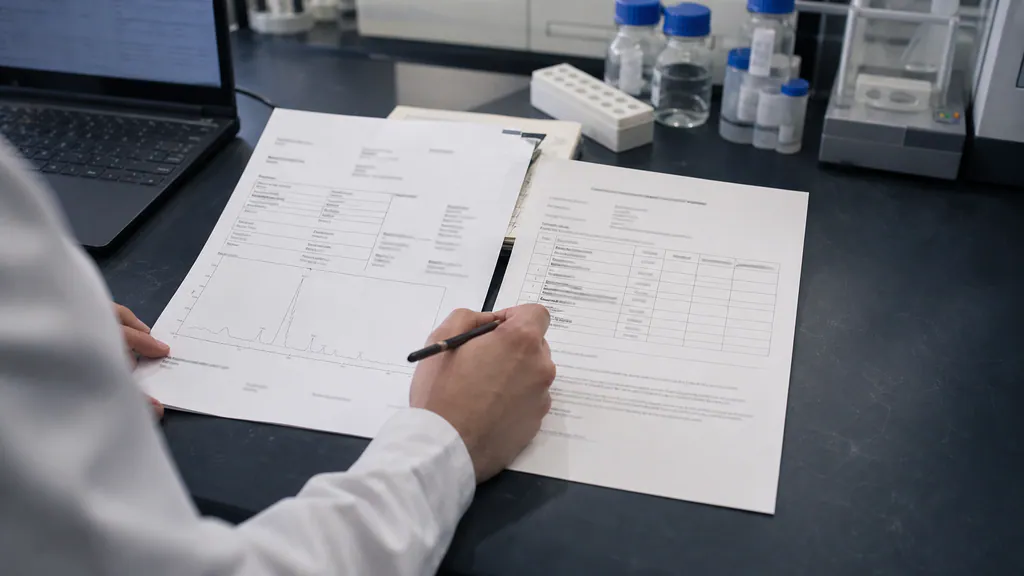
A peptide specification sheet defines what an acceptable material must meet. A Certificate of Analysis reports what one identified batch actually achieved. They should be read together: the specification supplies the tests and limits; the COA supplies the lot number and results.
The most important word is “identified.” A technically impressive report is not useful for batch approval if it cannot be tied to the material on the quotation, label and shipment.
COA vs specification sheet at a glance
| Question | Specification sheet | Certificate of Analysis |
|---|---|---|
| What is this document for? | Defines the approved quality requirements | Reports the results for one lot |
| Is it batch-specific? | Usually applies to a product and document version | Yes |
| What are its core fields? | Tests, method references and acceptance criteria | Lot, test results, limits or specification reference, dates and authorization |
| When does a buyer use it? | Before the order, during technical approval and after controlled changes | For sample, pre-shipment and receiving review of the applicable lot |
The ICH Q6A guideline defines a specification as a list of tests, references to analytical procedures and appropriate acceptance criteria. Its regulatory scope is drug substances and drug products; using the document logic for an RUO peptide does not turn that material into an approved pharmaceutical product.
What makes a COA batch-specific?
A batch-specific COA is connected to one production lot through identifiers. The lot number on the report should match the lot named on the quotation or packing record and the label on the received material. The tested sample or laboratory submission must also be traceable to that same lot.
“Representative COA” and “current-batch COA” therefore mean different things. A representative report can help a buyer understand the usual document format before ordering. It cannot release or approve a different batch. The current-batch report is the record that must follow the offered or delivered lot.
This distinction matters more than whether the PDF looks formal. A genuine report from a real laboratory can still be the wrong evidence if it belongs to a previous lot.
Reconcile the two documents line by line
Start with the material identity, then move through the tests. A simple worksheet makes the gaps visible.
| Review field | Specification says | COA says | Match? |
|---|---|---|---|
| Product, sequence or blend | |||
| Form, counterion and final format | |||
| Lot or batch | Applicable product/version | Specific lot | |
| Identity test and method | |||
| Purity test, method and limit | |||
| Content or fill requirement | |||
| Other required attributes | |||
| Document version and approval |
Work across the row rather than reading each PDF in isolation. The product name, form, test, method, unit and calculation basis all need to describe the same thing.
A worked example: why one purity number is not enough
Suppose a COA reports “HPLC purity: 99.1%.” That result may be useful, but it does not answer several acceptance questions on its own. The buyer still needs to know which HPLC procedure was used, whether 99.1% is peak-area purity or another basis, what the approved minimum was and whether molecular identity was checked separately.
Now pair it with a specification:
| Test | Procedure or reference | Acceptance criterion | Batch result |
|---|---|---|---|
| Identity | Controlled LC-MS method | Observed mass conforms under the method | Report actual observation or conclusion |
| Purity | Controlled RP-HPLC method | Not less than the approved area-percent limit | 99.1% area |
| Water | Controlled Karl Fischer method | Not more than the approved limit | Report numerical result |
The numbers above illustrate document structure, not universal peptide limits. The appropriate tests and criteria depend on the material and intended laboratory use.
HPLC and mass spectrometry remain complementary. The first can describe separation and chromatographic purity under a method; the second can support molecular identity. Our HPLC vs mass spectrometry guide explains why a high purity percentage does not independently establish identity.
Five mismatches that should pause approval
Approval should stop when the product or lot differs, a required specification test is absent, the method reference changes without explanation, the unit or calculation basis is unclear, or a limit was changed without a controlled document revision.
The correct response is not to repair the record by guessing. Write a short discrepancy list, ask which document governs, and request a corrected controlled copy or a scientific explanation approved by the responsible party. If the supplier cannot connect the report to the offered lot, treat the batch evidence as unresolved.
COA, raw report, data sheet and SDS serve different jobs
These documents often arrive in the same folder but are not substitutes.
| Document | What it tells the buyer |
|---|---|
| Specification | The approved material scope, tests and limits |
| COA | The summarized results and disposition for one lot |
| Chromatogram or spectrum | Instrument output supporting a particular analytical result |
| Product data sheet | General product description, formats, storage and commercial information |
| Safety Data Sheet | Hazard communication, handling, storage and emergency information |
A chromatogram without a sample identifier is not automatically stronger than a shorter COA. Evidence becomes useful when its identifiers stay connected from the instrument record through the COA to the delivered package.
Use the pair at three buying stages
Before an order, approve the product specification and review a representative document package. Before shipment, obtain the COA for the offered production lot and reconcile it with that specification. At receipt, confirm that the lot on the vial, box and packing record is the lot on the approved COA.
This three-stage approach avoids two common errors: approving a sample report as if it covered future production, and accepting a new lot because it has the same product name as a previously reviewed batch.
For the surrounding workflow, see the guides to batch traceability and sample vs bulk approval.
A concise document request for an RFQ
Ask the supplier for the current controlled product specification, a representative COA for preliminary review and the applicable batch-specific COA before shipment. Name any required identity, purity or other tests, and ask how the report, tested sample and delivered label will share the lot identifier.
Certiva can confirm the available document package for a defined product, batch and order scope. Review the published quality and COA process or send the product and acceptance requirements. Research peptides are supplied for laboratory research only and are not for human consumption.
Sources and further reading
- ICH Q6A: Specifications—Test Procedures and Acceptance Criteria
- FDA: ICH Q7 Good Manufacturing Practice Guidance for APIs
Frequently asked questions
What is the difference between a peptide COA and a specification sheet?
A specification lists the tests, analytical procedures or references, and acceptance criteria for a defined material. A COA reports the actual results for one identified batch against those requirements.
What makes a peptide COA batch-specific?
The product and lot identifiers on the COA must connect to the tested sample and match the lot on the offered or delivered material. A report for a previous or representative lot is not the release record for a new batch.
Can a COA replace a specification sheet?
No. A COA can show results, but the specification establishes the approved tests, methods and limits used to judge those results.
Is a product data sheet the same as a specification?
Not necessarily. A data sheet often summarizes general product features and storage. A controlled specification defines the exact material scope, required tests and acceptance criteria used for approval or release.
What should I do if the COA and specification do not match?
Pause approval, list each mismatch and ask for a corrected controlled document or written scientific explanation. Do not infer that similar test names, units or limits are equivalent.
For research use only. Not for human consumption. This article is educational and makes no medical, therapeutic, or dosing claims.
← More quality testing & COAs guides · Have a question? Start an inquiry →