


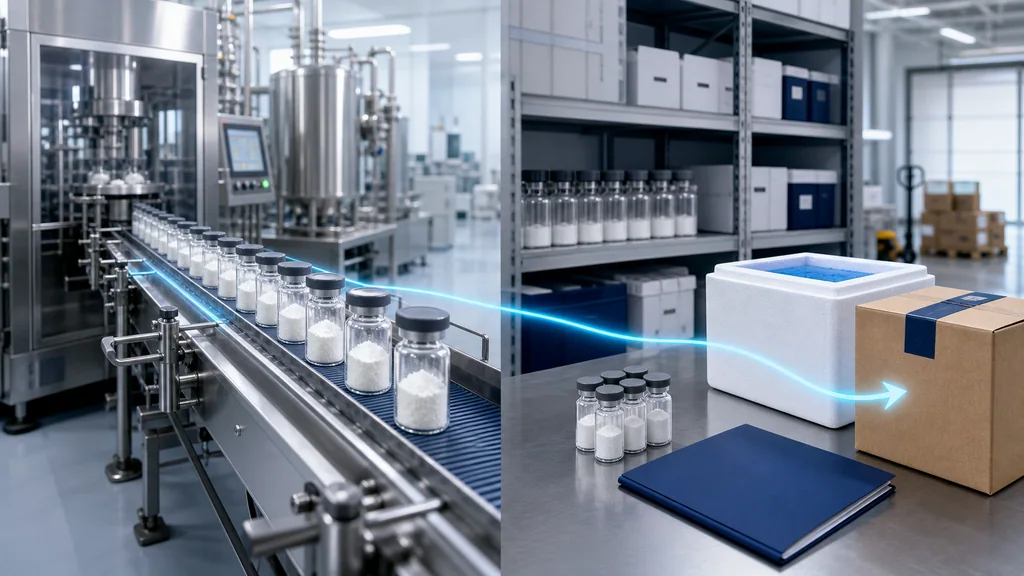
“Supplier” and “manufacturer” often appear on the same peptide website, but they do not mean exactly the same thing.
A peptide manufacturer makes the batch, while a supplier sells and delivers it. The best choice is the one that makes quality easy to verify.
That is the short answer. You do not need to memorize factory terms. Ask three questions instead. Who makes the product? Who sends it? Can you check the batch before you order?
Peptide supplier vs manufacturer at a glance
| Role | Main job | What the buyer should receive |
|---|---|---|
| Peptide manufacturer | Makes and prepares the batch | Product specification, batch records, test results |
| Peptide supplier | Offers, sells, and ships the batch | Availability, quote, matching documents, delivery support |
| Direct manufacturer-supplier | Does both jobs | One clear path from factory to quote and delivery |
The words on a homepage are a starting point. The proof is the product trail. Look for a clear product, batch number, test report, package, and shipping plan.
What does a peptide manufacturer actually do?
A peptide manufacturer turns a planned sequence into a finished batch. In simple terms, the process usually has five parts.
1. Plan the product specification
Before production starts, the manufacturer needs a clear target. What is the peptide? How much is needed? What purity, product form, and package are required?
For an everyday catalog buyer, most of this work has already been done. You see the result as a product name, vial strength, available quantity, and batch document.
2. Build the peptide
Peptides are chains of amino acids. During synthesis, the chain is assembled in a planned order.
You do not need to know every reaction. Production should follow a clear product target. The finished vial should match that target.
3. Purify the batch
Freshly made material still needs to be cleaned up. Purification separates the target peptide from leftover material.
This step matters because making the peptide and purifying it are not the same job. A strong manufacturing process controls both.
4. Prepare and package the finished material
After purification, peptide material may be freeze-dried. This is also called lyophilization. The dry material is divided, labeled, and packed for storage or shipping.
Quality is more than the powder. The vial strength, batch number, seal, label, and package all matter.
5. Test and document the batch
Testing turns a manufacturing claim into something a buyer can review.
- HPLC reports the purity profile.
- Mass spectrometry helps confirm molecular identity.
- The COA connects the sample, batch, methods, dates, and results.
Certiva also uses an independent third-party lab. The lab is separate from the seller. See our published peptide COAs and the guide to reading a peptide COA.
What does a peptide supplier do?
A supplier brings the product and the buyer together. That includes more than putting a product card on a website.
A useful supplier should be able to:
- confirm current product availability;
- provide the exact vial or bulk specification;
- share the matching batch COA;
- explain packaging choices;
- quote the requested quantity;
- confirm shipping origin and timing; and
- answer questions before and after the order.
A supplier may sell its own products, partner-made products, or both. The product and batch details should stay clear from the factory to the parcel.
Is buying direct from a manufacturer better?
Buying direct has a simple advantage. There are fewer steps between your question and the batch information.
When one company manages manufacturing and supply, it can often give direct answers about:
- how the product is made and prepared;
- which batch is currently available;
- which tests were run;
- which packaging formats are possible; and
- what a repeat or larger order requires.
An independent supplier can also serve buyers well. Look for clear source records and matching batch proof. Do not stop at “What do you call yourself?” Ask:
Can you show me the product, batch, tests, and delivery plan for my order?
Five signs that a peptide company is easy to verify
1. The product page is specific
You can see the product name, available formats, intended research use, and how to request current information.
2. The company shows batch-level evidence
The COA names the sample and includes a batch number that can be matched to the product being offered.
3. The testing methods are named
The page or report explains whether HPLC, mass spectrometry, or another method was used. It does not rely on the words “lab tested” alone.
4. Manufacturing information is connected to real support
Facility information is useful. It is even better when the company answers direct questions about the batch, documents, package, and lead time.
5. The quote is built around your request
The company confirms the peptide, amount, destination, documents, and shipping. Then the price has a clear meaning.
Use our seven-check peptide supplier guide to review these points before you order.
Why Certiva is both a manufacturer and supplier
Certiva manufactures at its own facility. We also supply research peptides directly. Buyers get one contact for the product, batch documents, package, shipping details, and quote.
For Certiva’s full factory-direct capabilities, read the research peptide manufacturer overview.
Our commercial promise is simple:
- clear product specifications;
- independent HPLC and mass-spectrometry testing;
- batch-specific COA support;
- traceable batch information;
- bulk and vial-format inquiries; and
- worldwide shipping coordination.
Browse the Certiva research peptide catalog or tell us the product, quantity, and destination you need. We will reply with current availability and the relevant documents for review.
Planning a branded or custom project? Compare peptide OEM vs ODM. Moving from evaluation to commercial quantity? Use the sample-order vs bulk-order checklist. Ready to send a buying brief? Review Certiva’s bulk peptide supply options and request the matching format, documents, and quote.
If the shipping address and manufacturing address differ, use the peptide supplier origin guide to map who manufactures, tests, packs, stores, sells, and ships the quoted batch.
Ask Certiva for a batch COA + quote →
Sources and further reading
- Bachem: peptide purification, scalability, and lyophilization
- PolyPeptide Group: peptide production and in-process controls
- FDA Q7 guidance for API manufacturing quality systems
Frequently asked questions
What is the difference between a peptide supplier and manufacturer?
A peptide manufacturer makes the batch, while a supplier sells and delivers it. The best choice is the one that makes quality easy to verify. Some companies perform only one role, while direct manufacturers such as Certiva also supply their products to buyers.
Is it better to buy from a peptide manufacturer or a supplier?
Both can provide a strong buying experience when the product, source, batch, testing, and shipping are clear. Buying from a company that manufactures and supplies directly can shorten the path to production details, current batch documents, and support.
What does a peptide manufacturer do?
A peptide manufacturer turns a planned amino-acid sequence into a finished batch through synthesis, purification, final preparation such as lyophilization, testing, documentation, and packaging.
What does a peptide supplier do?
A peptide supplier manages product availability, quotes, batch documents, packaging options, order communication, and shipping. A strong supplier keeps the original product and batch information traceable.
How can I tell if a peptide company manufactures its products?
Look for clear facility information, manufacturing capabilities, batch records, testing documents, and direct answers about the available lot. Factory images alone are less useful than a complete trail from product specification to matching COA.
Is Certiva a peptide manufacturer or supplier?
Certiva is both. We manufacture at our own facility and supply research peptides directly, with batch-specific documentation, third-party HPLC and mass-spectrometry testing, and inquiry-based support.
For research use only. Not for human consumption. This article is educational and makes no medical, therapeutic, or dosing claims.
← More sourcing & supply guides · Have a question? Start an inquiry →