


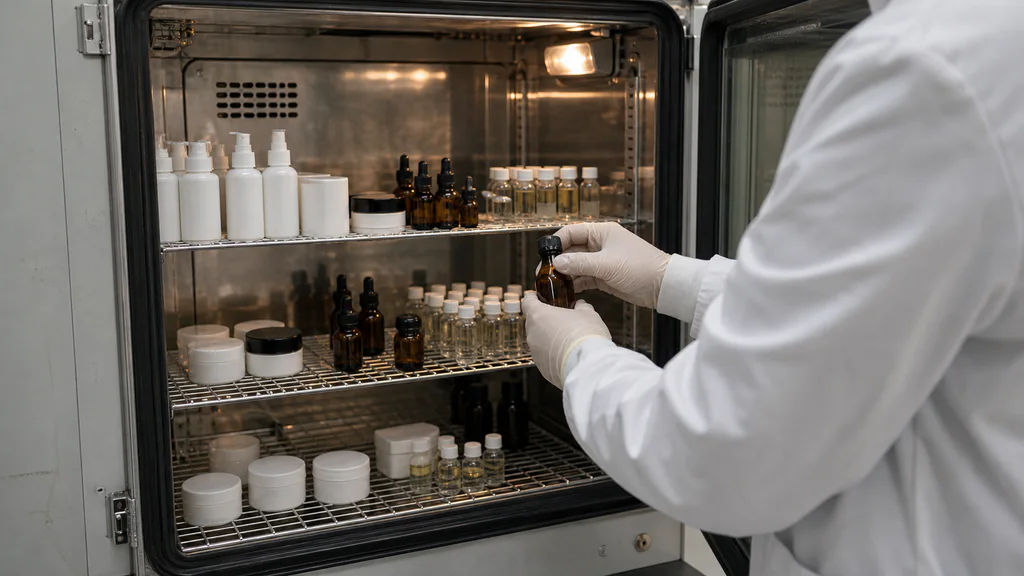
A stable-looking sample on day one can still become an expensive return on month six.
Peptide OEM stability testing should check the real formula, package, and quality targets over agreed conditions before a brand approves scale-up or shelf life. Write the protocol before placing samples in a chamber.
This guide gives skincare brands, research-product buyers, private-label teams, and OEM managers a plain-English stability plan they can use in an RFQ.
What is peptide OEM stability testing?
Stability testing asks a practical question: will this specific product remain acceptable for the proposed storage and use period?
The answer can include:
- appearance, color, odor, and texture;
- pH, viscosity, or another physical property;
- peptide identity, assay, purity, or degradation markers when relevant;
- microbial quality and preservative performance for applicable cosmetics;
- package compatibility, leakage, evaporation, and dispensing; and
- continued compliance with the approved product specification.
It is not one universal test. A dry research peptide, a water-based GHK-Cu serum, and a peptide cream have different risks.
Why this matters now
Peptides are appearing in more consumer formulas while metabolic-peptide demand is putting attention on manufacturing capacity. Faster launches and larger orders make early stability decisions more valuable, not less.
A 2026 peer-reviewed peptide-hydrogel study offers a useful real-world example. The researchers checked peptide stability, physicochemical properties, microbial purity, preservative performance, and compatibility with the package. That study does not create a universal protocol for every OEM product. It does show why a complete formula review needs more than a nice day-one sample.
Release testing and stability testing are different
| Question | Release testing | Stability testing |
|---|---|---|
| Main purpose | Does this batch meet requirements now? | Does it keep meeting requirements over time? |
| Timing | Before release or shipment | At planned timepoints |
| Conditions | Defined release method | Defined storage and stress conditions |
| Package | Finished or agreed batch package | Intended or representative package, often in planned orientations |
| Decision | Release, hold, investigate, or reject | Support storage, shelf life, package, or reformulation decisions |
A release COA cannot silently prove a two-year shelf life. It is a snapshot, not a movie.
For the wider test map, read our complete peptide quality-testing guide.
The eight parts of a useful stability protocol
1. Identify the exact test article
The protocol should name:
- formula or product code;
- formula revision;
- pilot or production batch number;
- peptide and target amount or concentration;
- manufacturing date;
- package and closure;
- fill quantity;
- storage statement; and
- intended product category and market.
If the formula changes, decide whether the existing study still represents the product. Do not quietly replace one formula revision with another.
2. Freeze acceptance criteria before testing
“Looks fine” is not a specification.
Possible acceptance criteria can cover:
- color range or reference;
- no visible separation, settling, or unexpected particles;
- pH range;
- viscosity range;
- package weight loss or leakage rule;
- assay or purity limit where justified;
- microbial limits or preservative criteria; and
- pump, dropper, seal, or closure performance.
The exact limits must come from the product and its applicable requirements. Do not invent limits after seeing the results.
3. Choose conditions that answer a business question
A program may include normal storage, elevated temperature, lower temperature, light exposure, freeze-thaw, transport simulation, or another justified stress.
Each condition needs a reason. For example:
- normal storage supports the proposed label statement;
- warmer conditions may reveal change sooner;
- cold or freeze-thaw exposure may model shipping or warehouse risk;
- light exposure may compare clear and protective packages; and
- transport testing may evaluate leakage or component movement.
Accelerated testing can help find weaknesses. It does not automatically convert into a guaranteed real-time shelf life without an appropriate model and evidence.
4. Set useful timepoints
Timepoints should be early enough to catch rapid change and long enough to support the business decision.
The plan should state:
- baseline testing;
- every pull date;
- allowable scheduling window;
- which tests occur at each timepoint;
- sample quantity per pull; and
- whether opened-use or in-use testing is separate.
There is no honest universal schedule for every peptide formula. The OEM or test partner should explain why the selected plan fits the product.
5. Include the real package
Formula and package are one system.
Test the intended bottle, vial, pump, dropper, cap, liner, label, and fill level. Where relevant, include upright, inverted, or side storage to challenge different contact points.
Look for:
- leaks and seal failure;
- evaporation or weight change;
- discoloration or odor change;
- cracking, swelling, softening, or corrosion;
- label lifting or ink damage;
- blocked pumps or inconsistent dispensing; and
- visible interaction between formula and component.
The 2026 peptide-hydrogel study specifically included packaging compatibility in its physicochemical review. That is a sensible question for commercial products, even when the exact protocol differs.
6. Match chemistry tests to the peptide risk
Not every formula needs every analytical method.
Possible questions include:
- Is the target peptide still present?
- Is its amount within the agreed range?
- Has the chromatographic impurity profile changed?
- Has pH shifted enough to affect the system?
- Is color change normal for the formula or a warning sign?
HPLC, LC-MS, assay, pH, or other methods may answer different parts of the problem. The test plan should identify which method supports which acceptance criterion.
For a buyer-friendly explanation, see HPLC vs mass spectrometry.
7. Build microbiology into water-based cosmetic projects
Cosmetics do not need to be sterile, but the finished product still needs an appropriate microbiological and preservation strategy. The FDA states that manufacturers and distributors are responsible for cosmetic safety and that there is no single prescribed test list for every cosmetic.
Depending on the product, a program can address:
- microbial limits;
- specified microorganisms;
- preservative efficacy or challenge testing;
- water quality and process controls;
- container use, such as fingers entering a jar; and
- opened-package or in-use risk.
ISO 22716 provides cosmetic GMP guidance for production, control, storage, and shipment. It is a useful framework, but it does not replace a product-specific study.
8. Define the decision path
Before testing begins, agree on what happens when a result changes.
The path should answer:
- Who reviews the result?
- What triggers an investigation?
- Can the sample be retested, and under what rule?
- Does a package issue require a new component study?
- Does a formula change restart or bridge the program?
- Who approves the final shelf-life or storage decision?
- How will repeat batches be monitored?
Without decision rules, a stability report becomes a folder rather than a control.
What should a brand ask an OEM supplier?
Send these questions before approving scale-up:
- Which stability work is included in the quote?
- Is the test article the pilot formula or production formula?
- Are the final package and closure included?
- Which conditions and timepoints are planned, and why?
- Which methods and acceptance criteria will be used?
- Who performs the tests?
- Will the brand receive the protocol and final report?
- What happens if a result is outside the approved limit?
- What formula or package changes require new testing?
- What evidence supports the proposed storage statement and shelf life?
Add the answers to your peptide OEM manufacturer checklist.
What should appear in the quote?
Stability work has a commercial scope. Confirm:
- protocol drafting and approval;
- test batches and sample quantity;
- package components and orientations;
- chamber conditions and duration;
- methods and timepoints;
- outside-laboratory fees;
- shipping of samples;
- interim and final reports;
- failure investigations; and
- repeat or bridging work after changes.
This prevents a low development quote from becoming an unexpected testing bill.
Stability is part of launch planning
Stability testing affects more than quality. It can control component ordering, artwork, launch timing, inventory, returns, and repeat manufacturing.
Build the testing schedule into the peptide lead-time plan and do not promise a fixed launch date before the key approval gates are visible.
Request a stability-ready OEM review
A stability-ready OEM brief names the formula, batch, package, conditions, timepoints, tests, limits, owners, and business decision before the study starts.
Certiva can review the peptide, format, quantity, specification, document needs, packaging, destination, and target date, then confirm the applicable bulk, wholesale, or OEM path. Final test scope depends on the product category and project requirements.
Send a product brief + request an OEM review →
Sources and further reading
- 2026 Scientific Reports study: peptide stability, microbial purity, and packaging compatibility
- FDA: Product Testing of Cosmetics
- ISO 22716: cosmetic GMP guidelines
Frequently asked questions
What is peptide OEM stability testing?
Peptide OEM stability testing checks whether the real formula in its intended package continues to meet agreed appearance, physical, chemical, microbiological, and packaging requirements under defined conditions and timepoints.
Is one release COA enough to set shelf life?
No. A release COA describes the tested batch at release. Shelf-life decisions need time-point data, defined storage conditions, acceptance criteria, and the actual formula and package.
Should stability testing use the final bottle?
Yes. Packaging can affect leakage, evaporation, light exposure, dispensing, color, odor, and compatibility, so the final or representative package should be included before scale-up approval.
Do all peptide formulas use the same stability test plan?
No. The plan should match the product format, peptide, other ingredients, package, storage statement, market, intended cosmetic or research category, and business risk.
What should a brand approve before starting a stability study?
Approve the exact formula and batch, packages and orientations, conditions, timepoints, test methods, acceptance criteria, sample quantity, responsibilities, report format, and decision rules for failures or changes.
For research use only. Not for human consumption. This article is educational and makes no medical, therapeutic, or dosing claims.
← More sourcing & supply guides · Have a question? Start an inquiry →