


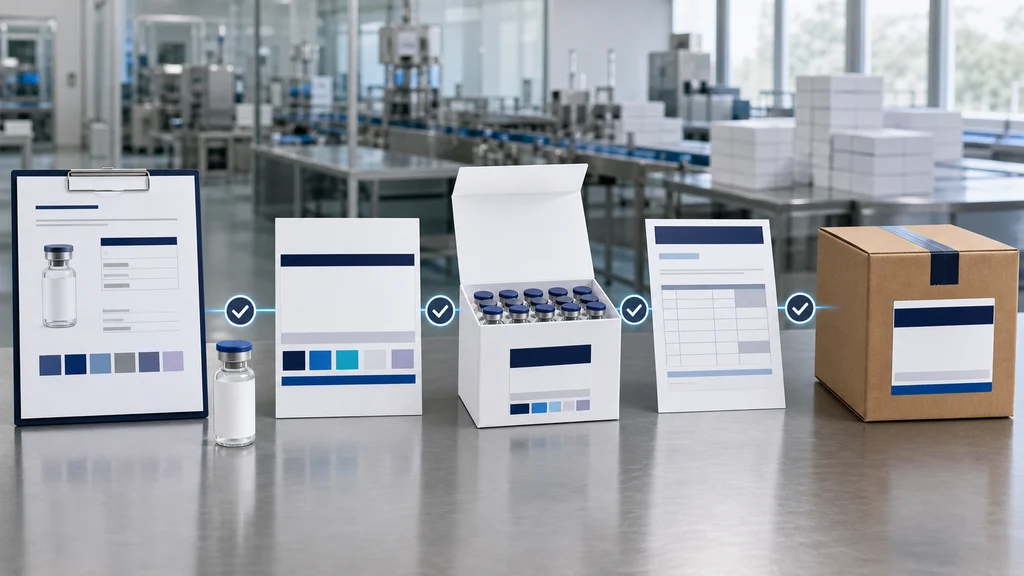
A logo is not a product launch.
A brand can finish a beautiful label and still have no approved specification, no batch-document plan, no carton count, and no answer for customer questions. That is artwork waiting for an operation.
A private-label peptide launch needs an approved product, label, packaging, document set, production plan, and market-ready sales process.
Build all six before announcing the launch date.
What is a private-label peptide launch?
In a private-label project, a buyer places its approved brand on an existing supplier product or platform. The exact meaning varies by supplier.
Brands that need repeat finished inventory can also review the wholesale peptide supplier guide.
Private label may include:
- an existing product specification;
- standard vial strength;
- buyer-approved vial label;
- buyer-branded box;
- standard batch documents; and
- agreed wholesale quantity.
If the brand changes the product, strength, test plan, vial, or package configuration, the project may move toward custom OEM.
Compare the paths in our peptide OEM vs ODM guide. Brands taking the custom route can then use the peptide OEM manufacturer checklist to assign every product, quality, artwork, package, and release approval.
Phase 1: Approve the product
Decide:
- exact peptide, blend, or cosmetic active;
- research or cosmetic product category;
- vial strength or bulk format;
- target specification;
- standard or custom product;
- intended market;
- initial quantity; and
- repeat-order forecast.
Do not begin final artwork while the product name or strength is still changing.
The product specification should become the master reference for the quote, label, COA review, purchase order, and receiving inspection.
Phase 2: Qualify the supplier
Before the brand depends on the supplier’s work, confirm:
- legal company identity;
- factory relationship;
- manufacturing location;
- current product and batch evidence;
- quality-document scope;
- packaging capability;
- lead-time basis;
- communication contacts; and
- process for changes or complaints.
Use the peptide supplier audit checklist for a structured review.
Phase 3: Approve the private-label scope
Put every included service in writing.
| Project line | Decision |
|---|---|
| Product | Existing or custom specification |
| Label | Buyer file, supplier template, or design service |
| Box | Standard size or custom component |
| Insert | Included, excluded, or custom |
| Documents | Standard COA or added requirements |
| Quantity | Product MOQ and packaging MOQ |
| Freight | Named shipping term and destination |
| Ownership | Artwork files and unused printed components |
“Private label included” is not detailed enough for production.
Phase 4: Build and approve the label
The label review should cover:
- exact product identity;
- strength or contents;
- batch and date fields;
- storage information;
- intended-use statement;
- warnings appropriate to the category;
- company and contact information;
- origin statement where applicable;
- barcode or SKU;
- label dimensions;
- print colors; and
- final file version.
For RUO products, the package, website, advertising, and sales conversation should remain consistent with research-only positioning. Do not place treatment, consumption, or dosing claims beside an RUO disclaimer.
Finished cosmetics follow a separate market and labeling path.
Phase 5: Approve the package
Review all three levels:
- Primary: vial, closure, seal, and direct label.
- Secondary: box, divider, tray, and insert.
- Tertiary: inner carton, shipping carton, cushioning, and shipping marks.
Check fit, count, label placement, batch fields, barcode, and carton strength.
Our wholesale peptide packaging guide includes the complete approval list.
Phase 6: Lock documents and quality review
Agree which documents support the first order:
- product specification;
- batch-specific COA;
- identity and purity support;
- packaging specification;
- approved artwork proof;
- invoice;
- packing list;
- origin information; and
- shipping documents.
The brand should know where these files will be stored and who can answer a customer or wholesale-account question.
Read how to read a peptide COA before approving the batch.
Phase 7: Place the first commercial order
The purchase record should match the approvals:
- product and strength;
- total vials or boxes;
- price and currency;
- setup and printing costs;
- packaging version;
- batch-document scope;
- payment schedule;
- lead-time starting point;
- shipping term;
- destination; and
- target arrival window.
Use a complete peptide RFQ and compare the real landed cost, not only the vial price.
Phase 8: Prepare sales and customer support
Before inventory arrives, prepare:
- accurate product page;
- RUO-consistent sales copy;
- batch-document access process;
- storage and handling information;
- wholesale price and account rules;
- inquiry response templates;
- complaint and damage process;
- return policy appropriate to the business; and
- inventory and reorder owner.
Do not let marketing invent claims that the approved product and documents do not support.
Phase 9: Receive and release the shipment
On receipt:
- count cartons and boxes;
- inspect visible damage and seals;
- match product and strength;
- match batch number to the COA;
- confirm label and artwork version;
- check box and carton counts;
- record transit concerns; and
- release inventory only after the review passes.
Keep receiving evidence for the repeat order.
What changes for cosmetic private label?
Research peptides and finished cosmetics are different categories.
For U.S. cosmetics, FDA says companies are responsible for product safety and proper labeling. Depending on the business and product, facility registration, product listing, adverse-event, and responsible-person duties may apply. Review the FDA cosmetics fact sheet and obtain market-specific advice.
Decide responsibility before printing the label, not after the first shipment.
Private-label launch gate
Do not approve production until every line has an owner:
- product approved;
- supplier qualified;
- quotation approved;
- label approved;
- packaging approved;
- documents agreed;
- payment authorized;
- lead time confirmed;
- shipping responsibility confirmed;
- receiving plan ready; and
- sales copy reviewed.
One missing owner can hold the entire launch.
Launch the operation behind the label
Launch the operation behind the label, not only the label itself.
A strong private-label brand can identify the product, prove the batch, receive the shipment, answer the buyer, and place the next order without starting over.
Research peptides are supplied for laboratory research use only and are not for human consumption.
Discuss a private-label project
Certiva manufactures at its own facility and evaluates private-label, wholesale, and custom OEM inquiries. Send the product, quantity, destination, target date, document needs, and packaging brief so we can confirm the applicable path.
Compare Certiva’s bulk, wholesale, private-label, and custom-production options before finalizing the launch brief.
Plan a private-label peptide project →
Sources and further reading
Frequently asked questions
What does a private-label peptide launch need?
A private-label peptide launch needs an approved product, label, packaging, document set, production plan, and market-ready sales process.
Is private label faster than custom peptide OEM?
It can be faster when the brand uses an existing product specification and packaging platform. Custom composition, testing, components, or artwork can add development and approval time.
Who is responsible for private-label artwork?
The contract should say who creates, reviews, approves, prints, and archives the artwork. The brand should approve one final version before production.
What should a brand approve before the first bulk order?
Approve the product specification, batch-document scope, label, package, carton count, quantity, price, lead-time basis, shipping term, destination, and receiving plan.
Does Certiva support private-label peptide inquiries?
Yes. Certiva evaluates private-label and custom OEM inquiries after the buyer provides the product, quantity, packaging brief, destination, document needs, and target date.
For research use only. Not for human consumption. This article is educational and makes no medical, therapeutic, or dosing claims.
← More sourcing & supply guides · Have a question? Start an inquiry →