


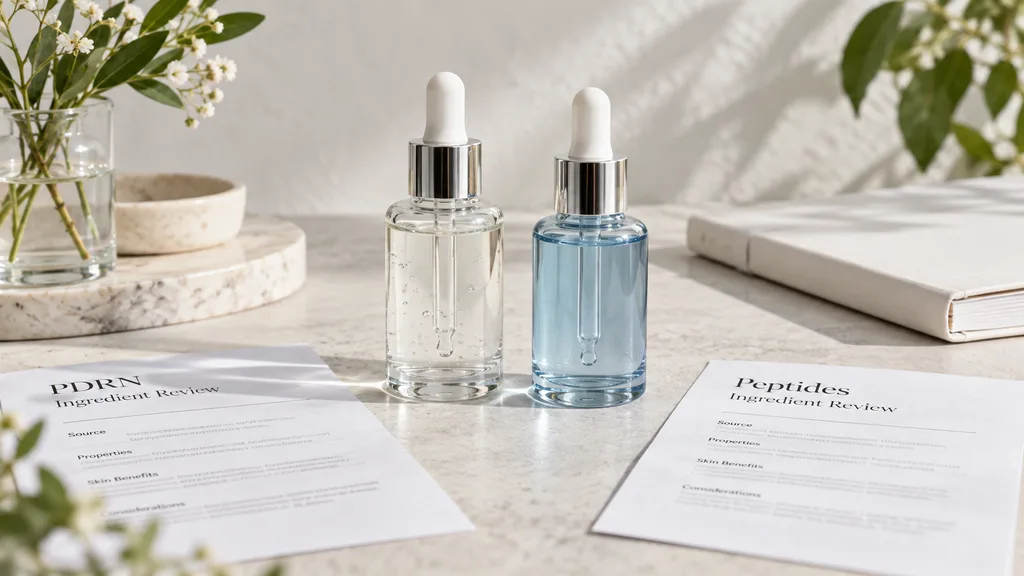
PDRN vs peptides is a comparison between DNA fragments and amino-acid chains. PDRN is not a peptide, even when both names appear on the same skincare bottle. Neither name, on its own, tells you how well a finished serum performs.
The useful comparison is the exact ingredient, the finished formula and the evidence for the result you want. A PDRN eye cream tested in a human study, a multi-peptide moisturizer and an injectable polynucleotide treatment are three different products, with different evidence requirements.
Why are PDRN and peptides appearing together?
Products combining the two ingredient stories have become visible in beauty content. For example, Syncly’s September 2026 short-form video index includes a Medicube PDRN Pink Peptide Serum video among its public examples. That is evidence of consumer attention, rather than proof of effectiveness.
For shoppers, a name such as “PDRN peptide serum” can obscure a basic question: is PDRN itself a peptide, or are there separate ingredients in the bottle? For beauty brands, answering that question clearly is a better starting point than repeating the language of a viral caption.
PDRN vs peptides at a glance
| Question | PDRN | Cosmetic peptides |
|---|---|---|
| What is it? | A mixture of DNA fragments | Amino-acid chains; some are chemically modified or complexed with copper |
| Is it one uniform ingredient? | Source, fragment distribution and preparation can differ | The family includes many different named molecules |
| What should a buyer identify? | Exact material, source, specification and amount | Exact peptide identity, specification and amount |
| Can a category name predict performance? | No | No |
| What evidence matters most? | Evidence for the relevant topical preparation and finished formula | Evidence for the named peptide and relevant finished formula |
| Does a serum study establish injection safety? | No | No |
For an introduction to the amino-acid side of the comparison, read our guide to peptides in skincare.
What does topical PDRN research actually show?
Topical evidence is developing, and it should be described precisely.
A 2026 PLOS ONE study examined a medium-length preparation called PDRN-850K. Its clinical component compared a specific 0.1% PDRN eye cream with a 0.1% retinol cream in a randomized, double-blind, split-face study over 28 days. The authors reported improvements in measured eye-area parameters and favorable tolerability.
That supports interest in the tested preparation. It does not establish that every PDRN serum works the same way, that every skin type will respond similarly, or that PDRN is better than cosmetic peptides. The comparator was retinol, not a peptide product. Short-term findings also leave longer-term questions open.
Research on a peony-derived PDRN preparation included a small topical skin-barrier experiment with 10 participants and reported eye-area elasticity findings. The authors were employed by the company developing the material. These details matter when assessing how broadly to apply the results.
“There are topical studies” is accurate. “Every PDRN serum is clinically proven” requires evidence that these studies do not supply.
How does that compare with peptide evidence?
Cosmetic peptides also need to be evaluated individually. A result for one peptide does not transfer automatically to another molecule or blend.
One controlled palmitoyl pentapeptide study enrolled 93 women in a 12-week split-face comparison. Researchers compared a moisturizer with the same moisturizer containing the peptide and reported improvements in the appearance of fine lines and wrinkles against the control. It is a useful example of evidence tied to a defined ingredient and formulation.
Copper peptides are another group. GHK-Cu and AHK-Cu have different identities, as explained in our GHK-Cu vs AHK-Cu comparison. Neither should inherit the results of a palmitoyl pentapeptide trial merely because all three appear in peptide marketing.
The practical question is therefore: which tested product resembles the one being sold? Category-wide rankings usually skip that step.
Can you use PDRN and peptides together?
The two ingredient families can appear in a finished cosmetic formula. Their coexistence on an ingredient list does not establish synergy or a particular level of benefit.
For shoppers, the product’s directions and full ingredient list are the starting point. Adding a second serum simply to cover another trending ingredient can make it harder to tell which product suits your skin. A combination product may be convenient, but convenience and proven added effectiveness are separate claims.
For formulators, compatibility is a question for the specific materials and finished product. Ask whether the supporting file covers the actual combination, the final packaging and the shelf-life claim. A supplier’s ingredient brochure cannot answer every question about a new commercial formula.
Why injections and microneedling studies need separate treatment
A cosmetic serum is not equivalent to a clinic procedure.
For example, a 2022 PDRN combination study investigated PDRN, vitamin C and niacinamide with microneedling-assisted delivery in a UV-exposed animal model. It was not a trial of an ordinary consumer serum applied to intact human skin, and it did not isolate a PDRN-plus-peptide combination.
When reading a claim, check the route, study population, comparator and complete formula before accepting the headline. “Studied in skin research” is much broader than “this bottle was tested under its labeled conditions of use.”
How should a beauty brand compare supplier proposals?
Use the same questions for both ingredient families:
- Identity: What exact material is being supplied, and how is it named in the finished-product documentation?
- Amount: Does the stated percentage refer to active material or a diluted supplier preparation?
- Traceability: Can the supporting documents be linked to the supplied batch?
- Product fit: Does the evidence concern topical use and a comparable formula?
- Finished-product support: What substantiates safety, stability and the proposed appearance claims?
- Source claims: What supports statements about animal origin, plant origin or suitability for a particular brand standard?
These are purchasing questions, not a promise that a longer document pack creates a better serum. The records should answer the questions raised by the actual product.
Our copper peptide OEM guide explains how to turn an ingredient idea into a more specific manufacturer brief.
Which should you choose?
Choose a documented formula that fits your intended use and product expectations. PDRN is worth evaluating when a supplier can substantiate its exact preparation and relevant topical evidence. A peptide formula is worth evaluating when the peptide identity and supporting data are clear. A combination needs its own rationale.
For a cosmetic brand exploring named peptide ingredients, start with Certiva’s cosmetic GHK-Cu information or send a formulation and documentation inquiry. This article does not establish that Certiva supplies PDRN.
Educational ingredient comparison. Cosmetic products should be used according to their labels. Research-use materials are for research use only, not for human consumption or home cosmetic preparation.
Frequently asked questions
Is PDRN a peptide?
No. PDRN is polydeoxyribonucleotide, a mixture of DNA fragments. Peptides are chains of amino acids. A serum can contain both, but the ingredients belong to different chemical families.
Is PDRN better than peptides for skin?
There is no category-wide winner. Evidence depends on the exact ingredient, formulation and outcome. The topical studies discussed here do not establish that all PDRN products outperform all peptide products.
Can PDRN and peptides be in the same serum?
A finished formula can contain both ingredient families. That does not automatically demonstrate synergy, stability or extra benefit; those claims need evidence for the combination and final product.
Does research on PDRN injections prove a PDRN serum works?
No. Injection, microneedling-assisted delivery and ordinary topical application are different exposures. Evidence should match the product format and intended use.
Is all PDRN made from salmon?
No. Published research also describes PDRN derived from Paeonia lactiflora, or peony. Source and manufacturing claims should be supported by documentation for the actual ingredient.
Educational content only. Cosmetic ingredients and finished products are not interchangeable, and this article does not diagnose or treat hair or skin conditions. Follow the finished-product label and ask a qualified healthcare professional about persistent concerns.
← More skin & hair peptides guides · Have a question? Start an inquiry →