


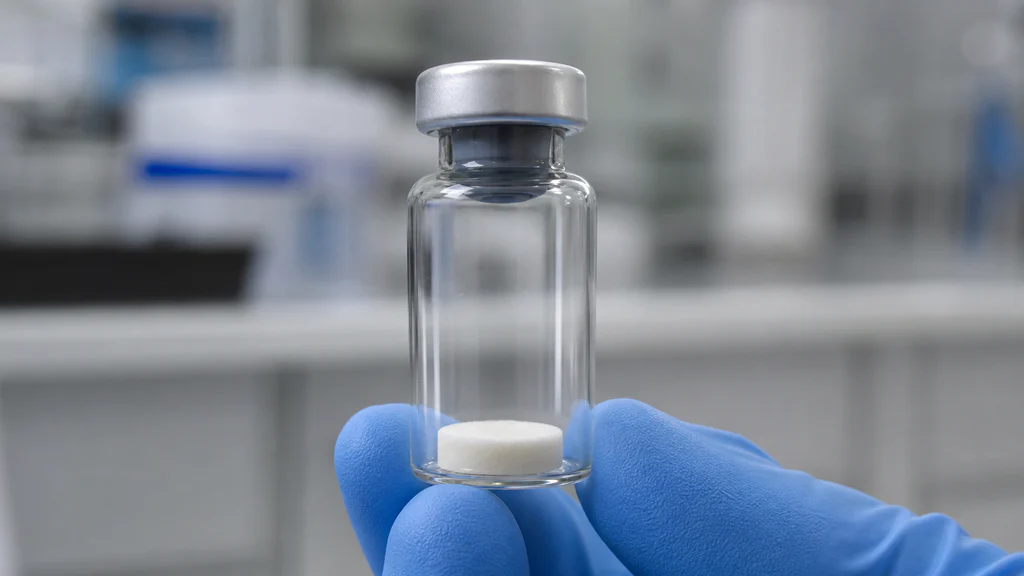
Lyophilized peptides should be stored sealed, dry, protected from light, and at the temperature stated on the product label. A compact cake, puck, or plug at the bottom of the vial can be normal after freeze-drying.
Appearance alone cannot confirm identity, purity, potency or stability. It is still a useful first check. A sealed, dry, white or off-white cake is generally less concerning than a broken seal, unexpected liquid, discoloration or visible foreign matter. If the vial is damaged or looks wet, leave it closed, photograph it and ask the supplier what to do next.
A cracked cake or a warm parcel falls between those two cases. Neither proves that the peptide has failed. Record what you can—the journey, packaging, time and likely temperature—then return the sealed vial to its labelled storage condition while the supplier assesses the excursion against product-specific data.
What a healthy freeze-dried “cake” can look like
Lyophilization removes water while the material is frozen. What remains does not have to be loose powder. A well-formed cake can look surprisingly solid—sometimes almost like a small white pill fixed to the base of the vial.
Normal-looking vials are not always visually identical. A cake may be compact, show fine cracks, pull slightly away from the glass, or shed a little powder after transport. Its visible volume can also differ between formulations because excipients contribute to the cake even when the amount of peptide is unchanged.
That means a vial becoming “less fluffy” is not reliable evidence that it was stored warm. The cake may have looked compact from the moment it was manufactured, or it may have cracked during ordinary handling.

What visual inspection can—and cannot—tell you
Visual inspection is useful because it can catch obvious physical or packaging problems. It cannot see many forms of chemical degradation. Oxidation, deamidation, hydrolysis, or a modest loss of purity may occur without a dramatic visible change. Likewise, an attractive white cake is not proof of identity or potency.
The US Food and Drug Administration’s inspection guide for lyophilized products notes that cake appearance and residual moisture matter, and that “meltback” or incomplete drying can create wet areas and raise stability concerns. But those observations still need to be interpreted alongside manufacturing records and testing.
| What you see | What it means | What to do |
|---|---|---|
| Solid cake, small cracks, slight separation from glass or a little dry powder | Usually inconclusive by appearance alone | Record it and continue the batch and storage checks |
| Cracked glass, loose cap, lifted stopper or damaged seal | The container may no longer protect the material | Keep it closed, quarantine it and contact the supplier |
| Unexpected liquid, wet or glassy areas, major collapse or discoloration | A drying, storage or packaging problem may have occurred | Photograph it and request a product-specific assessment |
| Foreign matter or a label/lot mismatch | The vial should not be accepted as documented | Hold it apart from usable inventory and investigate |
Do not open a questionable vial “just to check.” Photograph it from several angles, keep the packaging and temperature indicator if one was supplied, quarantine it, and contact the supplier.
A five-step arrival check anyone can follow
1. Match the label to the order and COA
Confirm the peptide name, lot or batch number, amount, and supplier. The number on the vial should connect to the same batch on the Certificate of Analysis (COA). If you are unsure what the document proves, start with our plain-English guide to reading a peptide COA.
A COA is a snapshot of the sample when that batch was tested. It does not prove that a particular vial retained the same condition after later shipping or storage. Evaluating a temperature excursion requires product-specific stability data—and, when the research risk warrants it, analytical retesting.
2. Inspect the vial before opening it
Look for cracked glass, a loose stopper, a damaged seal, leakage, or unexpected moisture. Take clear photos immediately if anything looks wrong.
3. Check appearance without overdiagnosing it
Note the cake’s color and physical condition. A solid cake or a few cracks are not a chemical test. Unexpected liquid, foreign matter, or a major change from an approved product image is more concerning.
4. Record the journey
Save the delivery time, outside temperature, tracking history, packaging condition, and any temperature-indicator reading. “It arrived warm” is less useful than “the parcel was delivered at 3:10 pm after two days in transit, and the indicator read 12°C.”
5. Move it to the labelled storage condition
Do this promptly. Do not leave the parcel in a car, on a sunny windowsill, or beside a heat source while deciding what to do.
How to store lyophilized peptides correctly
There is no honest one-temperature rule for every peptide. Stability varies with the amino-acid sequence, formulation, residual moisture, packaging, light exposure, and time. The product label and supplier’s batch-specific handling instructions come first.
In day-to-day handling, keep the vial sealed and within its stated temperature range. The original carton can help protect light-sensitive material, while a stable storage location reduces unnecessary temperature cycling. The point is not to make the vial as cold as possible; it is to keep it within the range supported for that product.
Moisture deserves particular care. Thermo Fisher’s standard peptide handling guide recommends allowing a sealed cold vial to reach room temperature before it is opened or dissolved. Opening it while cold can draw condensation from room air onto the dry material.
Dry peptide and peptide mixed with liquid are not the same
A dry lyophilized cake is usually more stable than the same peptide in solution. Once liquid is added—a step called reconstitution—hydrolysis, oxidation, adsorption to the container, and microbial-control concerns may change the storage window. Use a product-specific protocol for the solvent, concentration, container, light protection, temperature, and allowed time after reconstitution. Do not copy a storage period from a different peptide.
If the vial is an approved medicine rather than research material, follow the manufacturer’s label and pharmacist’s instructions exactly. Generic internet advice should never replace product-specific medical storage directions.
What if the vial was not refrigerated for a while?
Do not jump from “room temperature” to “destroyed.” A short, sealed transit period and weeks in a hot vehicle are not equivalent. The answer depends on five facts:
- Form: dry lyophilized cake or reconstituted liquid?
- Temperature: ordinary room temperature or severe heat?
- Time: hours, days, or weeks?
- Packaging: sealed and dry, or compromised?
- Product data: what excursion limits are supported for this sequence and formulation?
A 2024 stability study of an 18-peptide lyophilized mixture illustrates why blanket claims are risky: most peptides remained stable at room temperature for the tested period, while one methionine-containing peptide showed substantial oxidation much earlier. The lesson is not that room-temperature storage is safe—it is that peptide stability is sequence- and formulation-specific. Read the published study.
Record the temperature excursion—the time spent outside the labelled range—return the sealed vial to its labelled condition, and ask the supplier to assess it against stability data. For high-value or critical research, replacement or analytical retesting may be more defensible than guessing.
For the simple timeline behind these decisions, read how long peptides last in lyophilized and solution form.
A good-looking vial is not a quality certificate
Visual screening catches obvious physical problems, but quality evidence comes from a traceable batch and methods chosen for the question. HPLC can describe a purity profile, mass spectrometry can support identity, residual-moisture testing can assess the drying result, and stability studies can show what time and temperature do to that particular product. A photograph cannot replace any of them.
Our guide to HPLC versus mass spectrometry explains why neither method replaces the other. When evaluating a supplier, ask for the batch-linked COA, storage range, excursion policy, and packaging information—not just a photograph of a white cake.
The practical takeaway
If your lyophilized peptide looks like a small solid tablet, that can be completely normal. If it is not fluffy, that does not prove it was left unrefrigerated. Use appearance to identify obvious damage, then rely on the label, batch documentation, stability data, and analytical testing for the questions your eyes cannot answer.
For the shipping side of the story, read Do peptides need cold-chain shipping?. To review batch documentation before placing a research order, explore our quality and COA process or contact Certiva.
Sources and further reading
- FDA: Lyophilization of Parenteral Products
- Thermo Fisher Scientific: Standard Peptide Handling and Storage Instructions
- CPTAC: Recommendations for Peptide Storage and Handling
- Journal of Peptide Science: Stability of a Lyophilized Multi-Peptide Vaccine
Frequently asked questions
Should a lyophilized peptide look like loose, fluffy powder?
Not necessarily. Freeze-dried material often forms a dry cake, puck, or plug at the bottom of the vial. It may also crack or detach during handling. Appearance alone cannot confirm whether a peptide is potent, correctly identified, or degraded.
Can you tell whether a peptide has gone bad just by looking at the vial?
No. Visual inspection can reveal packaging damage, unexpected liquid, discoloration, foreign matter, or severe cake defects, but many chemical changes are invisible. Batch-linked HPLC, mass spectrometry, stability data, and other appropriate tests provide stronger evidence.
What should I do if a lyophilized peptide was left at room temperature?
Record how long it was out, the likely temperature range, the product form, and whether the vial stayed sealed. Move it to the storage condition on the product label and ask the supplier to assess the excursion against product-specific stability data. Do not assume that every excursion has the same effect.
Why should a cold vial warm up before it is opened?
Opening a cold vial can allow moisture from room air to condense on the dry material. Letting the sealed vial reach room temperature first helps keep water out. Follow the product-specific handling instructions.
For research use only. Not for human consumption. This article is educational and makes no medical, therapeutic, or dosing claims.
← More storage & shipping guides · Have a question? Start an inquiry →