


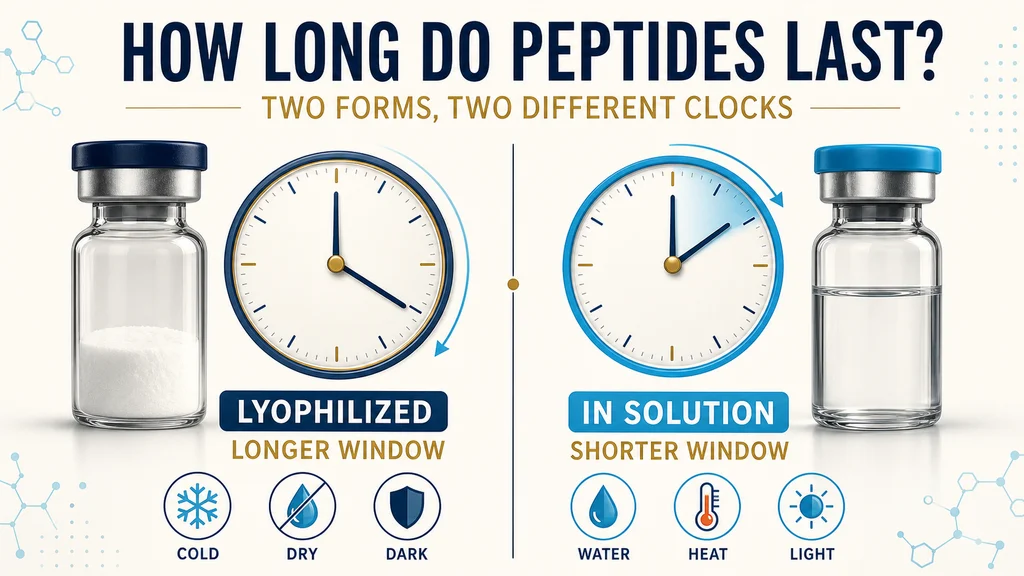
A peptide vial can look perfect long after its contents have started to change. Shelf life is not a beauty test—it is a race between the molecule and its environment.
Lyophilized peptides can remain stable for months or years when kept cold, dry, and dark; peptides in solution have a much shorter shelf life.
That difference comes down to one powerful ingredient: water. Removing water slows many degradation reactions. Adding it back starts a much faster clock.
Browse Certiva lyophilized research references →
Which shelf-life clock is running?
The form of the peptide matters before almost anything else.
Lyophilized powder
Months to years
The longer window when the vial stays sealed, cold, dry, and protected from light.
Peptide in solution
Days to weeks
The shorter window because water, pH, oxygen, and handling can speed degradation.
The deciding evidence
Product-specific data
The sequence, formulation, container, temperature, and stability testing set the real limit.
How long do peptides last?
There are two honest answers:
- Lyophilized peptides: commonly managed on a months-to-years timescale under appropriate sealed cold storage.
- Peptides in solution: commonly managed on a days-to-weeks timescale under an appropriate validated protocol.
Those are useful ranges, not universal expiration dates. A small, simple peptide and a longer oxidation-prone peptide can behave differently in the same freezer. The formulation, container, residual moisture, and temperature history also matter.
Think of the range as the starting answer. The product label, supplier documentation, and stability data provide the specific answer.
Why does lyophilized powder last longer?
Lyophilization means freeze-drying. The process freezes the material and removes water under vacuum, leaving a dry cake or powder in the vial.
Water enables or speeds several reactions that can change a peptide. Removing most of it:
- slows hydrolysis;
- reduces molecular movement;
- limits some aggregation pathways; and
- creates a more stable form for storage and transport.
That is why serious peptide suppliers usually ship research peptides as dry, lyophilized material rather than as ready-made liquid.
The dry form is not immortal. Oxygen can still reach sensitive amino acids, residual moisture can remain in the cake, and heat still speeds reactions. But the clock generally runs much more slowly.
How long do lyophilized peptides last?
Properly manufactured lyophilized peptides are often stored at −20°C for routine long-term laboratory inventory, with −80°C used for longer archival storage when appropriate.
Under supported cold, dry, dark conditions, the useful stability window can extend from many months to several years. The exact limit depends on:
- Peptide sequence — some amino acids oxidize or rearrange more easily.
- Formulation — buffers, counterions, and excipients change stability.
- Residual moisture — a drier cake generally slows water-driven reactions.
- Container closure — the vial and stopper must limit moisture and oxygen.
- Temperature — colder conditions usually slow chemical change.
- Temperature cycling — repeated warming can introduce condensation.
This is why “it was in the freezer” is helpful but incomplete. A supported shelf-life claim connects the exact material, package, and storage condition to measured data.
How long do peptides last after reconstitution?
Once a peptide enters solution, its stability window usually shrinks from months or years to days or weeks.
Adding water changes the environment immediately:
- hydrolysis becomes possible;
- dissolved oxygen can support oxidation;
- pH begins influencing chemical reactions;
- the peptide can interact with the vial surface;
- movement makes aggregation easier for some sequences; and
- repeated handling adds contamination risk.
There is no responsible universal “28-day rule” for every peptide. Some laboratory solutions remain within specification longer; other sequences can change sooner. The valid window depends on the molecule, solvent, pH, concentration, container, light, temperature, and test method.
For laboratory work, use the product-specific handling information and a validated protocol. Certiva materials are research references and are not finished prescription medicines or for human consumption.
What actually makes a peptide degrade?
“Degradation” sounds dramatic, but it often means small molecular changes that accumulate over time.
Heat speeds the clock
Higher temperature gives molecules more energy to react. Cold storage slows many chemical reactions, which is why temperature control is such a common stability tool.
Moisture turns reactions back on
A dry lyophilized cake is relatively quiet. Moisture creates the environment needed for hydrolysis and allows more molecular movement.
Oxygen can change sensitive amino acids
Methionine, cysteine, and tryptophan are among the residues that may be more sensitive to oxidation. Headspace, repeated opening, and formulation all affect that risk.
Light can add stress
Light-sensitive sequences or formulations can change faster when stored in direct light. Keeping the vial in appropriate secondary packaging is a simple protective step.
pH matters after water is added
In solution, an acidic or alkaline environment can speed different degradation pathways. The best pH is peptide- and formulation-specific.
Can a peptide look normal after it degrades?
Yes. Many important changes are invisible.
A visual check can catch:
- a cracked vial or loose stopper;
- unexpected liquid in a dry vial;
- severe cake collapse;
- particles;
- unusual discoloration; or
- packaging damage.
But a clear solution can still contain chemical variants, and a white cake can still have lost purity. A camera cannot see oxidation, deamidation, or a small drop in the main HPLC peak.
That is why HPLC and mass spectrometry matter. HPLC measures the main component and related peaks; mass spectrometry helps confirm molecular identity. Stability testing repeats appropriate methods over time to show how the material changes.
Does one warm shipment ruin a peptide?
Not automatically.
A sealed, dry lyophilized vial can be more tolerant of a short ambient excursion than the same peptide in solution. The useful questions are:
- Was the vial still sealed and dry?
- How warm did it likely become?
- How long did the excursion last?
- Was it exposed to direct sunlight?
- What do product-specific stability or excursion data support?
On arrival, document the package and vial condition, then follow the labeled storage condition. Read our complete guide to whether peptides need cold-chain shipping for the difference between transport and long-term storage.
Five habits that protect peptide shelf life
For laboratory reference materials, the basic habits are simple:
- Keep the vial sealed until it is needed.
- Store it cold, dry, and dark according to the product information.
- Let a cold sealed vial reach room temperature before opening to reduce condensation entering the vial.
- Avoid repeated temperature cycles by planning inventory and aliquots.
- Record dates and lot numbers so the material can be connected to its COA and storage history.
For a deeper handling checklist, see how to store lyophilized peptides.
What should a peptide buyer ask before ordering?
Shelf life starts with manufacturing and packaging—not when the box reaches the buyer.
Ask the supplier for:
- the current lot number and vial specification;
- the manufacture, fill, or applicable test date;
- the current batch Certificate of Analysis;
- the labeled storage condition;
- packaging and container-closure details;
- any available stability or temperature-excursion information; and
- current inventory, lead time, and replacement support.
Certiva supplies lyophilized research peptides in sealed vials, generally packed 10 vials per standard box. Buyers can request the applicable batch COA, current availability, storage information, bulk options, and a destination-based quote before ordering.
Browse research peptide specifications · See Certiva’s COA process · Review the manufacturing facility
Two physical forms create two stability clocks
Lyophilized peptides can remain stable for months or years when kept cold, dry, and dark; peptides in solution have a much shorter shelf life.
The simple reason is water. A dry, sealed lyophilized vial slows many degradation pathways. Once the peptide enters solution, chemistry and handling move much faster.
For a buyer, the best shelf-life answer combines the useful range with the exact peptide, lot, packaging, storage condition, and supporting data. That is stronger than guessing from how the vial looks or trusting one universal number.
Request current peptide specifications, COAs, and storage information
Tell Certiva the peptide, vial specification, quantity, destination country, and documents you need. We will reply with current availability, applicable batch information, storage notes, lead time, bulk options, and a quote.
Request current batch information + a quote →
Sources and further reading
- ICH Q1A(R2): Stability Testing of New Drug Substances and Products
- Review: Formulation Strategies for Stability of Peptides in Aqueous Solutions
- Peptide Stability in Solids and Solutions
- 2024 study: Stability of a Lyophilized Multi-Peptide Vaccine
Frequently asked questions
How long do peptides last?
Lyophilized peptides can remain stable for months or years when kept cold, dry, and dark; peptides in solution have a much shorter shelf life.
How long do lyophilized peptides last?
Properly prepared, sealed, and cold-stored lyophilized peptides are commonly managed on a months-to-years timescale. The exact shelf life depends on the peptide sequence, formulation, residual moisture, packaging, temperature, and supporting stability data.
How long do peptides last after reconstitution?
Peptides in solution are usually managed on a days-to-weeks timescale rather than months or years. The exact validated window depends on the molecule, solvent, pH, concentration, temperature, light exposure, and microbiological controls.
Do peptides expire even if they stay frozen?
Yes. Cold storage slows degradation but does not stop it forever. Moisture, oxygen, formulation, sequence, packaging, and temperature cycling still affect long-term stability.
Can you tell whether a peptide has degraded by looking at it?
Not reliably. Visible changes can reveal a damaged vial, unexpected liquid, particles, or discoloration, but many chemical changes are invisible. HPLC, mass spectrometry, and appropriate stability testing provide stronger evidence.
Does a short temperature excursion ruin a lyophilized peptide?
Not automatically. A sealed, dry lyophilized vial may tolerate a supported short ambient excursion. The supplier should assess the duration, likely temperature, vial condition, and product-specific stability information.
What should buyers ask a peptide supplier about shelf life?
Ask for the current lot, manufacture or test date, applicable COA, labeled storage condition, packaging details, available stability or excursion information, and guidance for the specific peptide.
For research use only. Not for human consumption. This article is educational and makes no medical, therapeutic, or dosing claims.
← More storage & shipping guides · Have a question? Start an inquiry →