


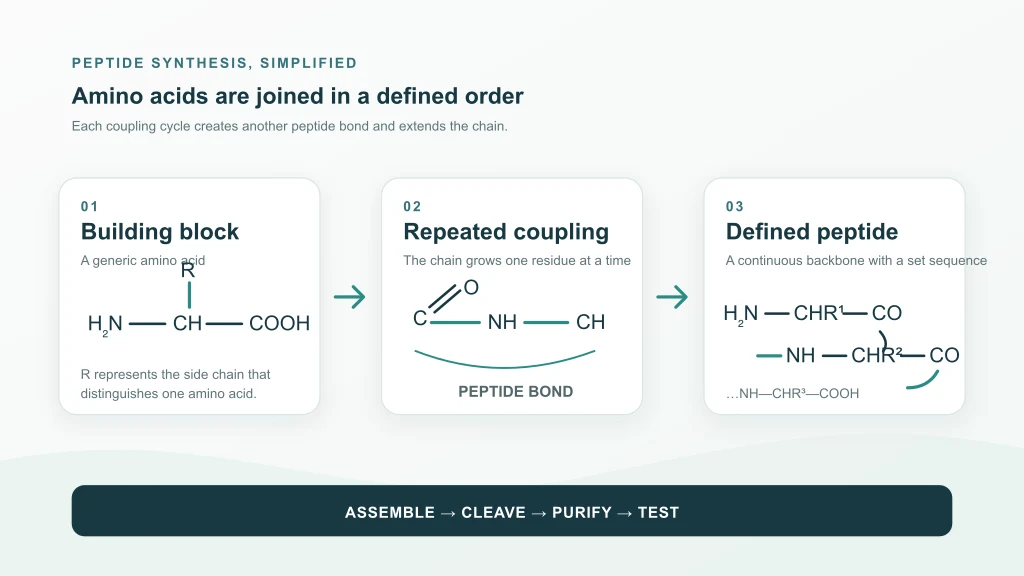
Peptides are made by joining amino acids in a precise order, then separating the intended molecule from everything the process produced around it. Most commercial research peptides use solid-phase peptide synthesis, followed by cleavage, purification, isolation, analytical testing, and batch release.
The simple answer sounds almost mechanical. The difficult part is that a peptide can look nearly correct while still missing one amino acid, carrying an unwanted chemical change, or containing closely related sequences that are hard to separate. Good manufacturing therefore does two jobs at once: it builds the target sequence and creates evidence that the finished batch matches the intended material.
The complete process in one view
Although manufacturing teams often speak about individual steps, the process works as one connected chain. A decision made during sequence design affects synthesis; the synthesis route shapes the impurities; those impurities influence purification and the final testing plan.
| Stage | What happens | What the team needs to know |
|---|---|---|
| Molecular definition | The sequence, modifications, form, quantity, and specification are agreed | What exact material is being made? |
| Chain assembly | Amino acids are joined chemically, recombinantly, enzymatically, or by a hybrid route | Can the intended sequence be built reproducibly? |
| Cleavage and purification | The peptide is released and separated from related impurities | Can the target be isolated from incomplete or modified sequences? |
| Isolation | Purified fractions become a defined dry material or solution | Will the physical form remain suitable through handling and storage? |
| Analytical testing | Identity, purity, content, and other required attributes are measured | Does the sample meet the written specification? |
| Batch release | Records and results are reviewed together | Does this particular lot have enough evidence to be released? |
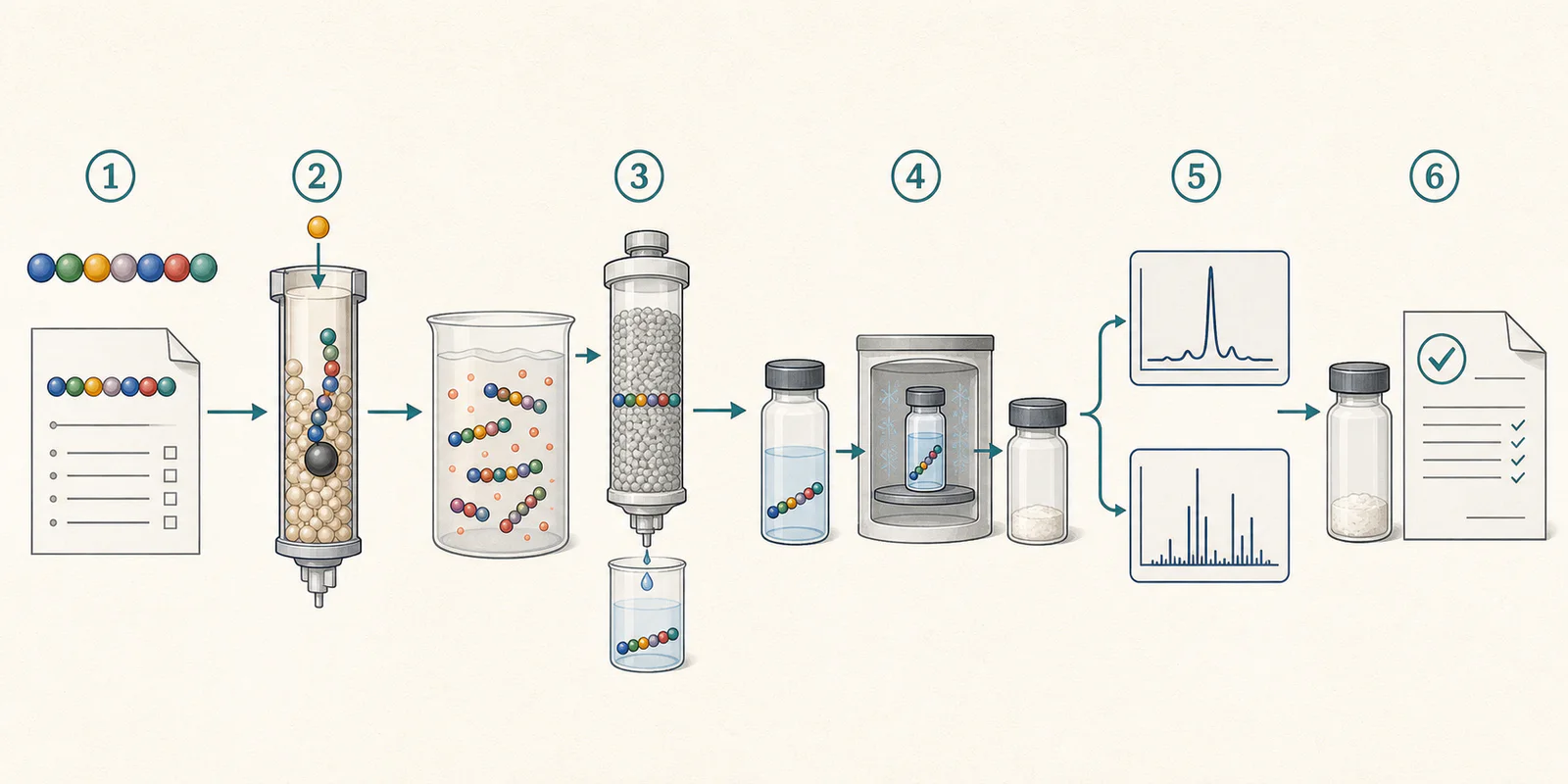
The arrows do not always point in only one direction. If purification cannot separate a difficult impurity, the synthesis conditions may need to change. If a peptide proves unstable during isolation, the formulation or packaging plan may need another round of development.
Manufacturing begins with a molecular definition
A familiar product name is not a sufficient manufacturing instruction. The team needs the complete amino-acid sequence and its direction, plus any terminal modifications, disulfide bonds, cyclization, branching, labels, lipid groups, or other structural features. It also needs to know the required form, quantity, purity target, analytical tests, packaging, and intended research use.
This is more than administrative detail. Changing one residue or terminal group creates a different molecule. Even when two materials share the same sequence, a different salt or counterion form can affect analytical results and handling. The written specification establishes what the manufacturing and quality teams are trying to make before the first reaction begins.
For a shorter introduction to sequences and peptide bonds, start with what peptides are.
How solid-phase peptide synthesis builds the chain
In solid-phase peptide synthesis, usually called SPPS, the growing peptide is anchored to an insoluble resin. The manufacturer removes a temporary protecting group, couples the next protected amino acid, washes away excess reagents and by-products, and repeats the cycle. Side-chain protecting groups keep other reactive sites from forming unwanted bonds while the sequence is assembled.
Keeping the chain attached to a solid support is what makes repeated washing and automated cycles practical. Bruce Merrifield’s solid-matrix approach, described in his Nobel lecture on solid-phase synthesis, became a foundation of modern peptide chemistry.
SPPS is efficient, but it is not a molecular printer that produces only perfect chains. A coupling may be incomplete. A protecting group may not be fully removed. The growing chain may aggregate on the resin, making later reactions less efficient. As sequences become longer or more chemically demanding, small losses at each cycle can accumulate into a complicated crude mixture.
That is why process development matters. Chemists adjust resin, protecting-group strategy, reagents, reaction time, temperature, and monitoring to improve the amount of full-length target and control the impurity profile. The best route is the one that can be repeated at the required scale, not necessarily the one with the most fashionable chemistry.
Cleavage produces a crude peptide, not a finished one
When chain assembly is complete, the peptide must be released from the resin and its remaining protecting groups removed. This cleavage stage creates a crude mixture. It contains the desired full-length sequence, but it may also contain deletion sequences, truncated chains, incompletely deprotected material, chemically modified by-products, and residual process chemicals.
Many of these impurities resemble the intended peptide closely. A sequence missing one residue may have similar solubility and chromatographic behavior, which makes the next stage more demanding than simply filtering away visible debris. Cleavage conditions themselves must also be chosen carefully so that releasing the molecule does not create avoidable damage.
Purification separates the target from close relatives
Preparative reverse-phase chromatography is commonly used to purify synthetic peptides. The crude mixture moves through a column, components separate according to their interactions with the stationary and mobile phases, and the process collects fractions over time. Those fractions are analyzed, and the ones meeting defined criteria are combined.
Preparative chromatography should not be confused with the analytical HPLC result on a COA. Preparative work is a production operation designed to collect material; analytical HPLC examines a small sample to describe a chromatographic profile. The two may use related scientific principles, but they serve different purposes and operate at different scales.
Purification is often where manufacturing economics become visible. Increasing the purity target can reduce recovery because the team rejects borderline fractions to avoid carrying related impurities into the final pool. A realistic quotation therefore depends on sequence difficulty, quantity, specification, and acceptable yield—not only the number of amino acids.
From purified solution to a stable physical form
After purification, selected fractions may be concentrated, adjusted to the required counterion or solution condition, filtered, and isolated. Many research peptides are lyophilized, although not every peptide or project requires that format.
Lyophilization first freezes the solution, then removes ice by sublimation under vacuum during primary drying and reduces remaining moisture during secondary drying. The cycle has to suit the material, concentration, excipients if present, and container. A tidy white cake can be convenient to handle, but appearance alone does not prove identity, purity, content, or stability. Those claims require their own evidence.
Packaging and storage are part of the same quality story. Moisture, oxygen, light, temperature, and repeated handling may matter differently for different sequences. Our article on storing lyophilized peptides explains what the physical form can—and cannot—protect against.
Testing asks several questions, not one
No single analytical result can describe an entire peptide batch. A useful test plan starts with the attributes in the specification and selects a suitable method for each one.
| Attribute | Common analytical evidence | The practical question |
|---|---|---|
| Identity | MS, LC-MS, or another orthogonal method | Is the expected molecule present? |
| Chromatographic purity | HPLC or UPLC | What does the detected purity and impurity profile look like? |
| Content or assay | A suitable quantitative method | How much target material is measured? |
| Water | Karl Fischer or a justified alternative | How much water remains? |
| Residual solvents | Suitable chromatographic methods | Are specified process solvents controlled? |
| Counterion | An appropriate chemical method | Which salt or counterion form is present? |
HPLC and mass spectrometry illustrate why those questions need separate answers. HPLC can describe a purity profile under its stated method, while mass spectrometry can support molecular identity. A high HPLC area percentage does not automatically prove the identity, amount per vial, water content, sterility, or endotoxin status. The peptide COA guide shows how to keep those results separate when reviewing a report.
FDA guidance for highly purified synthetic peptide drug products discusses how raw materials, reagents, solvents, and manufacturing steps can create peptide-related and process-related impurities. Research materials are not approved drug products, but the underlying scientific lesson still applies: the manufacturing route determines which impurity questions the analytical methods need to answer.
Not every peptide is made by SPPS
Chemical synthesis is common because it gives direct control over sequence and many non-natural modifications. It is not the only route. Recombinant production uses a genetic construct and a host system such as bacteria or yeast to express the peptide or a larger precursor. The target then has to be recovered and separated from host-related material.
Some projects use enzymatic assembly, solution-phase chemistry, or segment ligation. Native chemical ligation, for example, can join separately prepared peptide segments through a native peptide bond and is useful for some larger targets. Hybrid processes combine routes when no single method handles the whole molecule efficiently.
These routes create different impurity and control problems. “Synthetic” and “recombinant” explain how material was produced; neither word by itself proves that a particular batch is correctly identified, pure, or suitable for its intended research purpose.
What a buyer should ask the manufacturer
A productive manufacturing conversation starts with the molecule and ends with the evidence. Confirm the exact sequence, modifications, form, quantity, and intended research use. Ask which production route is proposed, which operations are performed by the named supplier, and how the planned release tests connect to the specification. The sample, quotation, COA, and shipment should all refer to the same defined material and traceable lot.
For custom work, it is also reasonable to ask what may change during scale-up and how the team handles deviations or out-of-specification results. A supplier does not need to disclose every proprietary process parameter to explain its quality system. It should, however, be able to explain the evidence supporting the material it plans to ship. The peptide supplier audit checklist turns that conversation into a structured review.
Manufacturing quality comes from the whole process
Peptide manufacturing is not merely the act of joining amino acids. It is a controlled chain from molecular definition through synthesis, purification, isolation, testing, and batch release. The quality of the final material depends on both the process and the evidence used to evaluate it.
Certiva supports wholesale, private-label, and custom OEM inquiries for legitimate laboratory and institutional research. Send the peptide or sequence, required form, quantity, specification, documents, destination, and target date so the manufacturing and quotation scope can be reviewed.
For a current scale-up example, read GLP-1 Peptide Manufacturing in 2026. It follows a long, modified peptide through synthesis, purification, isolation, testing and capacity planning.
Discuss a peptide manufacturing requirement →
Sources and further reading
- Nobel Prize: Bruce Merrifield’s solid-phase synthesis lecture
- Science/PubMed: Synthesis of proteins by native chemical ligation
- FDA: Guidance for Industry—Synthetic Peptides
- FDA: Q7 Good Manufacturing Practice Guidance for Active Pharmaceutical Ingredients
Frequently asked questions
How are peptides made?
Most research peptides are made by joining protected amino acids in a defined sequence, often with solid-phase peptide synthesis. The crude peptide is then released, purified, isolated, analytically tested, and reviewed against a batch specification.
What is solid-phase peptide synthesis?
Solid-phase peptide synthesis, or SPPS, builds a peptide while the growing chain remains attached to an insoluble resin. Repeated deprotection, coupling, and washing cycles add one protected amino acid at a time.
Why do synthetic peptides need purification?
Assembly can produce deletion sequences, truncated chains, incompletely deprotected material, and other process-related impurities. Purification separates the intended peptide from those unwanted components.
How is a finished peptide tested?
The test plan depends on the specification. It commonly includes an identity method such as mass spectrometry and a chromatographic purity method such as HPLC, with content, water, residual solvent, counterion, or microbiological tests added when required.
Does high HPLC purity prove peptide identity?
No. HPLC describes a chromatographic purity profile under the stated method. Mass spectrometry or another suitable identity method provides separate evidence that the expected molecule is present.
Are all peptides made by chemical synthesis?
No. Chemical synthesis is common, particularly for shorter and modified peptides, but recombinant expression, enzymatic methods, and segment ligation can be more suitable for some sequences and production scales.
For research use only. Not for human consumption. This article is educational and makes no medical, therapeutic, or dosing claims.
← More peptide basics guides · Have a question? Start an inquiry →