
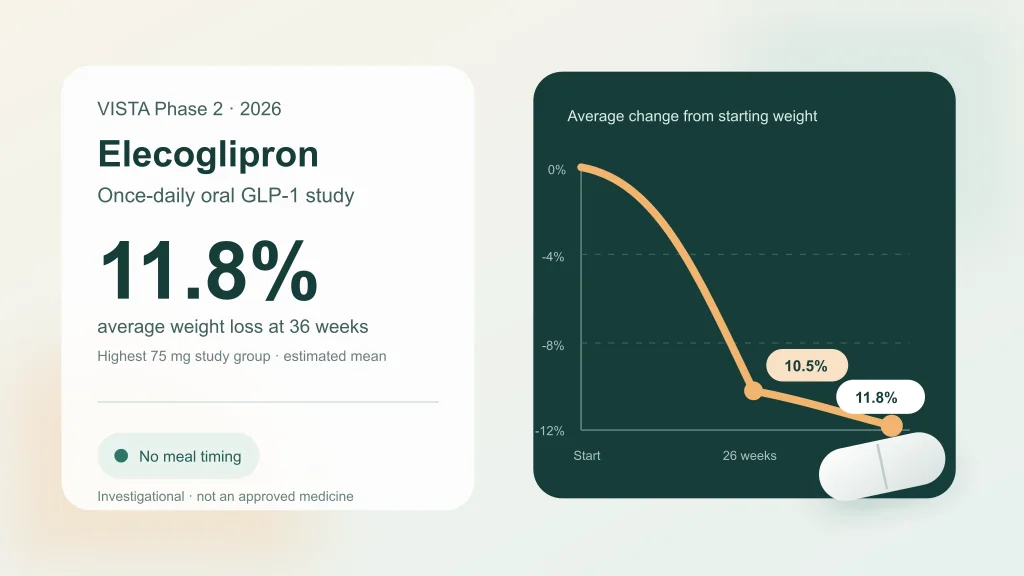
Elecoglipron produced up to 11.8% estimated average weight loss at 36 weeks in the 2026 VISTA Phase 2 trial. It is a once-daily oral small-molecule GLP-1 that was taken without food or fluid restrictions—not a peptide.
A GLP-1 pill that does not require planning breakfast or measuring a glass of water? That convenience question is the real hook behind elecoglipron. The Phase 2 result now gives people a reason to take the candidate seriously beyond the word “pill.”
What the VISTA study showed
The strongest study group kept losing weight through week 36, while the tablet remained easy to schedule.
Format
A once-daily oral small molecule.
Best result
11.8% average weight loss at 36 weeks.
Meal rules
No food or fluid restrictions in VISTA.
What is elecoglipron?
Elecoglipron, also called AZD5004, is an investigational small-molecule GLP-1 receptor agonist developed by AstraZeneca.
“Small molecule” describes how it is built. It does not describe the size of its effect. Elecoglipron can activate the GLP-1 receptor, but its chemical structure and manufacturing process are different from peptide GLP-1 drugs.
That makes the first distinction easy:
- Elecoglipron is a small molecule.
- Semaglutide is a peptide.
- Both act on the GLP-1 receptor.
- They are not the same material and should not share a purchasing specification.
What did the 2026 VISTA trial find?
VISTA was a randomized, double-blind Phase 2 study with 310 adults who had obesity, or overweight plus at least one related health condition, and did not have type 2 diabetes.
Participants received a once-daily elecoglipron tablet or placebo for 36 weeks. The study tested five active plans, including different dose-increase schedules.
| Daily study group | Average weight change at week 26 | Average weight change at week 36 |
|---|---|---|
| Elecoglipron 5 mg | -2.6% | -2.7% |
| Elecoglipron 15 mg | -5.6% | -6.5% |
| Elecoglipron 50 mg | -8.1% | -9.2% |
| Elecoglipron 75 mg, weekly increases | -10.5% | -11.8% |
| Elecoglipron 75 mg, increases every two weeks | -10.0% | -11.1% |
| Placebo | -0.6% | -0.3% |
At week 26, up to 88.8% of participants in an elecoglipron group reached at least 5% weight loss, compared with 15.6% for placebo.
The strongest average continued from 10.5% at week 26 to 11.8% at week 36. That suggests the weight curve had not fully flattened by the first main checkpoint.
Why do the food and water rules matter?
Some oral medicines have detailed timing rules because food or liquid can change how much medicine reaches the bloodstream. In VISTA, elecoglipron was taken without food or fluid restrictions.
That sounds like a small detail. For a daily product, it can be a large consumer benefit. Fewer timing rules may mean:
- an easier morning routine;
- less planning around meals;
- fewer missed tablets while traveling; and
- a simpler instruction for a large market.
Convenience does not replace efficacy or safety. It makes a proven product easier to live with if Phase 3 confirms the overall result.
Is elecoglipron a peptide?
No. Elecoglipron is not a peptide. It belongs to the growing group of oral small-molecule GLP-1 candidates.
Imagine two different keys opening the same kind of lock. The receptor is the lock. A peptide and a small molecule can be very different keys.
| Question | Elecoglipron | Semaglutide research peptide |
|---|---|---|
| Molecule type | Small molecule | Peptide |
| Main target | GLP-1 receptor | GLP-1 receptor |
| VISTA format | Daily tablet | Not the VISTA material |
| Manufacturing and identity testing | Small-molecule methods | Peptide-specific methods |
| Interchangeable? | No | No |
Read what are peptides? for the basic molecule difference and what is semaglutide? for the peptide side of the GLP-1 story.
Elecoglipron vs aleniglipron
Both are once-daily oral small-molecule GLP-1 candidates with 2026 Phase 2 results. They are still different compounds.
| Elecoglipron | Aleniglipron | |
|---|---|---|
| Other name | AZD5004 | GSBR-1290 |
| Named study | VISTA | ACCESS |
| Main study length | 36 weeks | 36 weeks |
| Largest reported average | 11.8% from baseline | 11.3% placebo-adjusted |
| Food or fluid restriction | None in VISTA | Separate study instructions apply |
The percentages should not be used as a direct winner table. VISTA and ACCESS used different participants, dose plans and statistical definitions. Their shared commercial message is stronger: the oral GLP-1 race now includes several credible small-molecule programs.
See the full aleniglipron 2026 Phase 2b results for that separate compound.
What side effects were reported?
The most common events included nausea, constipation, diarrhea, headache and vomiting. At the 75 mg level, the paper reported:
- nausea in 55% of participants versus 20% with placebo;
- constipation in 41% versus 6%;
- diarrhea in 35% versus 25%; and
- vomiting in 29% versus 5%.
Most events were described as mild or moderate. The study also tested different ways of increasing the dose because the starting plan can affect tolerability.
This is Phase 2 evidence, so larger and longer studies are still needed to understand uncommon events and long-term use.
What happens next for elecoglipron?
AstraZeneca moved elecoglipron into Phase 3 programs called EMBOLD and ELUMINATE. Later studies are expected to examine obesity, overweight and type 2 diabetes across larger groups.
Phase 3 needs to confirm three parts of the value proposition at the same time:
- meaningful weight loss;
- a tolerable plan that people can stay on; and
- real convenience from a daily pill without meal restrictions.
If all three hold up, elecoglipron could compete on routine and manufacturing scale as well as on the weight-loss percentage.
What the result means for research buyers
The expanding GLP-1 market makes one sourcing rule more important: a receptor target is not a complete product identity.
A request for “oral GLP-1” could refer to a small molecule, an oral peptide formulation or several different investigational candidates. A buyer should state the exact compound, chemical form, assay, identity method, impurity limits, packaging and intended research use.
Our oral GLP-1 peptide guide compares oral semaglutide, orforglipron, aleniglipron, and elecoglipron in one simple table.
Certiva supplies documented peptide research materials, including semaglutide. A small-molecule elecoglipron method should not be copied onto a semaglutide peptide specification. Our HPLC vs mass spectrometry guide explains why purity and identity are separate questions.
The bottom line
Elecoglipron’s direct answer is: up to 11.8% estimated average weight loss at 36 weeks from a once-daily small-molecule GLP-1 tablet taken without food or fluid restrictions in the VISTA Phase 2 trial.
That combination of result and convenience makes elecoglipron a 2026 program to watch. It remains investigational and is not a peptide or an approved medicine.
Review current semaglutide research specifications →
Sources and further reading
- The Lancet via PubMed: VISTA Phase 2 elecoglipron trial
- ClinicalTrials.gov: VISTA NCT06579092
- AstraZeneca: elecoglipron moves to Phase 3
This article explains public research reported through August 8, 2026. Elecoglipron remains investigational and is not offered here as a medicine or for personal use.
Frequently asked questions
What is elecoglipron?
Elecoglipron, also called AZD5004, is an investigational once-daily oral small-molecule GLP-1 receptor agonist that can be taken without food or fluid restrictions.
How much weight loss did elecoglipron produce?
In the 2026 VISTA Phase 2 trial, the 75 mg group with weekly dose increases produced an estimated 11.8% average weight loss at week 36, compared with 0.3% for placebo.
Is elecoglipron a peptide?
No. Elecoglipron is a small molecule, not a peptide. It activates the GLP-1 receptor but differs in structure, manufacturing and testing from peptide drugs such as semaglutide.
Does elecoglipron have food or water restrictions?
The VISTA study administered elecoglipron once daily without food or fluid restrictions. That convenience is one reason the program stands out among oral GLP-1 candidates.
What were the common elecoglipron side effects?
Common events included nausea, constipation, diarrhea, headache and vomiting. At the 75 mg level, most events were described as mild or moderate.
Is elecoglipron approved?
No. Elecoglipron remains investigational. The Phase 2 results support Phase 3 study but do not make it an approved medicine or a product for personal use.
For research use only. Not for human consumption. This article is educational and makes no medical, therapeutic, or dosing claims.
← More gLP-1 & weight management guides · Have a question? Start an inquiry →