
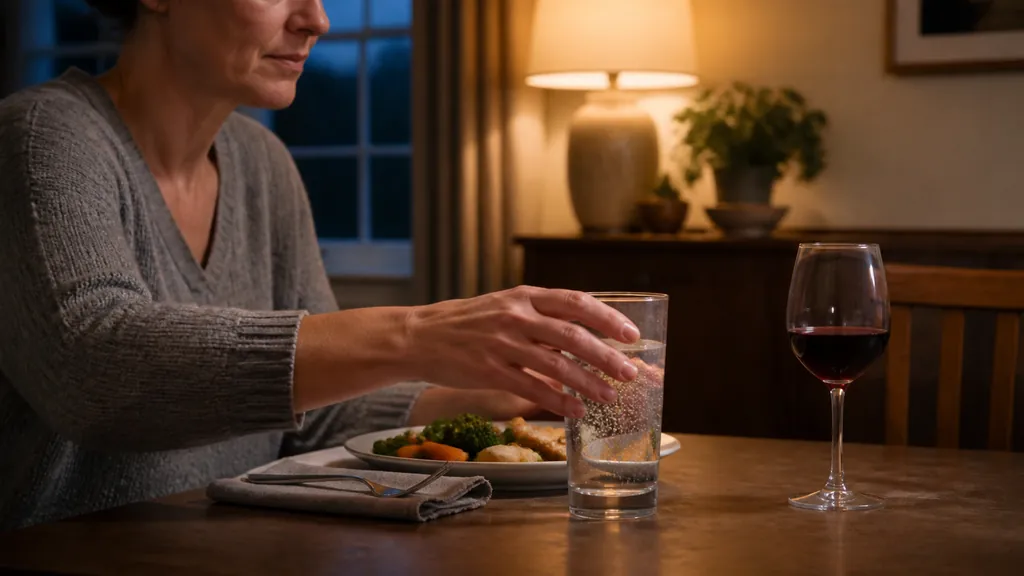
People already talk about GLP-1 medicines quieting “food noise.” A July 2026 study asked a more surprising question: could they also turn down the pull of a beer or glass of wine?
Yes. In a small randomized trial, oral semaglutide reduced heavy drinking days, drinks per drinking day and alcohol cravings reported in daily life. It did not improve every measure, and it is not an approved alcohol-use treatment, but this is now a real human research signal rather than an internet story.
What changed in the 2026 trial?
Several real-world drinking measures improved over eight weeks.
Participants
50 adults seeking help for moderate to severe alcohol use disorder.
Positive signal
Fewer heavy-drinking days, fewer drinks on drinking days and lower everyday craving.
Status
Early Phase 2 evidence, not an approved use.
What did the July 2026 study test?
The double-blind Phase 2 trial enrolled 50 adults with moderate to severe alcohol use disorder. Everyone was looking for treatment. Participants were randomly assigned to oral semaglutide or placebo for eight weeks.
The semaglutide schedule was 3 mg once daily for four weeks, followed by 7 mg once daily for four weeks. The researchers measured both reactions in a lab and what people reported in ordinary life.
| Question the study asked | Result with oral semaglutide |
|---|---|
| Did a lab alcohol cue produce less craving? | No clear difference from placebo |
| Were there fewer heavy-drinking days? | Yes |
| Were there fewer drinks on a drinking day? | Yes |
| Did daily-life alcohol craving fall? | Yes |
| Did alcohol-related negative consequences fall faster? | Yes |
| Did average drinks per day fall clearly versus placebo? | No clear difference |
This is why the clean answer is not “semaglutide makes everyone stop drinking.” The useful answer is that several meaningful real-world measures moved in the same favorable direction, even though the main laboratory craving test did not.
Why are GLP-1 researchers studying alcohol at all?
GLP-1 is best known for blood sugar, appetite and body-weight research. But the brain systems involved in appetite also overlap with systems involved in reward, motivation and learned habits.
In simple terms, researchers are asking whether a signal that makes food feel less demanding may also make alcohol feel less demanding. That does not mean hunger and addiction are the same thing. It means some of the brain circuits talk to each other.
The 2026 oral trial follows earlier work:
- a 2025 randomized study of weekly semaglutide found less alcohol consumed in a laboratory task and lower weekly craving;
- a larger 2026 trial in adults with obesity and alcohol use disorder found a greater reduction in heavy-drinking days with weekly semaglutide; and
- new registered studies are testing semaglutide alone or with established alcohol-use treatments.
One small trial can be a coincidence. Several trials pointing in a similar direction are a reason to keep studying the question.
For a plain-English guide to the molecule itself, read what semaglutide is. Our article on GLP-1 hunger and food noise explains the appetite side of the story.
Does this mean semaglutide treats alcohol addiction?
Not yet. Semaglutide is not approved for alcohol use disorder, and the July trial included only 50 people for eight weeks.
The results do support a direct next question: will the benefit remain in a larger, longer and more diverse group? Researchers also need to learn:
- which people are most likely to respond;
- whether the effect lasts after treatment changes;
- how much of the change comes from weight loss versus reward pathways;
- how semaglutide compares with existing alcohol-use treatments; and
- whether a combination approach is more useful than either treatment alone.
That work is already moving forward. A Johns Hopkins study updated in July 2026 is preparing to examine a GLP-1 agonist with naltrexone, while other registered trials are studying semaglutide in specific patient groups.
What should someone taking a GLP-1 medicine do with this news?
Treat it as research news, not a reason to change a prescription.
Alcohol can add its own risks, and individual guidance depends on the medicine, health history and pattern of alcohol use. A prescribing clinician is the right person to answer personal safety questions. People who may be physically dependent on alcohol should not suddenly stop without medical advice because withdrawal can be dangerous.
The commercial hook is still important: people are no longer searching only for “how much weight can I lose?” They are searching for food noise, cravings, reward and everyday behavior. Brands and research suppliers that explain the evidence in simple language can answer that growing set of questions without turning an early result into a treatment claim.
Why oral semaglutide does not make this a non-peptide story
Semaglutide is a peptide whether it is studied as an injection or in an oral formulation. The delivery system changes; the molecule does not turn into a small-molecule GLP-1 drug.
That distinction matters because the 2026 market now contains both oral peptide formulations and oral non-peptide GLP-1 candidates. Our guide is an oral GLP-1 a peptide? separates those two categories.
For laboratory buyers, “oral semaglutide study” also does not mean raw research material and a finished tablet are interchangeable. Verify:
- exact compound name and chemical form;
- raw material versus formulated presentation;
- batch-specific HPLC purity and mass-spectrometry identity;
- assay or peptide content when the project requires it;
- storage, handling and stability information; and
- a current COA that matches the supplied lot.
The peptide quality-testing guide explains which document and test answer each question.
The simple takeaway
Semaglutide reduced heavy drinking days, drinks per drinking day and everyday alcohol cravings in a small 2026 oral trial. That supports the growing idea that GLP-1 research may extend beyond appetite and body weight.
It is an interesting new use under investigation, not an approved alcohol-use treatment. The next proof will come from larger and longer trials.
Review semaglutide research specifications →
Sources and further reading
- American Journal of Psychiatry / PubMed: oral semaglutide randomized trial
- ClinicalTrials.gov: oral semaglutide trial NCT05892432
- The Lancet / PubMed: weekly semaglutide in alcohol use disorder and obesity
- ClinicalTrials.gov: semaglutide and naltrexone combination study
This article explains public research available through August 17, 2026. It does not provide personal medical advice or recommend changing prescribed treatment.
Frequently asked questions
Does semaglutide reduce alcohol cravings?
Yes, semaglutide reduced daily-life alcohol cravings in a small 2026 randomized trial. It also reduced heavy drinking days and drinks per drinking day, although the study did not find a significant improvement in its laboratory craving test.
What did the 2026 oral semaglutide alcohol trial find?
In 50 adults with moderate to severe alcohol use disorder, eight weeks of oral semaglutide reduced heavy drinking days, drinks per drinking day, daily-life craving and alcohol-related consequences compared with placebo.
Did semaglutide make people stop drinking completely?
The study was not an abstinence trial and did not show that everyone stopped drinking. It found improvement in several drinking measures over eight weeks, not a guaranteed cure.
Is semaglutide approved to treat alcohol use disorder?
No. Semaglutide is not approved as a treatment for alcohol use disorder. The 2026 trial was an early Phase 2 study, and larger studies are still needed.
Can semaglutide and alcohol be used together safely?
That question depends on the person, the prescribed product and their health history. Anyone taking a prescription GLP-1 medicine should ask the prescribing clinician for personal guidance rather than changing treatment or drinking habits from an article.
What should a semaglutide research buyer verify?
Verify the exact molecule and form, batch number, HPLC purity, mass-spectrometry identity, assay when required, storage conditions, test dates and the current batch COA before approving a research order.
For research use only. Not for human consumption. This article is educational and makes no medical, therapeutic, or dosing claims.
← More gLP-1 & weight management guides · Have a question? Start an inquiry →