


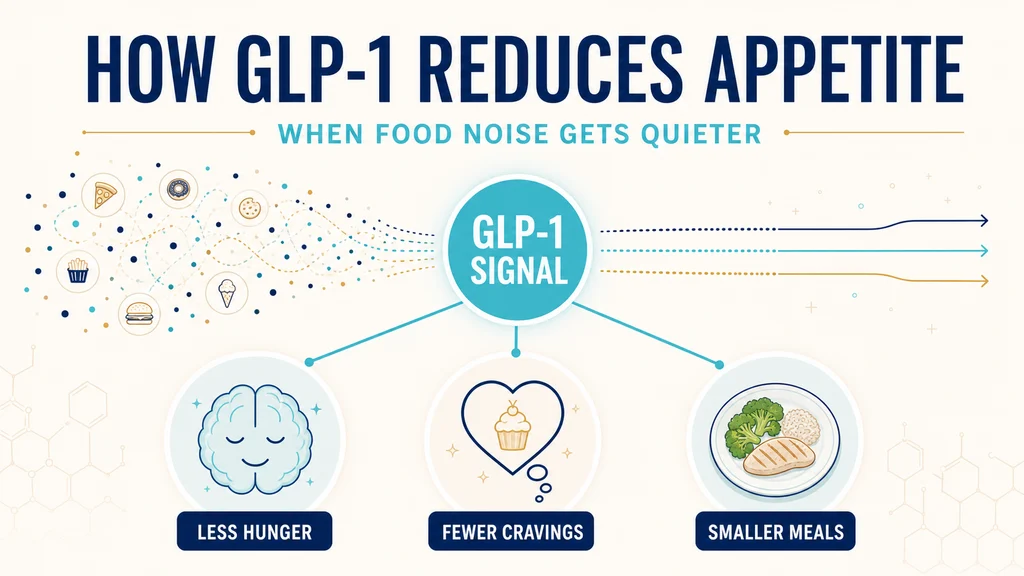
GLP-1 medicines can make hunger feel less urgent, help a smaller meal feel satisfying and quiet some of the mental pull of food. They can also make a previously appealing food seem uninteresting—or, for some people, actively unpleasant. Those experiences are related, but they are not interchangeable.
The distinction matters. Less hunger is an expected appetite effect. Food aversion can overlap with nausea, reflux, smell or taste changes and may become a problem if it makes eating or drinking difficult.
Hunger, satiety, food noise and food aversion are different
People often use one word—“appetite”—for several different experiences. A more useful way to read both personal reports and clinical research is to separate them.
| Experience | What it usually means |
|---|---|
| Hunger | The physical or mental drive to eat |
| Satiety | The feeling that a meal was enough |
| Food noise | Repeated thoughts, anticipation or cravings involving food |
| Food aversion | A food feels actively unappealing, sometimes with nausea or a sensory change |
“Food noise” is everyday language, not a diagnosis or a standardized trial endpoint. Researchers are more likely to measure hunger, cravings, food preoccupation, control of eating and responsiveness to food cues. The popular phrase is useful, provided it is not treated as a precise medical term.
Why can GLP-1 signaling reduce hunger?
GLP-1 is a hormone released by the gut after food arrives. It helps coordinate the response to a meal by signaling in the brain, digestive tract and pancreas. Natural GLP-1 is broken down quickly. GLP-1 receptor agonists extend that signal.
In the brain, GLP-1-related pathways influence hunger, reward and meal termination. In the digestive system, slower stomach emptying can help fullness last, especially early in treatment. Together, those effects can make smaller meals feel more satisfying and reduce the pull of cravings.
It is therefore incomplete to say that these medicines work only because “food sits in the stomach.” The gut and brain are both part of the explanation.
A small randomized 2026 study carried that reward question into another everyday behavior. Read what it found about semaglutide and alcohol cravings.
What have human studies actually measured?
The strongest answer does not rely only on anecdotes. Researchers have weighed food eaten at controlled meals and used structured questionnaires to record hunger, cravings and control of eating.
| Study | What researchers observed |
|---|---|
| 12-week semaglutide crossover trial | Total energy intake across lunch, dinner and snacks was 24% lower than with placebo; hunger and cravings also improved |
| 60-week semaglutide trial | Participants ate fewer calories at measured meals through week 60, even though some subjective appetite differences became less pronounced over time |
| Six-week tirzepatide trial | Energy intake at a test lunch was about 525 calories lower than placebo at week three, with lower hunger, cravings and reactivity to food cues |
These trials support a real reduction in appetite and food intake. They do not show that every person experiences the same degree of change, nor do they make “food noise” or food aversion guaranteed effects.
The 60-week result is especially helpful because it separates an early, noticeable feeling from a longer behavioral effect. A person may become less aware of the appetite difference over time while still eating less at a measured meal.
Why can food begin to feel different?
Recent research describes several changes that can overlap: earlier fullness, less wanting, lower reward value, altered food preference and gastrointestinal symptoms. A rich meal may simply feel less rewarding. A strong smell may become unpleasant. In another case, a food may be avoided because it was followed by nausea or reflux.
That is why “GLP-1 food aversion” does not have one universal mechanism. Clinical trials generally do not measure it as a single standardized outcome. A 2026 review of eating experiences during GLP-1 treatment also found that sensory changes, liking, wanting, early satiety and nausea are often difficult to separate, and that the evidence is still uneven.
The practical reading is cautious: reduced interest in food can be consistent with the drug class, but a persistent inability to eat or drink is not a result to pursue.
Does the effect change over time?
It can. Slower stomach emptying may be more noticeable near the beginning, and subjective hunger scores do not always remain as dramatically different later. That does not necessarily mean the broader appetite effect has disappeared.
Longer semaglutide data found lower measured food intake at weeks 20, 40 and 60. This suggests that the experience can evolve: the initial “I am never hungry” feeling may soften while meal size or eating behavior remains different.
When reduced appetite deserves medical attention
Finished GLP-1 medicines can cause gastrointestinal adverse effects including nausea, vomiting, diarrhea, constipation and abdominal discomfort. Reduced appetite needs clinical attention when it is accompanied by persistent vomiting, difficulty maintaining food or fluids, symptoms of dehydration, severe abdominal symptoms or another concerning change.
A licensed clinician and the current prescribing information for the specific medicine should guide treatment decisions. This article explains research; it does not replace individual medical care.
Where semaglutide, tirzepatide and retatrutide fit
Semaglutide activates the GLP-1 receptor. Tirzepatide combines GIP and GLP-1 receptor activity. Retatrutide adds glucagon-receptor activity to those two signals and remains investigational as of this update.
Their receptor profiles differ, so a result from one molecule should not be quietly assigned to another. For a direct evidence comparison, see our semaglutide vs tirzepatide guide. For the separate amylin pathway, begin with what cagrilintide is.
Certiva supplies lyophilized laboratory research references, not finished prescription medicines. They are not for human consumption.
Sources and further reading
- Semaglutide appetite and measured energy-intake trial
- Semaglutide appetite and energy intake through 60 weeks
- Tirzepatide ingestive-behavior randomized trial
- Systematic review of GLP-1 appetite and gastric-emptying studies
- Stanford Medicine: patient experiences of quieter “food noise”
- FDA: Wegovy prescribing information
Frequently asked questions
How does GLP-1 affect hunger and appetite?
GLP-1 signaling can reduce hunger, strengthen fullness after eating and lessen cravings. Human trials have also measured lower food intake, so the effect is not based only on how participants describe their appetite.
What is food noise?
Food noise is an informal term for frequent, distracting thoughts about food, eating or the next meal. It is not a medical diagnosis, although it overlaps with outcomes researchers describe as food preoccupation, cravings and control of eating.
Is food aversion the same as reduced hunger?
No. Reduced hunger means less drive to eat. Food aversion means a food feels actively unappealing and may overlap with nausea, smell or taste changes, reflux or an unpleasant experience after eating.
Does GLP-1 make people eat less?
Yes. Randomized studies of semaglutide and tirzepatide have measured lower energy intake as well as lower hunger and cravings.
Is the appetite effect only caused by slower stomach emptying?
No. Slower stomach emptying can contribute to fullness, particularly earlier in treatment, but GLP-1 also acts on appetite pathways in the brain.
When is reduced appetite a reason to contact a clinician?
Contact a licensed clinician if reduced appetite is accompanied by persistent vomiting, an inability to maintain food or fluid intake, signs of dehydration, severe abdominal symptoms or another concerning change. Follow the current prescribing information for the specific medicine.
For research use only. Not for human consumption. This article is educational and makes no medical, therapeutic, or dosing claims.
← More gLP-1 & weight management guides · Have a question? Start an inquiry →