


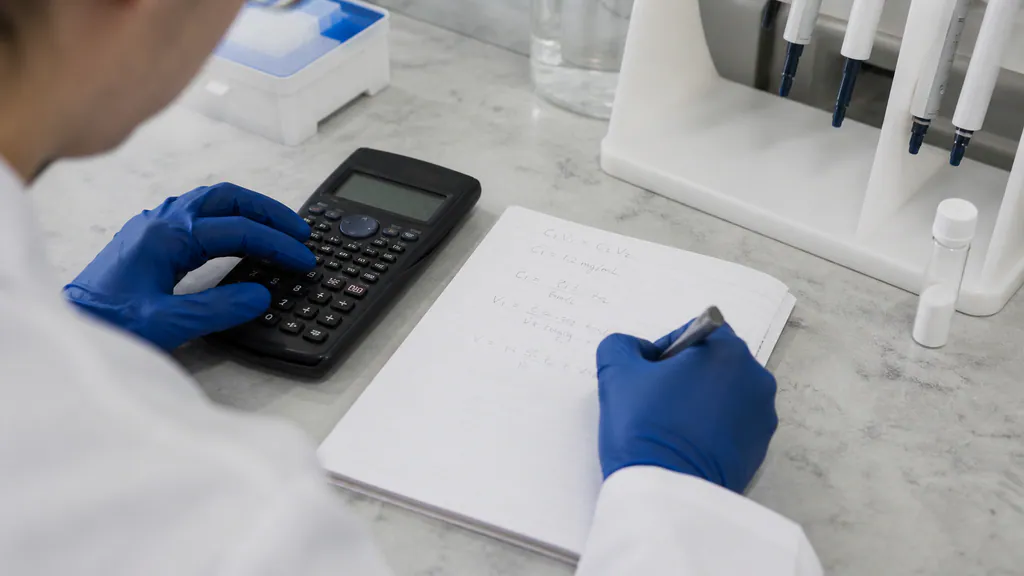
There is no established, FDA-approved human dosage for BPC-157. A calculator cannot determine a safe or effective amount where clinical evidence and approved labeling do not exist.
What it can do is check arithmetic. Enter a vial mass, total liquid volume and a reference amount that comes from an appropriate laboratory protocol; the tool will show concentration and the corresponding volume without selecting or recommending any of those inputs.
Open the concentration calculator →
What the calculator can and cannot answer
| It can calculate | It cannot determine |
|---|---|
| mg-to-mcg conversion | A human dose |
| Concentration from labeled mass and total volume | Safety, effectiveness or suitability |
| Volume corresponding to a visitor-supplied reference amount | A schedule, route or protocol |
| U-100 volume-scale equivalent when that scale is verified | Product identity, purity or sterility |
This boundary matters because pages ranking for “BPC-157 dosage calculator” often combine neutral vial math with unsupported dosing schedules. The equation does not validate the number entered into it.
The three inputs behind the result
The first input is the labeled vial mass, usually written in milligrams (mg). The second is the total liquid volume in milliliters (mL). Together they determine concentration.
The third input is a reference amount supplied by the visitor. For research work, that value should already exist in an appropriate protocol or other qualified source. The calculator does not generate it.
Keep the unit relationship visible:
| Unit | Equivalent |
|---|---|
| 1 milligram (mg) | 1,000 micrograms (mcg) |
| 1 microgram (mcg) | 0.001 milligram (mg) |
| 1 milliliter (mL) | 1,000 microliters (µL) |
The National Institute of Standards and Technology explains the SI prefixes behind these conversions. “Milli” represents one-thousandth; “micro” represents one-millionth. That is why a milligram contains 1,000 micrograms.
The concentration formula
The core equation is:
labeled vial mass ÷ total liquid volume = concentration
If a vial is labeled 5 mg and the total volume is 2 mL, its calculated concentration is 2.5 mg/mL. This example checks concentration only; it does not state or imply an amount to use.
To express the same concentration in mcg/mL, multiply mg/mL by 1,000. The physical mixture has not changed—only the unit used to describe it.
Once a separate reference amount has been supplied, the volume equation is:
reference amount ÷ concentration = liquid volume
The units must match before division. Use mg with mg/mL, or mcg with mcg/mL. Dividing mcg by mg/mL without first converting one side creates a thousand-fold error.
What a U-100 conversion means
On a verified U-100 volume scale, 100 markings correspond to 1 mL. The mathematical conversion is therefore:
volume in mL × 100 = U-100 marked units
A marking is not a unit of BPC-157 mass. The peptide mass represented by the same marking changes whenever the vial mass or total liquid volume changes. Copying a final marking without the original concentration discards the information needed to verify it.
The calculator’s U-100 output should be used only when the physical scale is actually confirmed as U-100. Other laboratory devices and syringes can use different graduations.
Why “dosage calculator” is a misleading name
Searchers commonly use the phrase, so this page answers it directly. Scientifically, however, the tool is a mass–concentration–volume calculator.
A dose recommendation requires evidence about the substance, formulation, route, population, risks and intended use. BPC-157 has no FDA-approved prescribing information that supplies those answers. Arithmetic can catch a unit error, but it cannot convert an investigational compound into an approved treatment.
The FDA has also identified safety-related concerns for BPC-157 as a bulk substance proposed for compounding, including possible immunogenicity, peptide-related impurities and limited human safety information. In July 2026, an FDA advisory committee voted to recommend adding BPC-157 to the Section 503A bulks list. That recommendation is nonbinding: it did not approve BPC-157, establish a human dosage or by itself change the formal list.
Five errors the visible formula helps catch
Confusing total mass with concentration. A 5 mg label states the total labeled mass. It does not mean 5 mg/mL unless the total volume is 1 mL.
Mixing mg and mcg. Convert both values to the same mass unit before dividing.
Treating a U-100 marking as peptide mass. The scale expresses volume. Concentration is still needed to connect that volume to mass.
Leaving out total volume. The same labeled vial mass can produce different concentrations when total liquid volume changes.
Starting with somebody else’s final number. A volume or marking cannot be audited without the vial mass, total volume, reference amount and units that produced it.
For a fuller explanation of the liquid-volume input, see how much bacteriostatic water to add to a peptide vial. That page also separates neutral math from protocol decisions.
How blended vials change the calculation
A BPC-157 and TB-500 blend has at least two relevant descriptions: total labeled mass and the labeled mass of each component. If a vial states only a combined total, the calculator can determine total concentration but cannot infer how the total is divided.
When component amounts are listed separately, calculate each component’s concentration from its own mass and the same total liquid volume. Do not apply the combined concentration to one component. Our BPC-157 vs TB-500 guide explains why the names should remain separate even when they share a vial.
Where the COA fits
The calculator checks numbers entered by the visitor. It does not verify that the vial contains the labeled material or that a batch meets a specification. Those are documentation and testing questions.
For laboratory procurement, match the product name and lot on the vial to the applicable batch report. The BPC-157 research guide covers specification and sourcing questions, while the peptide COA guide explains how to inspect a batch-linked report.
Research peptides are supplied for laboratory research use only and are not for human consumption. This calculator is an educational arithmetic tool, not medical advice.
Sources and further reading
- FDA: Certain Bulk Drug Substances for Use in Compounding That May Present Significant Safety Risks
- FDA: July 23–24, 2026 Pharmacy Compounding Advisory Committee meeting
- FDA briefing document: BPC-157 evaluation
- ABC News: advisory committee vote and its nonbinding status
- NIST: SI Units—Prefixes
Frequently asked questions
Is there an established human BPC-157 dosage?
No. BPC-157 is not an FDA-approved drug, and there is no FDA-approved labeling that establishes a human dose, schedule or route. A calculator cannot supply the missing clinical evidence.
What does the BPC-157 calculator calculate?
It uses visitor-supplied values to calculate concentration, the liquid volume corresponding to an entered reference amount and, when applicable, the mathematical equivalent on a verified U-100 volume scale.
Does the calculator recommend a BPC-157 dose?
No. It does not choose an amount, schedule, protocol, route or method of administration. It only performs unit and concentration conversions.
How many micrograms are in 1 milligram?
One milligram equals 1,000 micrograms. Mixing mg and mcg without converting them first creates a thousand-fold error.
Are U-100 markings the same as milliliters?
No. On a verified U-100 scale, 100 marked units correspond to 1 mL. The markings describe liquid volume, not peptide mass.
Can the calculator handle a BPC-157 and TB-500 blend?
It can calculate the total concentration from a stated total mass, but each component requires separate labeled amounts to calculate component-specific concentration. A combined total cannot reveal the ratio by itself.
For research use only. Not for human consumption. This article is educational and makes no medical, therapeutic, or dosing claims.
← More peptide basics guides · Have a question? Start an inquiry →