


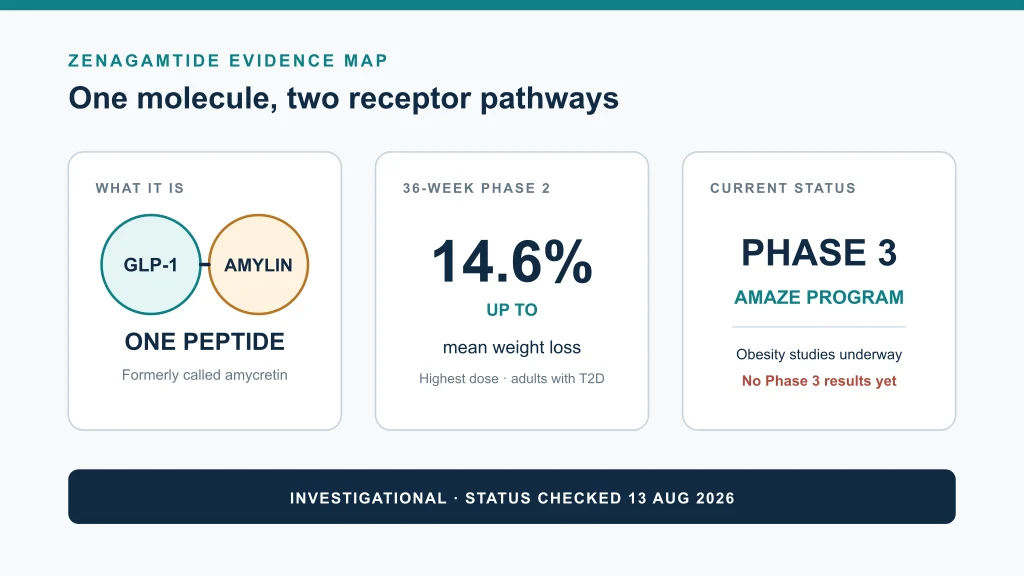
Zenagamtide is an investigational single-molecule peptide that activates both GLP-1 and amylin receptors. Novo Nordisk previously called it amycretin, and trial records may use the code NNC0487-0111.
The highest dose in a 36-week Phase 2 study produced 14.6% average weight loss in adults with type 2 diabetes, according to the sponsor. The injectable obesity program is now in Phase 3, but zenagamtide remains unapproved as of August 13, 2026.
Zenagamtide status at a glance
| Question | Current answer |
|---|---|
| What is it? | A unimolecular GLP-1 and amylin receptor agonist |
| Other names | Amycretin; NNC0487-0111 |
| Formulations under study | Subcutaneous and oral |
| Most cited Phase 2 result | Up to 14.6% mean weight loss at week 36 in the highest-dose group with type 2 diabetes |
| Development status | Phase 3 obesity studies underway or registered; type 2 diabetes Phase 3 program planned for H2 2026 |
| Approval status | Investigational; not approved |
The wording matters. “In Phase 3” does not mean that a Phase 3 result exists, and it does not mean regulatory approval is close or guaranteed.
How does zenagamtide work?
Zenagamtide is designed to carry two receptor activities in one peptide molecule. GLP-1 signaling is involved in glucose-dependent insulin secretion, appetite and gastric emptying. Amylin signaling contributes to satiety and the response to a meal.
Combining the pathways in one molecule is the defining feature. It differs from a co-formulation in which two separate active molecules are administered together. That design is scientifically interesting, but the clinical balance of efficacy, tolerability and dose can only be established through controlled trials.
What did the 36-week Phase 2 study find?
Novo Nordisk’s randomized dose-finding study evaluated once-weekly subcutaneous zenagamtide against placebo in 262 adults whose type 2 diabetes was inadequately controlled with metformin, with or without an SGLT2 inhibitor.
The company reported the following results at week 36:
| Outcome | Sponsor-reported result |
|---|---|
| Highest dose studied | 40 mg once weekly |
| Mean body-weight change | Up to −14.6% at the highest dose |
| HbA1c change | Statistically significant reductions across evaluated doses |
| Participants reaching HbA1c below 7% | Up to 89.1% |
These are Phase 2, dose-finding results in adults with type 2 diabetes. They should not be presented as an approved treatment outcome or silently generalized to all people with obesity.
Novo Nordisk reported that gastrointestinal adverse events were the most common and were generally mild to moderate. A larger and longer Phase 3 program is needed to characterize safety, discontinuation and durability more fully.
What did the earlier human trial establish?
The first-in-human program enrolled 144 adults with overweight or obesity and studied single and multiple ascending doses of oral and subcutaneous amycretin. The peer-reviewed report described dose-dependent gastrointestinal events and supported further clinical development.
That Phase 1 trial answered an early safety, tolerability and pharmacokinetic question. Its exploratory weight findings were promising, but the study was not designed to provide the kind of comparative effectiveness evidence expected from Phase 3.
Which Phase 3 zenagamtide trials are registered?
The Phase 3 program is a group of studies rather than one trial.
| Study | Population and comparison | Registry status or timing as of this update |
|---|---|---|
| AMAZE 1 — NCT07339423 | About 1,150 participants with obesity; weekly NNC0487-0111 vs placebo | Recruiting; actual start February 24, 2026 |
| AMAZE 7 — NCT07668414 | About 650 participants with obesity; zenagamtide vs semaglutide | Start estimated for September 2026 |
| NCT07567001 | About 5,610 participants with obesity and HFpEF/HFmrEF; morbidity and mortality study | Phase 3; estimated completion in 2029 |
Novo Nordisk has also said that the AMBITION Phase 3 program in type 2 diabetes was planned to begin in the second half of 2026. Because registries change, the linked records—not an undated summary—should be used for enrollment status and milestones.
No Phase 3 efficacy result is available from these studies yet.
Is zenagamtide an injection or a tablet?
Both subcutaneous and oral formulations have been investigated. The Phase 2 result summarized above concerns a once-weekly injection, and the registered AMAZE examples in this article also use subcutaneous dosing.
An oral peptide program has different delivery and exposure questions, so results from one formulation should not automatically be assigned to the other. Always check the formulation, dose schedule, population and endpoint before comparing trial figures.
Zenagamtide vs CagriSema
The two programs combine GLP-1 and amylin biology in different ways.
| Zenagamtide | CagriSema | |
|---|---|---|
| Molecular format | One molecule with GLP-1 and amylin receptor activity | Fixed-dose combination of semaglutide and cagrilintide |
| Number of active molecules | One | Two |
| Evidence should be compared as | Zenagamtide’s own trial program | CagriSema’s own trial program |
Neither molecular format is automatically superior. Cross-trial weight-loss percentages are also not head-to-head evidence because populations, durations, doses and statistical estimands can differ. Our cagrilintide vs semaglutide guide explains the two component pathways behind the separate-molecule approach.
What we know—and what remains unanswered
The established facts are that zenagamtide is a dual GLP-1/amylin peptide, the sponsor reported a dose-responsive 36-week Phase 2 signal, and several Phase 3 studies are underway or registered. The unresolved questions include the best long-term dose, discontinuation rate, durability, comparative performance and the full safety profile across larger populations.
Zenagamtide is not a Certiva product and is not offered for personal use. This page is an evidence summary of an investigational clinical program. Readers following the wider pipeline can compare the distinct mechanisms in our guides to cagrilintide, retatrutide and MariTide.
Primary sources
- Novo Nordisk: 36-week Phase 2 zenagamtide results
- Peer-reviewed first-in-human amycretin trial
- ClinicalTrials.gov: AMAZE 1, NCT07339423
- ClinicalTrials.gov: AMAZE 7, NCT07668414
- ClinicalTrials.gov: heart-failure outcomes study, NCT07567001
Frequently asked questions
What is zenagamtide?
Zenagamtide, formerly known as amycretin, is Novo Nordisk's investigational single-molecule peptide agonist of the GLP-1 and amylin receptors.
Is zenagamtide the same as amycretin?
Yes. Zenagamtide is the newer name for amycretin. Clinical-trial records may also identify the molecule as NNC0487-0111.
What did the zenagamtide Phase 2 trial report?
Novo Nordisk reported up to 14.6% average weight loss at 36 weeks with the highest 40 mg once-weekly dose in 262 adults with type 2 diabetes. The company also reported substantial HbA1c reductions.
Is zenagamtide in Phase 3?
Yes. The subcutaneous obesity program is in Phase 3. AMAZE 1 began in February 2026, while additional registered studies include a planned comparison with semaglutide. The type 2 diabetes Phase 3 program was planned to begin in the second half of 2026.
Is zenagamtide approved?
No. Zenagamtide remains investigational and cannot be prescribed as an approved medicine as of August 13, 2026.
How is zenagamtide different from CagriSema?
Zenagamtide combines GLP-1 and amylin receptor activity in one molecule. CagriSema is a fixed-dose combination of two separate molecules, semaglutide and cagrilintide.
For research use only. Not for human consumption. This article is educational and makes no medical, therapeutic, or dosing claims.
← More gLP-1 & weight management guides · Have a question? Start an inquiry →