


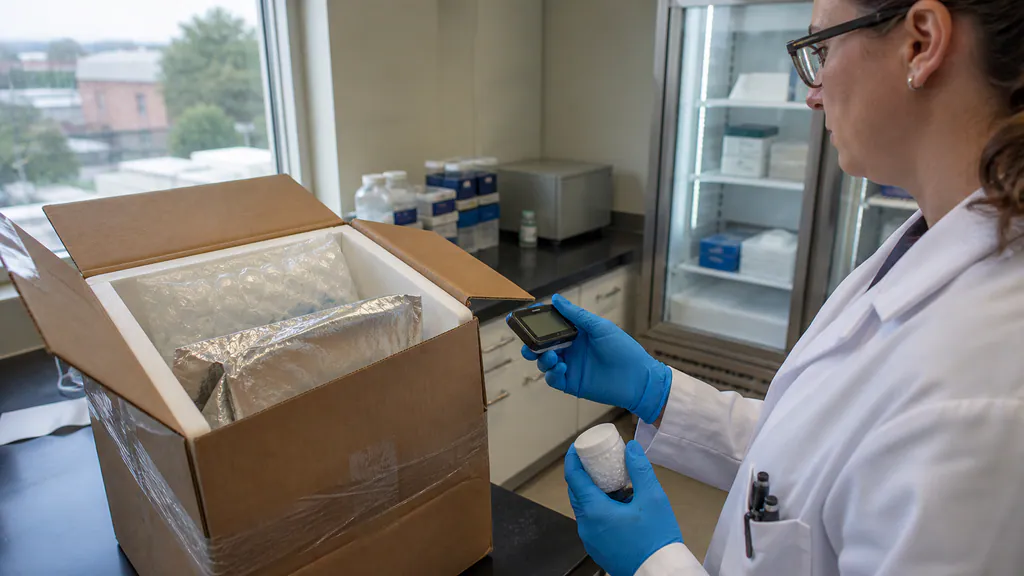
Peptide storage and shipping is a controlled system for keeping a specific research material within its approved specification from batch release through transport, receiving, warehouse storage, sampling, and laboratory use.
The right condition is not always “keep everything frozen,” and one warm package does not automatically mean the peptide is unusable.
The correct approach connects:
- the exact peptide and physical form;
- degradation risks;
- container and closure;
- material-specific stability data;
- numeric storage conditions;
- shipping route and duration;
- temperature-monitoring evidence;
- receiving and excursion procedures; and
- the period after opening or solution preparation.
This guide is for laboratory and B2B handling of research-use-only peptide materials. It does not provide instructions for human administration, self-injection, medication storage, or dosing. Certiva peptide materials are for laboratory research use only and are not for human consumption.
Why peptide storage cannot be reduced to one temperature
Peptides are diverse molecules. Sequence length, amino-acid composition, terminal modifications, disulfide bonds, aggregation tendency, counterion, residual water, excipients, concentration, pH, oxygen, light, container, and physical form can all change stability behavior.
A short lyophilized peptide in a sealed vial may respond differently from:
- the same peptide in solution;
- a multi-peptide blend;
- a peptide with oxidation-sensitive residues;
- a fluorescently labeled peptide;
- a hygroscopic powder;
- a high-concentration solution;
- a peptide stored in a repeatedly opened container; or
- a finished research vial exposed to uncontrolled moisture.
That is why storage advice should be batch- and format-aware. Generic guidance can support risk assessment, but the label, specification, and stability evidence for the actual material should control.
The complete peptide stability model
Think of peptide stability as a relationship among five elements:
- Material: sequence, form, purity, content, water, excipients, and impurities.
- Container: vial, stopper, seal, headspace, light barrier, and moisture protection.
- Environment: temperature, humidity, light, oxygen, vibration, and time.
- Handling: opening, sampling, solution preparation, transfers, and freeze-thaw cycles.
- Evidence: release results, stability studies, shipping studies, excursion data, and ongoing monitoring.
Changing one element can invalidate assumptions based on another. Stability in a sealed amber vial does not automatically transfer to a clear tube. Stability of a lyophilized solid does not automatically establish stability in solution. A shipping test with one insulated box does not qualify a different box size and summer route.
Storage, shipping, shelf life, and stability at a glance
| Term | Practical meaning | Evidence needed | Common mistake |
|---|---|---|---|
| Storage condition | Environment intended for routine holding | Stability and packaging rationale | Copying a competitor’s temperature |
| Shipping condition | Environment and packout used during transport | Route/packout qualification plus stability knowledge | Assuming storage and shipping must be identical |
| Shelf life / expiry | Period a finished product is expected to remain within specification | Long-term stability under labeled conditions | Deriving two years from one release COA |
| Retest period | Time before material should be tested again | Stability program and retest procedure | Treating retest as guaranteed expiry |
| Excursion | Exposure outside the defined condition | Actual time/temperature plus excursion assessment | Automatically accepting or destroying material |
| Cold chain | Controlled temperature system across custody changes | Equipment, packaging, monitors, procedures and records | Thinking dry ice alone creates control |
| Stability-indicating method | Method capable of detecting meaningful degradation | Method-development and specificity evidence | Repeating a non-specific release test |
| After-opening period | Controlled period after the original container is opened | Handling and in-use evidence | Applying unopened stability to repeatedly sampled material |
Precise terms prevent teams from making silent assumptions.
Lyophilized peptide vs peptide in solution
Physical form is one of the biggest stability variables.
Lyophilized research peptide
Lyophilization removes much of the water by freezing the solution and reducing pressure so ice sublimes. The resulting cake or powder can reduce molecular mobility and slow some degradation pathways.
Lyophilized does not mean:
- zero water;
- unlimited stability;
- no need for temperature control;
- resistance to light or oxygen;
- tolerance of repeated opening;
- identical performance across containers; or
- suitability for human use.
Residual moisture remains a quality attribute. Stopper integrity and storage humidity matter because moisture can enter a compromised container.
Peptide solution
Once a peptide is in solution, hydrolysis, oxidation, deamidation, aggregation, adsorption, pH effects, and microbial concerns can change. The solution may have a much shorter supported period than the unopened lyophilized material.
Solution stability depends on:
- solvent and buffer;
- pH;
- concentration;
- ionic strength;
- excipients;
- container surface;
- headspace and oxygen;
- light;
- temperature;
- mixing;
- microbial controls; and
- number of freeze-thaw cycles.
No universal “use within X days” rule applies to every research peptide solution. Use a project-specific protocol and supporting data.
Two separate stability clocks
A useful record tracks at least:
- the unopened material’s manufacture, release, and retest or expiry timeline; and
- the after-opening or after-solution-preparation timeline.
Opening the container or preparing a solution creates a new handling state. The unopened date does not answer how long the changed material remains suitable.
The peptide shelf-life guide explains these two clocks in more detail.
How temperature affects peptide stability
Lower temperature often slows chemical reaction rates and molecular motion, which is why cold storage is common. But “colder” is not always automatically “better.”
Potential temperature-related risks include:
- accelerated degradation at high temperature;
- freeze concentration and pH shifts in solution;
- precipitation or aggregation;
- container stress;
- stopper movement;
- repeated condensation;
- freeze-thaw damage;
- brittle packaging; and
- labels or adhesives failing at low temperature.
Numeric ranges matter
“Keep cold” is ambiguous. A controlled instruction should give a numeric range or recognized storage term supported by the applicable evidence.
USP <659> provides definitions relevant to packaging and storage of active
ingredients and medical products. For research procurement, it is still wise to
write the actual expected range in the purchase and warehouse record.
Air temperature vs product temperature
A logger measures temperature at its own location. Product temperature can lag behind air temperature because of insulation, thermal mass, refrigerant, box position, and time.
During a short door opening, freezer air may warm rapidly while a sealed vial remains cold. During a long delay, the package interior and product eventually follow the environment.
Excursion assessment should therefore consider:
- logger location;
- package configuration;
- product quantity;
- refrigerant;
- duration;
- peak temperature;
- starting condition; and
- available thermal-profile data.
Moisture control
Moisture can affect lyophilized peptide content, physical appearance, dissolution, and chemical stability.
Moisture sources
- residual water after lyophilization;
- permeation through the container system;
- compromised stopper or seal;
- humid air during opening;
- condensation on a cold vial;
- repeated sampling;
- wet tools or transfer containers; and
- storage with inadequate desiccant or barrier packaging.
Condensation risk
Removing a very cold container into humid air can cause water to condense on the outside and, if opened before temperature equilibration, potentially enter the container.
A laboratory handling procedure can require sealed containers to equilibrate appropriately before opening, while keeping the batch protected and tracking time outside storage. The exact procedure should reflect the material and container.
Water testing
Karl Fischer titration is a common method for water content. Stability trending can show whether moisture changes over time or after packaging changes.
Desiccants
A desiccant can protect secondary packaging but does not repair a defective primary container. Define desiccant type, amount, placement, indicator if used, replacement, and safety controls.
Light and oxygen
Some peptides or labels are light sensitive. Oxidation-sensitive residues can also respond to oxygen, peroxides, metals, or repeated headspace exchange.
Light protection
Options include:
- amber primary containers;
- opaque secondary packaging;
- foil pouches;
- controlled laboratory lighting;
- limited exposure time; and
- “protect from light” labeling.
Light protection should follow actual risk. An amber vial is not a substitute for a stability study, and a clear vial is not automatically unacceptable when secondary packaging provides validated protection.
Oxygen control
Depending on the material, controls can include:
- minimized headspace;
- inert-gas overlay;
- oxygen-barrier packaging;
- antioxidant or chelator in a defined formulation;
- low-peroxide excipients;
- controlled opening; and
- suitable closure integrity.
Changes to headspace, stopper, fill, or formulation can affect stability and should enter change control.
Peptide degradation pathways
Understanding likely degradation helps select stability tests.
Oxidation
Residues such as methionine, cysteine, tryptophan, tyrosine, or histidine may be susceptible under particular conditions. Oxygen, light, metals, and peroxides can contribute.
Deamidation
Asparagine and glutamine residues can undergo deamidation depending on sequence, pH, temperature, and water activity.
Hydrolysis
Peptide bonds or side-chain modifications can hydrolyze, especially in solution or under unfavorable pH and temperature.
Isomerization and racemization
Specific residues and conditions can produce structural variants that may require appropriate separation to detect.
Disulfide changes
Peptides containing cysteine and disulfide bonds may undergo reduction, scrambling, or other changes.
Aggregation
Peptides can self-associate or form visible/subvisible particles. Concentration, pH, ionic strength, surfaces, mixing, freezing, and impurities can influence the behavior.
Adsorption
At low concentration, peptide loss to glass, plastic, filters, tubing, or closures can affect apparent content. Container choice and handling procedure matter.
Microbial change
Solutions without suitable microbial controls can support contamination. This is a separate concern from chemical degradation and must be managed according to the research protocol.
A stability-indicating program should monitor the pathways plausible for the specific peptide rather than testing only appearance.
What is a peptide stability study?
A stability study stores defined batches in defined container systems under specified environmental conditions and tests them at planned time points.
ICH Q1A(R2) describes stability principles for new drug substances and products, including long-term and accelerated studies used to establish retest periods or shelf life. A research peptide program may have a different regulatory purpose, but the study-design logic remains useful.
Study objectives
A study can support:
- proposed storage condition;
- retest period;
- shelf life;
- shipping excursion;
- after-opening period;
- solution hold time;
- packaging selection;
- process change; or
- comparison of formulations.
One protocol should state which objective it addresses.
Batch selection
Use batches representative of the intended process and scale. Record whether they are pilot, engineering, or routine production.
Container-closure system
Study the material in the same or representative container intended for storage and distribution. Container material, fill, headspace, stopper, cap, pouch, desiccant, and secondary package can all matter.
Storage conditions
Define:
- numeric temperature;
- humidity when relevant;
- light;
- orientation;
- protected or open state;
- frozen or refrigerated condition;
- cycling condition; and
- excursion condition.
Time points
Time points depend on the objective and proposed period. Include release and enough intermediate points to detect trends rather than only initial and final.
Test attributes
Potential stability attributes include:
- appearance;
- identity;
- HPLC purity and impurities;
- content or assay;
- water;
- pH for solutions;
- visible or subvisible particles where relevant;
- aggregation;
- microbial attributes;
- container-closure integrity; and
- functional or project-specific assay.
Acceptance criteria
Set criteria before data review. A trend can matter even if every time point still passes.
Release COA vs stability data
A release COA answers “did the batch meet specification when released?” Stability data answers “how did representative batches behave over time under defined conditions?”
The release COA cannot, by itself, justify:
- a two-year retest date;
- room-temperature shipping;
- repeated freeze-thaw;
- a 30-day solution hold;
- protection from a packaging change; or
- recovery after a severe excursion.
Ask the supplier what supports the storage and date on the label. A useful answer may refer to:
- real-time data;
- accelerated data;
- forced degradation;
- platform or bracketing rationale;
- ongoing stability;
- shipping qualification; or
- a scientifically justified provisional period.
The strength of the claim should match the evidence.
Retest date vs expiry date
These terms are not interchangeable.
Retest date
A retest date marks when material should be examined again to confirm that it still meets specification and remains suitable for use. If it passes and the procedure allows, a new period may be assigned.
Expiry date
An expiry or shelf-life date generally marks the period through which a finished product is expected to remain within specification when stored as labeled.
Remaining period at delivery
B2B buyers should specify a minimum remaining retest or shelf-life period at delivery. A discounted batch close to retest may be useful for immediate work but poor for slow inventory.
Date format
Avoid ambiguous numeric formats. Use ISO-style dates such as 2026-07-30 in controlled records when possible.
Do peptides need cold-chain shipping?
Not always.
Long-term storage condition and short-term shipping condition can differ when stability evidence supports the difference.
For example, a lyophilized research batch may be stored frozen for long-term control yet tolerate a defined short transport at a higher temperature. Another peptide solution may require uninterrupted refrigeration. A third material may be damaged by freezing.
The correct question is:
What time-temperature exposure can this material tolerate in this container while remaining within the agreed specification?
The answer should come from stability, excursion, or shipping data—not from the fact that another peptide arrived without ice.
Our focused guide, do peptides need cold-chain shipping?, explains how to separate storage labels from shipping decisions.
Designing a peptide shipping lane
A shipping lane includes origin, carrier network, transfer points, customs, destination, season, and expected duration.
Lane profile
Record:
- origin;
- destination;
- courier;
- service level;
- pickup day;
- hubs;
- customs pathway;
- typical and worst-case duration;
- seasonal temperatures;
- weekend exposure;
- last-mile conditions; and
- receiving hours.
Route risk
High-risk routes can include:
- extreme summer heat;
- deep winter cold;
- long customs clearance;
- remote delivery;
- multiple transfers;
- unreliable address handling;
- weekend arrival;
- limited dry-ice replenishment;
- restricted goods review; or
- destination without immediate cold storage.
Shipping condition selection
Choose controlled ambient, refrigerated, frozen, or another condition based on:
- material stability;
- duration;
- route extremes;
- product thermal mass;
- package performance;
- container compatibility;
- monitor strategy; and
- cost/risk balance.
Peptide shipping packaging
A controlled package usually has layers.
Primary container
The vial, tube, bottle, or bag directly contains the peptide. Evaluate:
- material compatibility;
- seal;
- moisture barrier;
- light protection;
- headspace;
- fill;
- label adhesion; and
- low-temperature performance.
Secondary protection
Secondary components can include:
- individual vial box;
- tray;
- sealed pouch;
- desiccant;
- absorbent material;
- tamper evidence; and
- light barrier.
Insulated shipper
The shipper may use:
- expanded foam;
- vacuum-insulated panels;
- reflective layers;
- phase-change materials;
- gel packs;
- dry ice;
- corrugated outer box; and
- dividers.
Refrigerant
Refrigerant selection controls the thermal profile.
- Gel or phase-change packs can support refrigerated or controlled ranges.
- Dry ice supports very low temperatures but creates sublimation, ventilation, handling, labeling, and carrier requirements.
- Frozen water packs may accidentally freeze products that should remain refrigerated.
Product should not contact refrigerant directly unless the packout was designed for it.
Void fill and orientation
Air gaps, product placement, box orientation, and number of units affect performance. A packout qualified with a full box may not behave the same when one vial is shipped in the center of a larger empty space.
Shipping qualification
Qualification demonstrates that the packout and lane can maintain the desired condition or otherwise protect the material for the defined duration.
Operational qualification
Test the package under controlled worst-case profiles. Consider:
- summer;
- winter;
- minimum and maximum product load;
- refrigerant amount;
- delayed duration;
- orientation;
- opening events; and
- logger placement.
Performance qualification
Use actual shipments or representative lanes to confirm real-world performance.
Bracketing
A justified bracketing strategy may cover similar box sizes, loads, or routes, but the boundaries must be defined. Do not assume one successful shipment validates every country and season.
Requalification
Requalify after:
- packaging-material change;
- refrigerant change;
- route or courier change;
- box-size change;
- product-load change;
- repeated excursion;
- warehouse change;
- new extreme climate; or
- defined time interval.
Temperature monitors and data loggers
A monitor turns a shipping condition from assumption into evidence.
Indicator vs logger
- A chemical or electronic indicator may show whether a threshold was crossed.
- A data logger records temperature over time, providing duration, peaks, and profile.
Choose according to decision needs.
Logger specifications
Consider:
- measurement range;
- accuracy;
- calibration;
- recording interval;
- start delay;
- alarm thresholds;
- battery;
- download method;
- time zone;
- serial number;
- placement; and
- data retention.
Placement
One logger cannot describe every location in a large shipper. Qualification should identify hot and cold spots and define operational placement.
Start and stop
Procedures should state who starts the logger, verifies activation, records the serial number, stops it, downloads data, and links it to the shipment and batch.
Data integrity
Save the original file and a readable report. Record any missing data, logger failure, time shift, or download issue.
What to do after a temperature excursion
An excursion is exposure outside the defined condition. It is a signal for assessment, not an automatic disposition.
1. Quarantine
Do not use or distribute affected material until assessment is complete.
2. Preserve evidence
Keep:
- original logger file;
- indicator;
- photographs;
- tracking history;
- package condition;
- refrigerant state;
- arrival time;
- batch and quantity; and
- witness notes.
3. Define the excursion
Calculate:
- lowest and highest temperature;
- total time outside range;
- continuous and cumulative duration;
- timing during route;
- logger position;
- starting temperature; and
- uncertainty.
4. Compare with evidence
Review:
- material-specific stability;
- accelerated data;
- prior excursion study;
- shipping qualification;
- degradation kinetics;
- packaging thermal data;
- release margin; and
- remaining retest period.
5. Decide whether testing can help
Testing may support a decision when suitable stability-indicating methods and a representative sample are available. A passing HPLC purity test after excursion does not automatically prove every quality attribute or remaining life.
6. Document disposition
Possible outcomes include:
- release without change;
- release with shortened retest or restricted research use;
- additional testing;
- return;
- rejection; or
- destruction under an approved process.
State the scientific rationale and approver.
7. Correct the system
Investigate pickup timing, refrigerant, packout, customs, courier, receiver hours, and monitor placement. Prevent recurrence.
Receiving research peptide shipments
Receiving should be fast, documented, and tied to storage capacity.
Before delivery
- confirm arrival date;
- assign trained receiver;
- reserve freezer/refrigerator space;
- provide courier contact;
- prepare quarantine labels;
- verify logger download capability; and
- avoid unattended weekend delivery.
At arrival
Record:
- date and time;
- outer-box condition;
- seal;
- wetness or crushing;
- shipper orientation;
- refrigerant condition;
- indicator or logger;
- product temperature if procedure requires it;
- product and quantity;
- batch; and
- photographs.
Transfer to storage
Move material promptly to the required condition without waiting for full document review at room temperature. Maintain quarantine status in storage.
Document reconciliation
Compare:
- purchase order;
- commercial invoice;
- packing list;
- product label;
- vial count;
- batch;
- COA;
- storage statement;
- retest or expiry;
- logger serial; and
- shipment tracking.
Acceptance
Release from quarantine only after required document, excursion, visual, and test reviews are complete.
Research peptide warehouse design
Storage control continues after receiving.
Equipment
Select equipment based on:
- temperature range;
- capacity;
- recovery after door opening;
- uniformity;
- defrost behavior;
- alarm;
- backup power;
- maintenance;
- calibration; and
- data export.
Household units may have large gradients or defrost cycles. Critical inventory needs equipment performance appropriate to the requirement.
Temperature mapping
Map empty and loaded conditions to locate hot and cold spots. Consider:
- shelves;
- door areas;
- corners;
- air outlets;
- full and partial load;
- door opening;
- power recovery; and
- seasonal room conditions.
Place operational sensors based on mapping, not convenience.
Monitoring
Define:
- sensor location;
- recording interval;
- alarm limits;
- action limits;
- delay;
- calibration;
- review frequency;
- data retention; and
- missing-data response.
Alarm response
An alarm is only effective if:
- someone receives it;
- contact lists are current;
- response time is defined;
- backup storage is available;
- material can be moved safely;
- decisions are documented; and
- events are reviewed.
Backup power and equipment
Plan for:
- generator;
- uninterruptible power where suitable;
- backup freezer;
- dry ice or emergency refrigerant;
- after-hours access;
- transport between sites; and
- prioritization of critical batches.
Test the plan rather than assuming it will work.
Inventory and sample control
Status separation
Clearly separate:
- quarantine;
- approved;
- rejected;
- returned;
- expired or past retest;
- investigation hold; and
- retained samples.
Electronic status should match physical labels.
FEFO
First-expire-first-out or first-retest-first-out helps use inventory with the shortest remaining period first. Do not rely only on first-in-first-out.
Location control
Record exact freezer, shelf, rack, and box position. Minimize door-open time by knowing where material is.
Opening and sampling
Define:
- trained personnel;
- clean tools;
- sampling environment;
- amount;
- time out of storage;
- resealing;
- label update;
- remaining quantity;
- after-opening date; and
- return to storage.
Aliquoting
Aliquoting can reduce repeated opening and freeze-thaw but creates new containers, labels, transfers, and contamination risks. Qualify the procedure and maintain traceability.
Freeze-thaw cycles
Freeze-thaw exposure matters mainly for solutions and some complex materials, but the impact is peptide- and formulation-specific.
Potential risks include:
- aggregation;
- precipitation;
- concentration gradients;
- pH shifts during freezing;
- surface adsorption;
- container stress;
- oxidation; and
- microbial handling risk.
Control strategy
- prepare fit-for-purpose aliquots;
- avoid unnecessary cycles;
- record each cycle;
- define thaw condition;
- mix according to protocol;
- inspect solution;
- limit hold time;
- use stability-indicating tests; and
- do not refreeze automatically without evidence.
Cycle definition
Define what counts as one cycle. Partial warming can matter even if the sample never fully thaws.
Handling lyophilized research vials
A controlled laboratory procedure can include:
- verify product, batch, and storage;
- retrieve only required units;
- keep other inventory in storage;
- document time out;
- protect from moisture and light;
- allow sealed-vial equilibration when needed to reduce condensation;
- inspect container, seal, cake, and label;
- open only in the appropriate research environment;
- record any solution preparation according to the approved protocol;
- label the changed state;
- apply the supported after-opening period; and
- return or dispose according to procedure.
This is laboratory inventory control, not a human-use preparation procedure.
Peptide solution preparation and storage records
When a research protocol calls for a solution, record:
- source batch;
- operator;
- date and time;
- solvent or buffer;
- component lots;
- target concentration;
- calculation;
- actual preparation;
- container;
- pH if relevant;
- appearance;
- storage;
- aliquots;
- freeze-thaw limit;
- use-by or retest time supported by the protocol; and
- disposition.
Concentration effects
Very dilute solutions may lose peptide to surfaces. Concentrated solutions may aggregate or precipitate. Stability data should cover the relevant concentration range.
Container effects
Glass and different plastics can interact differently with peptides. Filters, tubing, syringes, and transfer tools can also adsorb material in research workflows.
Buffer and pH
Buffer species, ionic strength, and pH influence solubility and degradation. Changing a buffer creates a new stability question.
Microbiological control
Solution handling can introduce microorganisms. Use the laboratory’s aseptic or microbiological controls appropriate to the experiment. A preserved or sterile medical-product assumption must not be imported into an RUO material without evidence.
Peptide packaging for long-term storage
Packaging protects against environmental stress and preserves traceability.
Container selection
Evaluate:
- chemical compatibility;
- adsorption;
- extractables or leachables where relevant;
- moisture transmission;
- oxygen transmission;
- light;
- low-temperature performance;
- breakage;
- closure integrity; and
- sampling needs.
Vial fill and headspace
Fill volume, cake size, headspace, and stopper position can affect heat transfer, lyophilization, oxygen exposure, and appearance.
Stopper and seal
Inspect:
- material;
- dimensions;
- compression;
- seating;
- crimp;
- defects;
- puncture or opening needs; and
- storage performance.
Secondary package
Boxes, pouches, trays, and labels add light, moisture, breakage, and identification control.
Label durability
Labels should remain legible and attached under the actual storage condition. Test adhesives, ink, barcode, and overlaminate at low temperature and after condensation exposure.
Packaging changes
A new vial, stopper, cap, pouch, label, or box can affect stability or handling. Assess and document the change before routine use.
International peptide shipping
International routes add time and handoffs.
Customs delay
Prepare accurate:
- product description;
- intended research use;
- quantity;
- value;
- country of origin;
- tariff classification with qualified support;
- commercial invoice;
- packing list;
- COA;
- safety documentation;
- permits or declarations when applicable; and
- broker instructions.
Do not misdescribe goods to avoid review.
Dry ice
Dry ice is regulated as a transport hazard and sublimates. The shipper must meet carrier and transport requirements for packaging, ventilation, marking, labeling, and quantity. Plan for route duration and possible replenishment.
Courier handoffs
Know whether local subcontractors perform last-mile delivery and whether they recognize temperature-sensitive instructions.
Importer of record
Assign the importer before dispatch. The importer should understand local requirements and respond quickly to customs questions.
Time zones and communication
Provide escalation contacts across origin, broker, courier, buyer, and receiver. Delays grow when every party waits for another time zone.
Seasonal shipping strategy
A packout that works in spring may fail in summer or winter.
Summer
Risks include:
- hot trucks;
- airport tarmac;
- customs warehouse;
- direct sun;
- weekend delay; and
- depleted refrigerant.
Winter
Risks include:
- unintended freezing;
- brittle materials;
- gel packs freezing product;
- long exposure below the minimum; and
- condensation after delivery.
Shoulder seasons
Routes can cross climates. The origin may be cool while the destination is hot.
Seasonal controls
- season-specific packout;
- weather review;
- different refrigerant;
- route restriction;
- shorter service;
- pickup-day rules;
- expanded logger use; and
- extra duration qualification.
Peptide shipping without ice
An ice-free shipment is not automatically uncontrolled.
A supplier may use:
- qualified controlled-ambient packaging;
- material-specific short-term stability allowance;
- overnight service;
- insulated packaging without refrigerant;
- temperature indicator; and
- immediate cold storage on arrival.
Ask for the rationale:
- What condition was targeted?
- What duration was qualified?
- Which material and package were evaluated?
- What seasonal profile applies?
- How are excursions assessed?
Similarly, a package containing ice is not automatically controlled if the product freezes unintentionally, the refrigerant is misplaced, or the route exceeds duration.
Warehouse temperature excursion plan
Create a written response before an alarm.
Immediate actions
- acknowledge alarm;
- verify sensor and independent reading;
- limit door opening;
- identify affected equipment;
- start event record;
- contact responsible personnel; and
- prepare backup storage.
Equipment assessment
- power status;
- compressor;
- door;
- frost or defrost;
- sensor;
- room temperature;
- load;
- recent maintenance; and
- estimated recovery.
Material assessment
- batches;
- positions;
- product temperature evidence;
- exposure duration;
- stability allowance;
- criticality; and
- remaining retest.
Transfer
If transfer is required:
- verify backup equipment;
- pre-cool transport containers;
- maintain batch/status separation;
- record time;
- use monitors;
- reconcile quantity; and
- avoid creating a larger excursion during movement.
Closeout
Document root cause, disposition, corrective action, repair, monitoring review, and whether mapping or qualification remains valid.
Stability after shipping
Shipping is one segment of the material’s history. A batch may meet release specification before transport and still need assessment after a severe event.
Receiving tests
Risk-based receiving testing can include:
- appearance;
- package integrity;
- HPLC purity;
- content;
- water;
- solution appearance;
- or another stability-indicating attribute.
Testing cannot recover missing temperature history or prove every untested attribute. Use it with shipment data.
Cumulative exposure
Multiple small excursions can matter. Track cumulative history when material moves between manufacturer, distributor, warehouse, and laboratory.
Remaining life
An excursion assessment may conclude that the material remains acceptable but with a shortened retest period. The decision should be scientific and documented.
Stability of peptide blends
Blends create additional interactions.
Study:
- identity and content of each component;
- component ratio;
- total purity;
- component-specific degradation;
- co-elution;
- moisture;
- excipient interactions;
- physical appearance;
- solubility;
- aggregation;
- container adsorption; and
- shipping stress.
Stability data for BPC-157 alone and TB-500 alone, for example, do not automatically prove stability of a fixed BPC-157 + TB-500 blend in one vial.
The method must distinguish the components or use suitable orthogonal approaches.
Stability changes during OEM and private label
Private-label changes can alter the product system.
New vial or stopper
May change moisture, oxygen, adsorption, closure, or low-temperature performance.
New label
May change light protection, legibility, condensation behavior, or batch coding.
New box
May change shipping density, insulation fit, orientation, and breakage protection.
New pack size
Ten vials and one vial have different thermal mass and shipper geometry.
New warehouse
Changes equipment, monitoring, mapping, backup, and handling.
New route
Changes climate, customs, duration, and courier handoffs.
Evaluate changes through a defined process rather than assuming the peptide itself did not change.
Building a research peptide stability program
Phase 1: Risk assessment
Document:
- sequence liabilities;
- form;
- formulation;
- process;
- residual water;
- container;
- intended storage;
- expected shipping;
- after-opening use; and
- analytical capabilities.
Phase 2: Method package
Select identity, purity, content, degradation, physical, and other methods capable of detecting relevant change.
Phase 3: Initial studies
Run:
- release testing;
- forced degradation;
- short accelerated or stress studies;
- freeze-thaw if relevant;
- light exposure if relevant;
- packaging comparison; and
- preliminary shipping challenge.
Phase 4: Long-term program
Place representative batches under intended storage and test planned time points.
Phase 5: Shipping qualification
Connect material tolerance to packout and lane performance.
Phase 6: Ongoing monitoring
Add routine production batches, trend results, investigate atypical behavior, and adjust dates only with evidence.
Phase 7: Lifecycle change control
Reassess after changes to process, form, formulation, method, container, site, equipment, warehouse, or route.
A peptide storage SOP outline
A laboratory or warehouse SOP can include:
- purpose and scope;
- product categories;
- responsibilities;
- approved equipment;
- storage ranges;
- receiving and quarantine;
- location assignment;
- monitoring;
- alarm response;
- calibration;
- mapping;
- door-opening control;
- sampling and time out;
- after-opening labeling;
- freeze-thaw tracking;
- inventory review;
- retest/expiry control;
- excursion assessment;
- backup and disaster response;
- cleaning and maintenance;
- data retention;
- training; and
- deviation and corrective action.
The SOP should not claim one range fits every peptide. Product-specific labels or specifications should remain authoritative.
A peptide shipping SOP outline
Include:
- lane and service selection;
- seasonal risk review;
- product and quantity verification;
- storage-to-pack time;
- packout diagram;
- refrigerant conditioning;
- logger activation and placement;
- label and document check;
- pickup timing;
- weekend/holiday controls;
- tracking and escalation;
- customs response;
- receiver notification;
- proof of delivery;
- logger return/download;
- excursion handling;
- complaint and claim;
- packaging return or disposal;
- performance review; and
- requalification triggers.
Use photographs and diagrams for packout consistency.
Questions to ask a peptide supplier about storage
- What exact numeric long-term condition applies to the offered batch?
- Is the instruction specific to the lyophilized material or a solution?
- What supports the retest or expiry date?
- Which container system was used in stability studies?
- What attributes are tested during stability?
- Are the methods stability indicating?
- How much data are real time versus accelerated?
- Is ongoing stability active?
- What short-term excursion data exist?
- Is room-temperature shipping qualified?
- How many freeze-thaw cycles have been evaluated for solutions, if relevant?
- How should opened research containers be controlled?
- Does light protection matter?
- What is the effect of a packaging change?
- How are shipment excursions assessed?
- Can the supplier provide a route-specific packout?
- Does the label match the supporting condition?
- How much retest period will remain at delivery?
Answers should be specific. “Peptides are stable” is not a stability package.
Questions to ask a cold-chain courier or logistics provider
- Which service and route will be used?
- What are cutoff and weekend rules?
- Is dry-ice replenishment available?
- How are dangerous-goods requirements handled?
- Will local subcontractors deliver?
- What happens during customs hold?
- Can the package remain in a controlled area?
- Is live temperature monitoring supported?
- Who receives alarms?
- How are delays escalated?
- What proof is needed for a claim?
- Are there country restrictions?
- Can the service return the logger?
- What peak seasonal delays occurred historically?
- Is delivery to a named trained receiver possible?
The courier moves the package; the shipper and buyer still own the quality plan.
Common peptide storage myths
Myth 1: Every peptide must ship on dry ice
Reality: shipping condition depends on material stability, physical form, route, and duration. Dry ice can be necessary, unnecessary, or harmful depending on the product.
Myth 2: Lyophilized peptides are stable forever
Reality: lyophilization often improves stability but does not eliminate moisture, oxidation, light, packaging, and time effects.
Myth 3: A release COA proves shelf life
Reality: it proves release results. Shelf life requires time-based stability evidence.
Myth 4: One warm hour ruins every peptide
Reality: assess actual exposure against evidence. Do not automatically release or reject.
Myth 5: A frozen logger means the peptide itself instantly froze
Reality: logger location and product thermal mass matter. Qualification connects logger data to product conditions.
Myth 6: No visible change means no degradation
Reality: chemical changes can occur without visible change.
Myth 7: HPLC purity after shipment proves the whole batch is fine
Reality: HPLC answers one attribute on a sample. Other quality attributes and remaining life may still need assessment.
Myth 8: The coldest freezer is always safest
Reality: container compatibility, freeze-thaw, equipment reliability, and actual stability data matter.
Myth 9: Storage labels and shipping labels must be identical
Reality: a qualified short shipping allowance can differ from long-term storage.
Myth 10: A courier’s “temperature-controlled” service removes supplier
responsibility
Reality: responsibilities, packout, monitoring, and excursion decisions still need definition.
Peptide storage and shipping red flags
Pause when:
- no numeric storage range is provided;
- every peptide has identical copied storage text;
- retest dates lack any stability rationale;
- solution and lyophilized instructions are mixed;
- supplier cannot explain shipping without ice;
- supplier cannot explain shipping with dry ice;
- no one owns excursion decisions;
- logger data are discarded after delivery;
- package qualification ignores minimum load;
- summer and winter use the same packout without evaluation;
- customs duration is excluded from qualification;
- batch labels and COA storage statements conflict;
- repeatedly opened material is treated as unopened;
- freeze-thaw cycles are not recorded;
- freezers are not mapped or calibrated;
- alarm contacts are obsolete;
- no backup storage exists;
- labels detach or become unreadable when cold;
- a new vial or stopper bypasses stability review;
- RUO storage instructions are presented as medical-use guidance.
The complete peptide storage checklist
Material
- Exact peptide and form are known.
- Lyophilized, solution, bulk, or blend state is defined.
- Container and closure are defined.
- Batch and COA match.
- Critical degradation risks are assessed.
Stability
- Storage condition has a numeric range.
- Retest or expiry has supporting evidence.
- Release and stability data are not confused.
- Methods can detect relevant change.
- Long-term and accelerated evidence are distinguished.
- Ongoing stability is defined.
- After-opening period is separate.
- Solution period is project specific.
Warehouse
- Equipment is suitable.
- Mapping is current.
- Sensors are calibrated.
- Monitoring interval is defined.
- Alarm limits and contacts are current.
- Backup power/storage is available.
- Quarantine and released inventory are separated.
- FEFO/retest control is active.
- Door-opening and sampling are controlled.
- Freeze-thaw cycles are recorded.
Packaging
- Primary container is compatible.
- Seal integrity is acceptable.
- Moisture and light protection are appropriate.
- Secondary pack protects vials and labels.
- Cold labels remain legible.
- Packaging changes enter change control.
Shipping
- Lane is defined.
- Seasonal conditions are assessed.
- Duration includes customs and delay.
- Packout is qualified.
- Minimum and maximum loads are covered.
- Refrigerant is conditioned correctly.
- Logger is calibrated and activated.
- Logger placement is defined.
- Pickup avoids weekends/holidays where possible.
- Receiver is notified.
- Customs documents are accurate.
Receiving
- Trained receiver is available.
- Storage space is ready.
- Package condition is photographed.
- Refrigerant and logger are checked.
- Product, quantity, and batch are reconciled.
- Material moves promptly to storage.
- Quarantine remains until review.
- Excursions are assessed scientifically.
Lifecycle
- Shipment performance is trended.
- Excursions trigger corrective action.
- Route and packaging changes trigger review.
- Stability trends are reviewed.
- Retest decisions are documented.
- Records are retained.
A 24-hour response plan for a delayed peptide shipment
Hour 0–1
- confirm tracking event;
- contact courier;
- locate package;
- notify sender and receiver;
- identify batch and packout duration; and
- stop duplicate actions.
Hour 1–4
- obtain expected recovery;
- determine storage environment at the hold point;
- assess refrigerant duration;
- arrange replenishment if lawful and available;
- update customs documents if needed; and
- preserve all communications.
Hour 4–12
- escalate service;
- prepare receiver for off-hours arrival;
- identify backup shipment if critical;
- review excursion evidence;
- plan quarantine; and
- avoid premature disposition.
Hour 12–24
- retrieve package as soon as possible;
- inspect and download logger;
- move to storage;
- define actual exposure;
- begin documented assessment; and
- decide whether replacement should ship before final disposition.
Speed matters, but evidence matters too.
How Certiva supports research peptide storage documentation
For a qualified inquiry, request:
- current batch;
- product form and vial configuration;
- COA;
- labeled storage condition;
- shipping option;
- packaging details;
- destination;
- route timing; and
- any project-specific handling requirement.
Certiva can align the quotation and shipment plan with the offered research batch and destination. Buyers should move received materials promptly into their controlled storage system and maintain their own inventory, excursion, and research handling records.
Use the guide to storing lyophilized peptides for a concise laboratory checklist and the peptide shelf-life guide for date interpretation.
Storage decisions should follow evidence
Peptide storage and shipping are evidence-based control systems, not one universal temperature rule.
Define the exact material and physical form. Use material-specific stability data to set storage, retest, and excursion limits. Qualify packaging for the route, season, duration, and load. Monitor shipments, inspect them immediately, quarantine exceptions, and make disposition decisions from actual exposure and stability-indicating evidence.
Keep unopened, after-opening, and solution timelines separate. Track cumulative handling. Treat packaging, warehouse equipment, courier lane, and receiving process as parts of product quality.
Certiva supplies documented peptide reference materials for laboratory research use only. Send the peptide, specification, quantity, delivery country, required documents, and timing to receive current availability, batch information, shipping options, and a quote. Materials are not for human consumption.
Request batch documents and a shipping quote →
Sources and further reading
- ICH: Q1A(R2) Stability Testing of New Drug Substances and Products
- FDA: Q7 Good Manufacturing Practice Guidance for Active Pharmaceutical Ingredients
- USP: Packaging and Storage Requirements
<659> - USP: Shipping and Storage Conditions of USP Reference Standards
- FDA: Q1A stability storage-condition references for drug substances
- FDA: Analytical Procedures and Methods Validation for Drugs and Biologics
Frequently asked questions
How should lyophilized research peptides be stored?
Follow the batch label and supplier documentation. Many lyophilized research peptides are stored cold, dry and protected from light, but the correct numeric range and retest period should come from material-specific stability evidence rather than a universal internet rule.
Do research peptides always need cold-chain shipping?
No. Storage and shipping are related but not identical. Some lyophilized materials may tolerate a qualified short ambient shipment even when long-term storage is cold. Other materials or solutions may need continuous temperature control. The shipping plan should be based on stability and route risk.
Is a peptide ruined after one temperature excursion?
Not automatically. Quarantine the material, preserve logger and shipment data, identify the actual time and temperature exposure, and compare it with available stability or excursion evidence. Release, testing, shortened use period or rejection should follow a documented scientific assessment.
What is the difference between peptide shelf life and retest date?
Shelf life or expiry generally describes the period a finished product is expected to remain within specification under labeled storage. A retest date indicates when a material should be tested again to confirm continued suitability. Neither date should be assigned from a release COA alone.
Can a release COA prove peptide stability?
No. A release COA shows the batch result at or near release. Stability requires results from defined time points, storage conditions, container systems and stability-indicating methods. Release quality and future stability are separate questions.
What should I check when a peptide shipment arrives?
Inspect the outer package, seals, refrigerant and temperature indicator, record arrival conditions, compare product, quantity and batch with the order and COA, move the material promptly to the required storage condition, and quarantine it until discrepancies or excursions are resolved.
For research use only. Not for human consumption. This article is educational and makes no medical, therapeutic, or dosing claims.
← More storage & shipping guides · Have a question? Start an inquiry →