


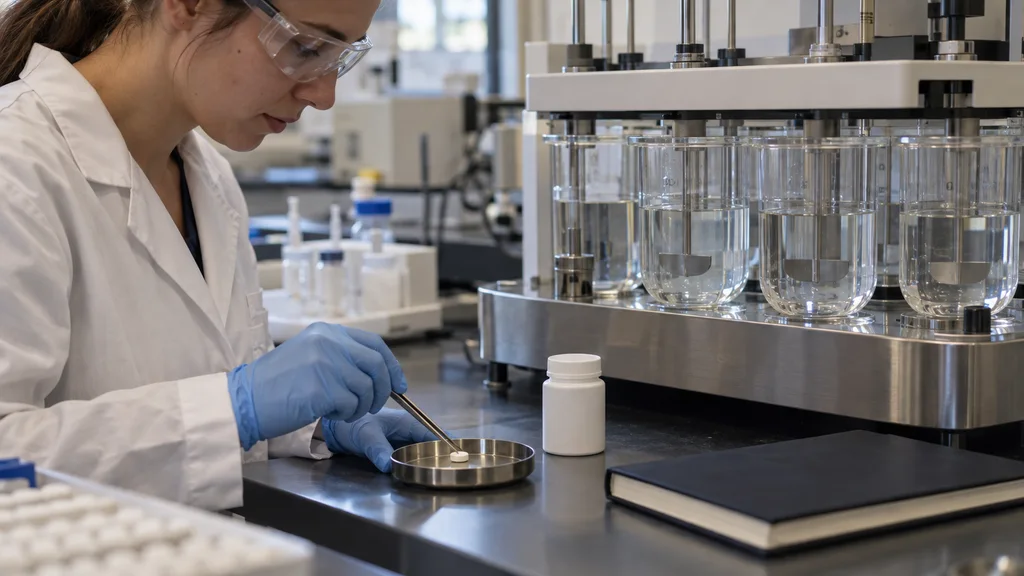
GZC8072 is an investigational oral peptide GLP-1 receptor agonist designed to be taken once a week. Gan & Lee began its first-in-human Phase 1 study in September 2026. The idea is unusually ambitious: combine the convenience of a tablet with the long action of a weekly peptide. Human weight-loss results have not been reported yet.
A weekly GLP-1 pill sounds simple. The science behind it is not.
Most peptides do poorly in the digestive tract. Acid can damage them. Enzymes can cut them apart. Even when a peptide survives, the intestinal wall is built to keep large, water-loving molecules from slipping into the bloodstream. That is why so many peptide medicines are injected and why a genuine oral peptide attracts attention.
GZC8072 adds one more challenge. It is not being developed as a tablet taken every morning. Its proposed schedule is once a week. To make that idea work, the developer needs an oral formulation that gets enough peptide into the body and a peptide design that remains active long enough after absorption.
That combination makes GZC8072 one of the most interesting GLP-1 development stories of 2026. It also makes the program a useful case study for research buyers, formulation teams and peptide manufacturers trying to understand where oral peptide technology is going.
Why GZC8072 is different
It is designed to combine a real peptide, oral delivery and once-weekly exposure in one tablet program.
Molecule
A peptide GLP-1 receptor agonist based on native GLP-1.
Format
An oral tablet designed for once-weekly administration.
Status
First-in-human Phase 1 development began in September 2026.
What happened with GZC8072 in September 2026?
Gan & Lee Pharmaceuticals announced two closely related milestones.
First, the company said GZC8072 received authorization in China to begin a clinical study for type 2 diabetes. The company had already received clinical authorization for an obesity and overweight program. Then, on September 9, it announced that the first participant had been dosed in a first-in-human Phase 1 study.
The planned study includes 112 participants. It is randomized, double-blind and placebo-controlled. The design has two main parts. A single-ascending-dose portion studies individual doses in healthy adults. A multiple-ascending-dose portion studies repeated administration in adults with overweight or obesity.
The first job of this trial is to learn how the tablet behaves in people. That includes safety and tolerability, but it also includes pharmacokinetics: how much of the compound appears in the blood, how quickly it appears, how long it remains and how exposure changes as the dose changes.
Those measurements matter more than an early weight-loss headline. A weekly oral peptide needs a dependable exposure pattern before a large efficacy trial makes sense. If absorption varies too much from person to person or from one dose to the next, the convenience of a weekly tablet becomes much harder to deliver in practice.
Is GZC8072 a peptide or a small-molecule GLP-1 pill?
GZC8072 is described by Gan & Lee as a peptide GLP-1 receptor agonist based on native GLP-1. That separates it from oral GLP-1 candidates such as orforglipron, aleniglipron and elecoglipron, which are small molecules rather than peptides.
The difference is easy to miss because both groups are pills and both activate the GLP-1 receptor. But the manufacturing and delivery problems are different.
| Oral GLP-1 approach | What the active is | Main development problem |
|---|---|---|
| GZC8072 | Peptide GLP-1 receptor agonist | Protecting and absorbing a peptide, then sustaining exposure |
| Oral semaglutide | Peptide with an absorption-enhancing formulation | Achieving reproducible absorption from a low-bioavailability oral dose |
| Orforglipron and similar candidates | Non-peptide small molecule | Balancing receptor activity, oral pharmacology and off-target profile |
A small molecule can often cross biological barriers more easily than a peptide. It may also be manufactured through a different chemical process. A peptide offers the familiar logic of an amino-acid sequence engineered around a biological signal, but it must overcome digestion and poor membrane permeability.
Our guide to whether an oral GLP-1 is a peptide explains the distinction in plain English. The short answer is that the dosage form does not reveal the molecule type. A pill can contain a peptide or a non-peptide active.
How can a peptide survive as an oral tablet?
An oral peptide does not succeed because someone presses peptide powder into a tablet. The finished product must solve several problems in a coordinated way.
The first problem is stability. A peptide needs protection from chemical damage and from digestive enzymes. The second problem is contact. The dosage form needs to release the active in a place and over a period that gives absorption a chance. The third problem is permeability. The formulation needs a defensible way to help the peptide cross a biological barrier without creating an unacceptable safety or variability problem.
A 2026 review of emerging oral-peptide delivery technologies describes the same connected challenges: peptide stability, intestinal transport, bioavailability and manufacturability have to be solved together.
Gan & Lee says GZC8072 uses two proprietary platforms. NovaPeptide is described as the company’s platform for long-acting peptide development and manufacturing. SupOraTide is described as its oral peptide delivery platform. According to the company, the combined design aims to improve intrinsic activity, extend half-life and increase oral bioavailability.
Those are development claims, not yet a public human performance result. The Phase 1 pharmacokinetic data will be the first important test of how the complete tablet performs in people.
For a deeper look at the science, read our oral peptide delivery in 2026 guide. It explains why stomach protection is only one part of the problem and why permeability, variability and manufacturing economics often determine whether an oral peptide becomes a practical product.
Why does once-weekly oral dosing matter?
Most discussions about oral GLP-1 products focus on avoiding injections. GZC8072 adds a second convenience question: how often does the tablet need to be taken?
A weekly tablet could reduce the number of administration events compared with a daily pill. Fewer events may simplify routines, packaging and adherence. It could also create a clear point of difference in an increasingly crowded metabolic pipeline.
But weekly oral dosing is not automatically better. A longer interval raises the importance of exposure control. The tablet has to deliver enough active material, and the molecule has to remain effective across the intended period. If one dose produces widely different exposure in different people, the seven-day promise becomes difficult to manage.
The commercial value therefore rests on three connected achievements: an oral formulation that works, a long-acting peptide that behaves predictably and a manufacturing process that can reproduce the same product at scale.
This is why the phrase “once-weekly oral peptide” is more than marketing language. It describes a demanding product specification.
Does GZC8072 have weight-loss results?
No human weight-loss result was included in the September 2026 first-participant announcement. GZC8072 is at the stage where researchers are establishing dose, exposure, safety and tolerability.
That makes this article different from a Phase 2 or Phase 3 results report. There is no responsible percentage to place in the headline. The meaningful news is that a weekly oral peptide GLP-1 has moved from a platform concept into human testing.
Later studies may ask how GZC8072 affects body weight, blood glucose and other metabolic measures. Before those results exist, the useful questions are more basic. Does the tablet deliver measurable and reasonably consistent peptide exposure? Does the exposure last long enough to support the planned interval? How does tolerability change as the dose increases? Can the same performance be reproduced across batches?
Readers who want an oral peptide program with published efficacy data can compare this early-stage story with our report on oral ribupatide Phase 2 results. Ribupatide is a different molecule, uses a different target combination and follows a different dosing schedule. The programs should not be treated as interchangeable.
How does GZC8072 compare with oral semaglutide?
Both are oral peptide GLP-1 programs, but that is where the simple comparison ends.
Semaglutide is a specific peptide with extensive clinical evidence and approved products. Its oral formulation uses an absorption enhancer and has a defined administration procedure in its approved labeling. GZC8072 is a different peptide and a different formulation platform. It is being designed around an unusually long weekly interval and remains in Phase 1.
The fair comparison in 2026 is about development strategy, not a claim that one product works better. Semaglutide proves that a peptide GLP-1 can be delivered by mouth. GZC8072 asks whether oral peptide engineering can stretch that idea to a weekly schedule.
That is a valuable question for the whole market. If the program succeeds, it may encourage more investment in long-acting oral peptides beyond obesity and diabetes. If it encounters variability or dose-size limits, those findings will still help define what the current technology can and cannot do.
For background on the established molecule, see what semaglutide is and our semaglutide research peptide specifications. The product information on Certiva refers to research materials. It does not represent GZC8072 or an approved finished medicine.
What does GZC8072 mean for peptide manufacturing?
Long-acting oral peptides bring the active ingredient and the finished dosage form into one manufacturing problem.
At the peptide stage, the manufacturer must control sequence identity, chemical form, process-related impurities and lot-to-lot consistency. A long or modified peptide can place heavy demands on synthesis yield and purification. Small losses at each step become expensive when the final tablet may require more active material than an injected product because only a fraction of the oral dose is absorbed.
At the formulation stage, the team must control how the tablet protects, releases and presents the peptide. Excipients, moisture, compression and coating can affect performance. The package may also matter because a moisture-sensitive tablet can change during storage before it ever reaches a study participant.
At the analytical stage, one HPLC purity number is not enough. Identity, assay or content, degradants, water, dissolution or release behavior and other product-specific attributes may all be necessary. The correct test panel depends on whether the material is raw peptide, a development blend or a finished clinical tablet.
Our GLP-1 peptide manufacturing guide explains why synthesis, purification, isolation and testing must scale together. Buyers can also use the peptide quality testing guide to separate the questions answered by HPLC, mass spectrometry, assay and stability work.
What should a research buyer verify?
The name “oral GLP-1” is not a complete purchasing specification. A buyer first needs to identify the exact compound and the intended work.
For a raw peptide research material, confirm the sequence or identity, salt or counterion form where relevant, molecular mass, purity method, content basis, packaging and storage. Match the batch number on the container with the batch number on the certificate. Confirm that the mass-spectrometry result supports the expected identity and that the chromatographic report belongs to the same lot.
For formulation research, define whether the project needs API supply, pre-formulation screening, prototype tablets, analytical method development, stability work or a full regulated development path. These are different scopes. A supplier of characterized peptide powder is not automatically a finished-drug CDMO, and a prototype made for laboratory evaluation is not an approved medicine.
The most useful request for quotation states the molecule, required form, target quantity, quality category, documents, destination and timeline. It also separates the immediate sample need from the expected repeat volume. That gives the supplier enough information to discuss a real process instead of sending a generic price.
Where GZC8072 fits in the oral GLP-1 race
The oral GLP-1 field now includes several distinct strategies.
Some programs use a known peptide with an absorption-enhancing formulation. Some use newly designed peptides and delivery platforms. Others avoid the peptide delivery problem by building small molecules that activate the same receptor.
GZC8072 occupies a particularly bold corner of that map: a peptide tablet with a weekly goal. Its success will depend on the complete product, not only receptor activity. A molecule can look powerful in a laboratory assay and still fail as an oral medicine if exposure is too low, too variable or too expensive to manufacture.
The next meaningful public update should include human pharmacokinetic and safety data. After that, larger studies can begin to answer efficacy questions. Until then, GZC8072 is best understood as a serious test of how far oral peptide design has advanced.
The bottom line
GZC8072 is a once-weekly oral peptide GLP-1 receptor agonist that entered first-in-human testing in September 2026. It is a peptide, not a small-molecule GLP-1 pill, and its proposed weekly interval makes the program especially notable.
The immediate story is delivery and duration. Human weight-loss results have not yet been reported. The Phase 1 study is designed to establish the exposure, tolerability and dose information needed for later trials.
For peptide buyers, GZC8072 is also a reminder that molecule identity, formulation and manufacturing scope must stay separate. A research peptide, an oral prototype and a regulated finished tablet require different specifications, tests and quality systems.
Certiva supplies documented research peptide materials and reviews suitable bulk, wholesale and OEM inquiries. To discuss an exact molecule, batch documentation, analytical scope or formulation-ready sourcing requirement, send the project details and request a quote.
See how Certiva verifies peptide identity and purity →
Sources and further reading
- Gan & Lee: first participant dosed in the GZC8072 Phase 1 study
- Gan & Lee: clinical trial authorization for the type 2 diabetes indication
- 2026 review: Emerging Technologies for Oral Peptide Delivery
- ICH Q2(R2): validation of analytical procedures
This article explains public research and manufacturing information available on September 27, 2026. GZC8072 remains investigational. Certiva research materials are not GZC8072, are not approved medicines and are not offered for personal use.
Frequently asked questions
What is GZC8072?
GZC8072 is an investigational once-weekly oral peptide GLP-1 receptor agonist developed by Gan & Lee. Its first-in-human Phase 1 study began dosing in September 2026.
Is GZC8072 really a peptide pill?
Yes. Gan & Lee describes GZC8072 as an oral peptide based on native GLP-1, not as a non-peptide small molecule. The tablet combines long-acting peptide design with an oral-delivery platform.
How often is GZC8072 designed to be taken?
GZC8072 is designed for once-weekly oral administration. That schedule is a development goal being tested in clinical studies, not an approved dosing recommendation.
Does GZC8072 have weight-loss results yet?
No human weight-loss result was reported in the September 2026 Phase 1 announcement. The current study first evaluates safety, tolerability and dose escalation in healthy adults and adults with overweight or obesity.
Is GZC8072 approved?
No. GZC8072 is an investigational program in early clinical development. It is not an approved medicine and should not be confused with approved semaglutide products.
What should buyers verify when sourcing an oral GLP-1 peptide for research?
Verify the exact molecule, sequence and chemical form, then match HPLC purity, mass-spectrometry identity, content, stability, packaging and the current batch COA to the intended research scope.
For research use only. Not for human consumption. This article is educational and makes no medical, therapeutic, or dosing claims.
← More gLP-1 & weight management guides · Have a question? Start an inquiry →