


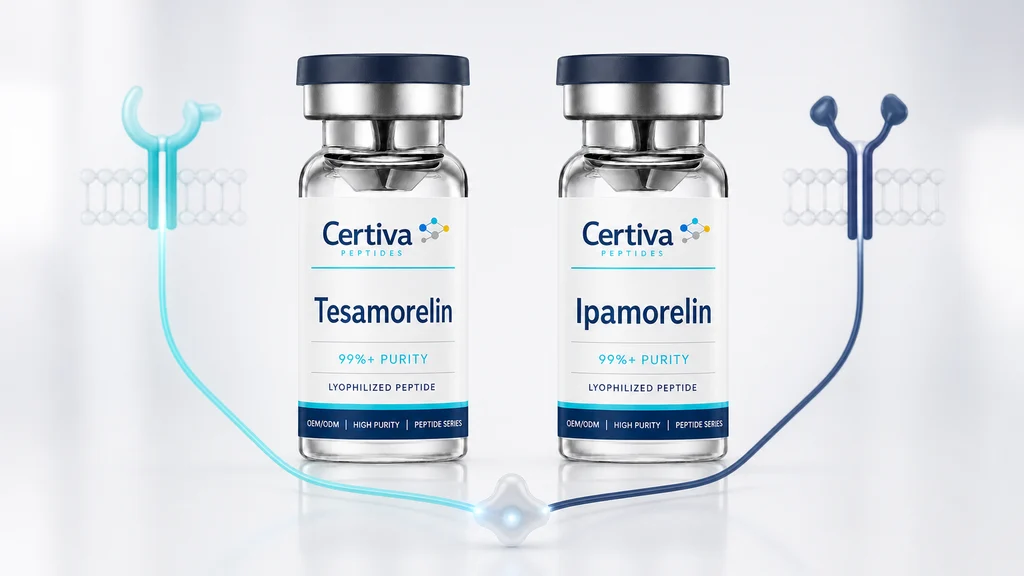
Same headline: growth-hormone signaling. Completely different button.
That is the fast answer to Tesamorelin vs Ipamorelin. Both appear in growth-hormone research, but they do not speak to the pituitary through the same receptor.
Tesamorelin uses the GHRH receptor; ipamorelin uses the ghrelin receptor, so they create different growth-hormone research models.
One copies a natural releasing-hormone message. The other acts like a selective secretagogue signal.
Tesamorelin vs Ipamorelin at a glance
| Question | Tesamorelin | Ipamorelin |
|---|---|---|
| What is it? | A stabilized GHRH analog | A five-amino-acid GH secretagogue |
| Main receptor | GHRH receptor | Ghrelin receptor, or GHS-R |
| Main research theme | GH pulsatility, IGF-1, visceral adipose tissue | Selective GH release and GHS-R signaling |
| Human clinical evidence | Multiple randomized trials | Early human work exists, but foundational selectivity work used animals |
| Certiva vial sizes | 5, 10, and 20 mg | 5 and 10 mg |
The easiest memory trick is releasing hormone versus secretagogue.
Tesamorelin looks like the longer natural GHRH message. Ipamorelin is a much smaller signal built to activate another receptor path.
What is Tesamorelin?
Tesamorelin is a stabilized synthetic analog of growth-hormone-releasing hormone, usually shortened to GHRH.
Natural GHRH tells pituitary cells to make and release growth hormone. Tesamorelin was designed to keep that basic message while improving stability.
A study in healthy men found that Tesamorelin increased overnight GH output while preserving pulsatile release. In simple terms, it turned up the body’s existing GH pulse pattern instead of replacing growth hormone with full-length HGH. Read the Tesamorelin GH-pulsatility study on PubMed.
Tesamorelin also has a large human evidence base around visceral adipose tissue. A 404-person randomized study in people with HIV-associated abdominal fat accumulation reported a 10.9% reduction in visceral adipose tissue after six months, compared with 0.6% for placebo. See the randomized Tesamorelin trial on PubMed.
That specific clinical history explains why Tesamorelin is the more visceral-fat-focused name in this comparison.
What is Ipamorelin?
Ipamorelin is a pentapeptide, meaning it contains only five amino acids. It is a growth-hormone secretagogue that acts through the ghrelin receptor, also known as GHS-R.
The original pharmacology paper compared Ipamorelin with other GH-releasing peptides. In animal models, Ipamorelin produced a strong GH-release signal without the same significant ACTH or cortisol release seen with two comparison GHRPs.
That finding gave Ipamorelin its best-known description: a selective growth-hormone secretagogue. Read the Ipamorelin selectivity paper on PubMed.
Ipamorelin therefore fits studies centered on GHS-R activation, receptor selectivity, and secretagogue signaling.
Which is better: Tesamorelin or Ipamorelin?
The better research peptide depends on the question.
- Choose Tesamorelin when the project centers on a stabilized GHRH analog, GH pulses, IGF-1, or visceral-adipose-tissue models.
- Choose Ipamorelin when the project centers on the ghrelin receptor, selective GH release, or GHRP comparisons.
- Choose separate vials of both when the project compares GHRH-receptor signaling with GHS-R signaling.
Tesamorelin has the clearer human clinical story for visceral adipose tissue in a specific approved context. Ipamorelin has the cleaner “small selective secretagogue” research identity.
That does not make one universally stronger. It makes them useful for different experimental designs.
Is Tesamorelin the same as CJC-1295?
No. Tesamorelin and CJC-1295 are both GHRH analogs, but they are different sequences with different development histories.
If a project is comparing receptor paths, start with this article. If it needs a closer look at a different GHRH analog and Ipamorelin, read our CJC-1295 vs Ipamorelin guide.
What formats can I order?
Certiva supplies:
- Tesamorelin: 5 mg, 10 mg, and 20 mg per vial;
- Ipamorelin: 5 mg and 10 mg per vial; and
- standard packaging: 10 vials per box.
The products are available separately, giving researchers control over the identity and amount of each reference.
What should I check before ordering?
Do not let “GH peptide” replace the actual product name. Verify:
- the peptide is Tesamorelin or Ipamorelin;
- the vial strength matches the inquiry;
- the lot number matches the report;
- HPLC shows the batch purity profile;
- mass spectrometry supports identity; and
- storage, shipping, and lead time are documented.
Our peptide COA guide explains those checks without laboratory jargon.
The key difference is the signaling route
Tesamorelin is the GHRH-analog choice. Ipamorelin is the selective ghrelin-receptor secretagogue choice.
Choose the pathway that matches the research question, then verify the exact vial and batch documents before ordering.
Certiva supplies these products strictly for laboratory research use only, not for human consumption.
Compare current COAs
Tell us which peptide, vial strength, box quantity, destination, and documentation you need. We will reply with current availability, applicable batch information, lead time, and a quote.
Compare Tesamorelin and Ipamorelin COAs →
Sources and further reading
- PubMed: Tesamorelin and endogenous GH pulsatility
- PubMed: randomized Tesamorelin visceral-fat trial
- PubMed: Ipamorelin as a selective GH secretagogue
Frequently asked questions
What is the main difference between Tesamorelin and Ipamorelin?
Tesamorelin uses the GHRH receptor; ipamorelin uses the ghrelin receptor, so they create different growth-hormone research models.
Is Tesamorelin the same as Ipamorelin?
No. Tesamorelin is a stabilized GHRH analog, while Ipamorelin is a five-amino-acid growth-hormone secretagogue that acts through the ghrelin receptor, also called GHS-R.
Which is better, Tesamorelin or Ipamorelin?
Tesamorelin is the stronger match for GHRH, GH pulsatility, and visceral-adipose-tissue research. Ipamorelin is the stronger match for selective ghrelin-receptor and GH-secretagogue research.
Does Tesamorelin have human clinical research?
Yes. Randomized trials studied prescription tesamorelin in specific populations, including people with HIV-associated abdominal fat accumulation. Those results do not change the research-only status of Certiva material.
Can I order Tesamorelin and Ipamorelin separately?
Yes. Certiva supplies Tesamorelin in 5, 10, and 20 mg vials and Ipamorelin in 5 and 10 mg vials, with 10 vials per standard box.
For research use only. Not for human consumption. This article is educational and makes no medical, therapeutic, or dosing claims.
← More sourcing & supply guides · Have a question? Start an inquiry →