


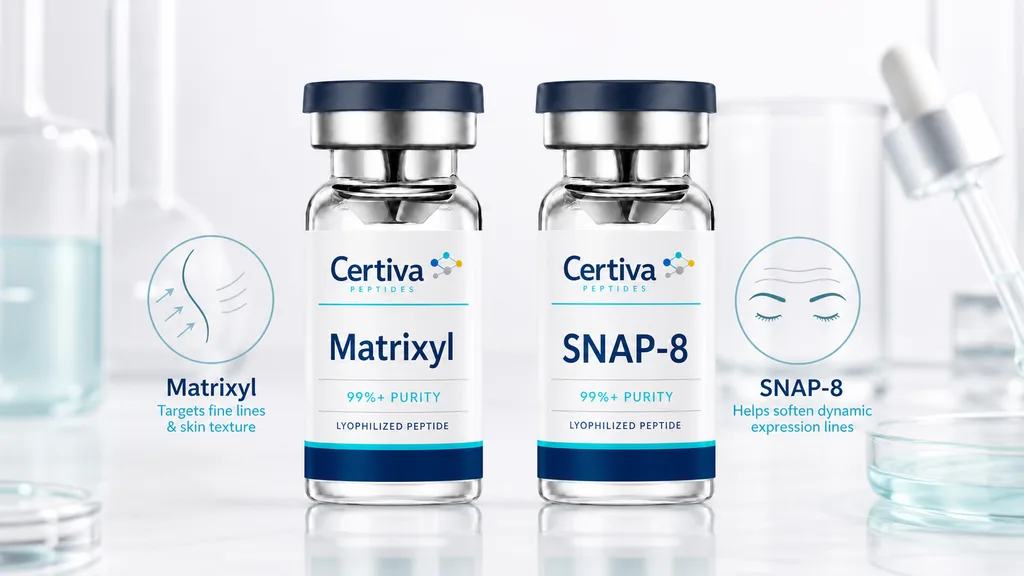
Not every wrinkle is telling the same story.
Some lines come with time and changing skin structure. Others deepen every time you smile, squint, or raise an eyebrow.
Matrixyl is the stronger all-around choice for fine lines and firmness; snap-8 is the more targeted choice for expression-line formulas.
The best peptide is the one that matches the promise on the front of the product.
Compare Matrixyl and SNAP-8 specifications →
Which wrinkle peptide fits your formula?
Start with the type of line your customer sees in the mirror.
Fine lines
Choose Matrixyl
The broader anti-aging signal peptide for fine lines, wrinkles, and firmness.
Expression lines
Choose SNAP-8
The focused choice for forehead, between-the-brow, and eye-area concepts.
Multi-peptide serum
Use both roles
Build one formula around broad wrinkle support plus targeted expression-line care.
Matrixyl vs SNAP-8 at a glance
| Comparison | Matrixyl | SNAP-8 |
|---|---|---|
| Common ingredient name | Palmitoyl Pentapeptide-4 | Acetyl Octapeptide-3 |
| Number of amino acids | 5, plus a palmitoyl group | 8, plus an acetyl group |
| Simple peptide type | Signal peptide | Expression-line peptide |
| Best consumer story | Fine lines, wrinkles, firmer-looking skin | Lines from repeated facial expressions |
| Popular formats | Face serum, moisturizer, eye cream | Targeted serum, eye product, forehead treatment |
| Certiva specification | 10 mg | 10 mg |
Both are anti-aging cosmetic peptides. They earn their place in a formula for different reasons.
What is Matrixyl?
Matrixyl is one of the best-known peptide names in anti-aging skincare.
The classic ingredient is commonly associated with Palmitoyl Pentapeptide-4. It is a short signal peptide with a fatty palmitoyl group attached.
That fatty part helps make the peptide more useful in a topical cosmetic formula. The peptide part supports a message connected with the skin’s structural proteins.
The consumer explanation is simple:
Matrixyl is designed for the broader appearance of fine lines, wrinkles, and firmness.
This makes it a strong hero ingredient for:
- everyday anti-aging serums;
- firming moisturizers;
- eye creams;
- night creams; and
- multi-peptide facial products.
What is SNAP-8?
SNAP-8 is commonly listed as Acetyl Octapeptide-3.
“Octapeptide” means the chain contains eight amino acids. The ingredient was designed for a more specific cosmetic story: the appearance of lines connected with repeated facial expressions.
Think about the places the face moves most:
- the forehead;
- between the eyebrows;
- around the eyes; and
- the outer corners of the eyes.
That gives SNAP-8 a clear job in:
- targeted expression-line serums;
- eye-area formulas;
- forehead treatments;
- smoothing primers; and
- multi-peptide wrinkle products.
The useful positioning is:
SNAP-8 is the expression-line specialist.
Which has the stronger wrinkle evidence?
Matrixyl has the cleaner all-around wrinkle study.
A 12-week randomized, placebo-controlled study included 93 women. Researchers compared two moisturizers: one with palmitoyl pentapeptide and one without it.
The moisturizer containing the peptide produced significantly greater improvement in fine lines and wrinkles. The change was measured with technical imaging and expert grading.
That study makes Matrixyl easy to explain to ordinary shoppers:
the peptide moisturizer outperformed the matching moisturizer without the peptide.
Read the study in PubMed’s palmitoyl pentapeptide record.
SNAP-8 has encouraging formula-level evidence. A 12-week clinical study of a formula containing Acetyl Octapeptide-3 and other skin-supporting ingredients reported a 25.8% reduction in visible fine lines and wrinkles.
That supports SNAP-8 as part of a thoughtfully designed expression-line product. See the Acetyl Octapeptide-3 combination study.
Which is better for forehead lines?
SNAP-8 has the sharper forehead-line story.
Forehead lines are strongly connected with repeated movement. SNAP-8 was designed for the signaling involved in expression-line appearance, so the ingredient fits the way a targeted forehead product is marketed.
That does not limit it to one part of the face. It can also support concepts for:
- crow’s-feet;
- lines between the eyebrows;
- eye-area smoothing; and
- expression-heavy areas.
A well-named targeted serum can make the ingredient easy to understand: “expression-line peptide” is clearer than a long technical name on the front label.
Which is better for fine lines and firmness?
Matrixyl is the broader choice.
Its consumer story is not tied to one moving area. It fits a full-face routine and the general signs people associate with skin aging:
- small fine lines;
- deeper-looking wrinkles;
- loss of firmness;
- rougher texture; and
- skin that looks less supported.
This is why Matrixyl works well in an everyday face serum or moisturizer. It supports a wider promise without asking the shopper to identify one exact type of wrinkle.
Can Matrixyl and SNAP-8 work together?
Yes. They can give a multi-peptide product two clear jobs.
| Ingredient | Job inside the product story |
|---|---|
| Matrixyl | Broad fine-line, wrinkle, and firmness positioning |
| SNAP-8 | Targeted expression-line positioning |
That combination is commercially attractive because it is easy to explain:
one peptide for the skin’s support story, one peptide for the lines created by movement.
The final product still needs good formulation work. The manufacturer should check:
- ingredient compatibility;
- pH and temperature limits;
- preservation;
- packaging;
- stability over time;
- skin feel; and
- finished-product performance.
Read our consumer guide to choosing peptides in skincare.
What should shoppers look for on the label?
The front may say “peptide complex.” The ingredient list gives the more useful answer.
Look for:
- Palmitoyl Pentapeptide-4 for the classic Matrixyl peptide;
- Acetyl Octapeptide-3 for SNAP-8;
- packaging that protects the full formula;
- realistic directions for consistent use; and
- a brand that names the actual peptide instead of hiding behind a vague blend.
Visible changes from peptide skincare are usually judged over weeks, not one night. Many of the better-known facial studies use an 8- to 12-week window.
What should a cosmetic peptide buyer compare?
Before ordering a raw material, request:
- the exact peptide and INCI name;
- the raw-material specification;
- the current batch COA;
- identity and HPLC purity information;
- appearance, solubility, and storage guidance;
- formulation and stability information;
- minimum quantity and lead time; and
- OEM, private-label, bulk, or custom-formulation options.
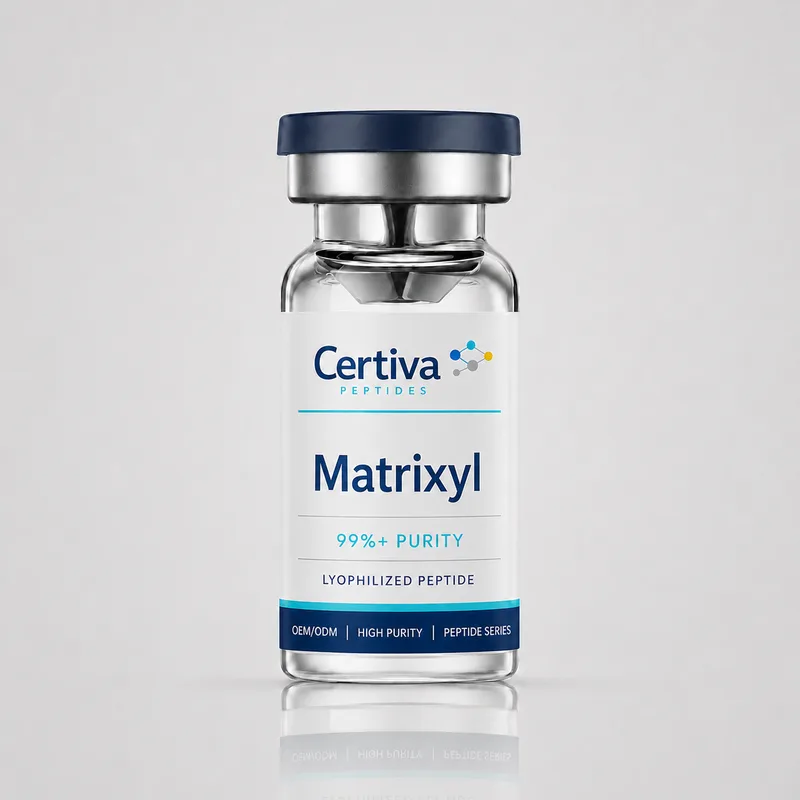
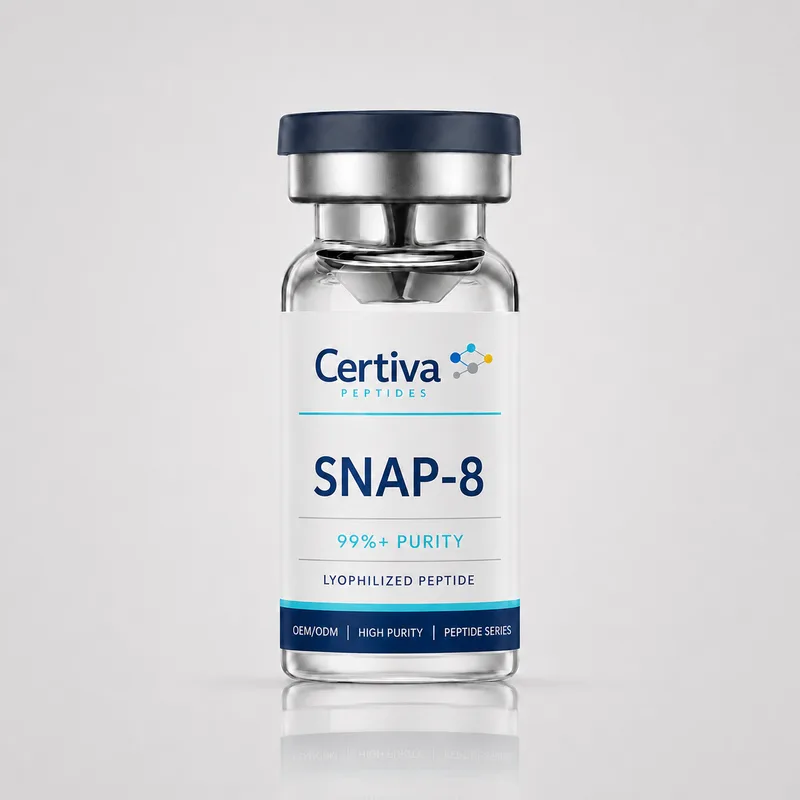
Certiva supplies Matrixyl and SNAP-8 in 10 mg vial specifications, with 10 vials per standard box. Larger professional formulation quantities are available by inquiry.
Choose by formulation goal, not name recognition
Matrixyl is the stronger all-around choice for fine lines and firmness; snap-8 is the more targeted choice for expression-line formulas.
Choose Matrixyl for an everyday anti-aging serum, moisturizer, or eye cream with a broad wrinkle story.
Choose SNAP-8 for a targeted forehead, eye-area, or expression-line concept.
Use both when the formula needs two complementary messages that shoppers can understand in seconds.
Request Matrixyl and SNAP-8 specifications and a quote
A Matrixyl–SNAP-8 inquiry should start with the product format and formulation goal, then define concentration, quantity, target market, and documentation. Certiva can use those details to recommend the appropriate active and OEM supply path.
View Matrixyl specifications · View SNAP-8 specifications · Ask about cosmetic peptide OEM
Request Matrixyl and SNAP-8 specifications + a quote →
Sources and further reading
- PubMed: Palmitoyl pentapeptide study in 93 women
- PubMed: Acetyl Octapeptide-3 combination study
- PubMed: 2026 systematic review of cosmetic peptides for skin aging
Frequently asked questions
Which is better, Matrixyl or SNAP-8?
Matrixyl is the stronger all-around choice for fine lines and firmness; snap-8 is the more targeted choice for expression-line formulas.
What is the main difference between Matrixyl and SNAP-8?
Matrixyl is a signal peptide used for collagen-support and general wrinkle-focused skincare. SNAP-8 is an acetylated octapeptide positioned for lines linked with repeated facial expressions.
What is Matrixyl called on an ingredient list?
The classic Matrixyl peptide is commonly listed as Palmitoyl Pentapeptide-4. Matrixyl is also a wider trademarked ingredient family, so shoppers should check the exact INCI list.
What is SNAP-8 called on an ingredient list?
SNAP-8 is commonly listed as Acetyl Octapeptide-3.
Can Matrixyl and SNAP-8 be used together?
Yes. A multi-peptide formula can pair Matrixyl's broad fine-line and firmness story with SNAP-8's expression-line focus. The finished product still needs compatibility, stability, safety, and performance testing.
Does Certiva supply Matrixyl and SNAP-8 for cosmetic formulation?
Yes. Certiva supplies Matrixyl and SNAP-8 cosmetic actives in 10 mg vial specifications, with 10 vials per standard box. Bulk, OEM, and private-label quantities are available by inquiry.
Educational content only. Cosmetic ingredients and finished products are not interchangeable, and this article does not diagnose or treat hair or skin conditions. Follow the finished-product label and ask a qualified healthcare professional about persistent concerns.
← More skin & hair peptides guides · Have a question? Start an inquiry →