


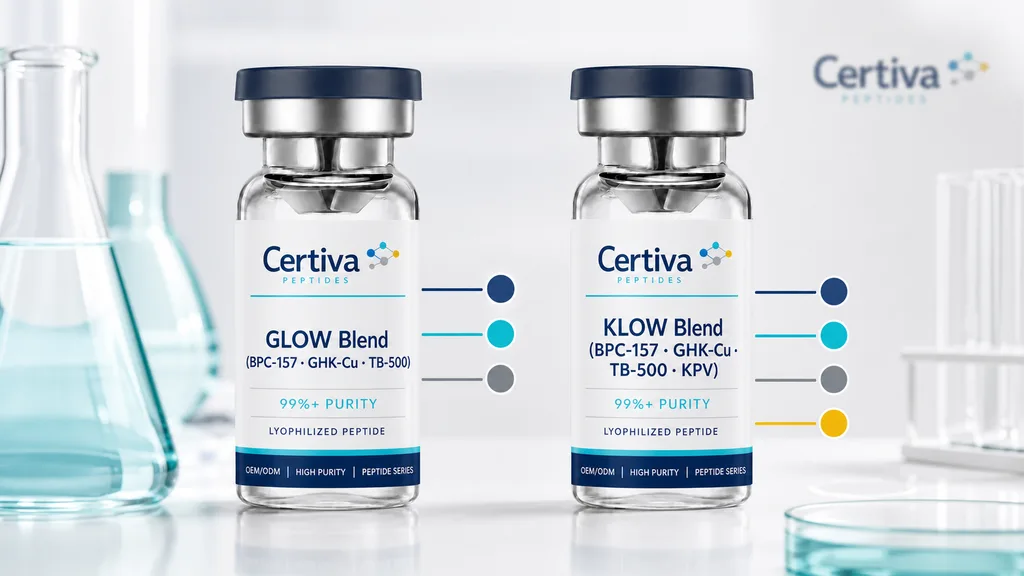
One extra letter. One extra peptide. Ten extra milligrams.
Klow is glow plus kpv: both share BPC-157, GHK-Cu, and TB-500, while klow adds a fourth peptide for inflammation-focused research.
That is the whole GLOW vs KLOW difference in one sentence. GLOW is the original three-peptide blend. KLOW keeps the same three components and adds KPV.
Compare GLOW-70 and KLOW-80 specifications →
GLOW or KLOW?
Decide whether the project needs the original three-peptide base or that base plus KPV.
GLOW-70
The original trio
BPC-157, GHK-Cu, and TB-500 in one 70 mg research blend.
KLOW-80
The trio plus KPV
The same 70 mg base with a fourth 10 mg inflammation-research component.
Buyer shortcut
Check all four amounts
The name alone does not confirm the exact recipe in a supplier’s vial.
GLOW vs KLOW at a glance
| Component | Certiva GLOW-70 | Certiva KLOW-80 |
|---|---|---|
| BPC-157 | 10 mg | 10 mg |
| GHK-Cu | 50 mg | 50 mg |
| TB-500 | 10 mg | 10 mg |
| KPV | — | 10 mg |
| Total | 70 mg | 80 mg |
| Number of components | 3 | 4 |
The first three rows are identical. The fourth row creates the difference.
What is GLOW peptide?
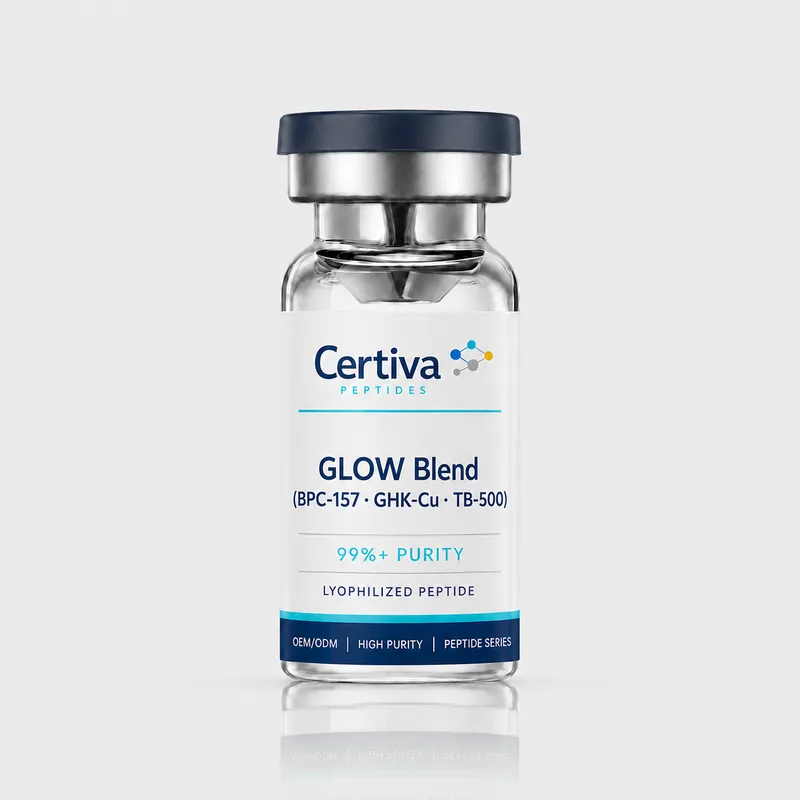
GLOW-70 is a three-component lyophilized research blend:
- BPC-157: 10 mg
- GHK-Cu: 50 mg
- TB-500: 10 mg
Together, those amounts total 70 mg.
The GLOW name became popular because it is easier to remember than listing three peptides every time. Each component also brings a distinct research story:
- BPC-157 for cell-movement and repair models;
- GHK-Cu for copper-peptide, collagen, and matrix research;
- TB-500 for research connected with thymosin beta-4, cell movement, and tissue organization.
That gives the blend a three-part identity without adding a fourth component.
If you want the ingredient-by-ingredient introduction, start with what GLOW peptide is.
What is KLOW peptide?
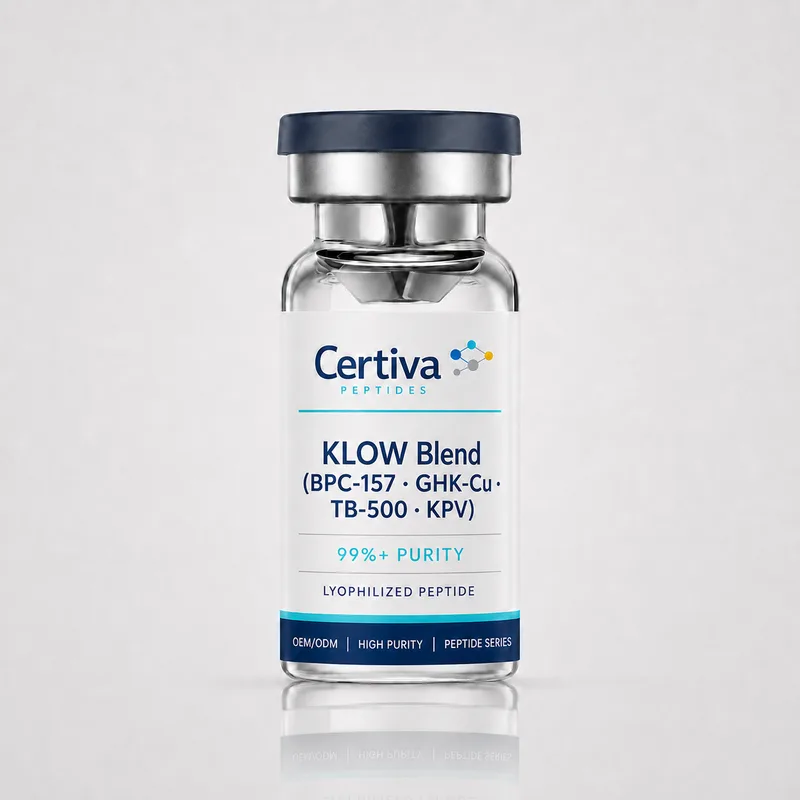
KLOW-80 keeps all three GLOW components at the same Certiva amounts and adds:
- KPV: 10 mg
That addition brings the total to 80 mg.
KPV contains only three amino acids: lysine, proline, and valine. It comes from the end of a larger natural signal called alpha-MSH.
Researchers have studied KPV in cell and animal models involving inflammatory signals. Published work has connected it with lower activity in pathways such as NF-kB and MAP kinase.
You do not need to remember those pathway names. The simple idea is:
KPV gives KLOW an extra inflammation-research component that GLOW does not contain.
See the component research in the PubMed KPV study.
Is KLOW stronger than GLOW?
KLOW is broader, because it contains one more peptide.
It is not simply a stronger version made by increasing the same three ingredients. In Certiva’s specifications:
- BPC-157 stays at 10 mg;
- GHK-Cu stays at 50 mg;
- TB-500 stays at 10 mg;
- KPV adds another 10 mg.
That means KLOW contains the full GLOW-70 composition plus a separate KPV arm.
For buyers, this distinction matters. “80 mg” sounds larger than “70 mg,” but the useful question is not only the total. It is which peptide creates the extra 10 mg?
The answer is KPV.
What do the three shared peptides bring?
GLOW and KLOW have the same base, so most of their ingredient story is shared.
GHK-Cu: the copper-peptide member
GHK-Cu is a three-amino-acid peptide carrying copper. Researchers have connected it with collagen production, fibroblast activity, and extracellular-matrix remodeling.
It also gives these blends their most recognizable visual feature: copper peptide material can have a blue appearance.
BPC-157: the 15-amino-acid member
BPC-157 is a chain of 15 amino acids. Published laboratory and animal work has looked at cell movement, tendon models, ligament models, and tissue-repair signals.
It is one of the best-known names in the consumer conversation around recovery peptides.
TB-500: the cell-movement member
TB-500 is related to an active region of thymosin beta-4. Research around thymosin beta-4 has explored cell movement, blood-vessel formation, and wound closure in laboratory and animal models.
Together, the three components create the GLOW base that also sits inside KLOW.
What does KPV change?
KPV changes the emphasis.
The original GLOW trio already covers copper-peptide signaling, cell movement, and several repair-research pathways. Adding KPV gives KLOW another component with a direct inflammation-signaling research story.
That makes the commercial distinction easy:
- GLOW: the recognizable three-peptide blend;
- KLOW: the same three-peptide blend plus KPV.
Brands, resellers, and research buyers can explain the difference without vague language or invented promises. The exact ingredient list does the work.
Which blend should a research buyer choose?
Choose GLOW-70 when the project needs:
- the original BPC-157, GHK-Cu, and TB-500 combination;
- a simpler three-component comparison;
- a 70 mg co-formulated research reference; or
- comparison with the individual components.
Choose KLOW-80 when the project needs:
- all three GLOW components;
- an additional KPV component;
- a four-component comparison; or
- an inflammation-signaling arm in the research design.
Choose both when the project is designed to isolate what changes after KPV is added to the same three-component base.
What should buyers check before ordering?
Blend names are convenient. Batch documents are more useful.
Before ordering GLOW or KLOW, request:
- the exact ingredient list;
- the amount of every component;
- the total vial specification;
- the current applicable batch report;
- the testing method and what it confirms;
- packaging and storage information;
- availability, minimum quantity, and lead time; and
- bulk or custom-formulation options.
A COA showing one strong purity number does not automatically describe every component in a co-formulated blend. Ask how the supplier connects the report, identity information, and composition to the batch being offered.
Our guide to reading a peptide COA explains the questions in plain English.
The simplest way to distinguish GLOW and KLOW
Klow is glow plus kpv: both share BPC-157, GHK-Cu, and TB-500, while klow adds a fourth peptide for inflammation-focused research.
GLOW-70 is the original three-peptide reference.
KLOW-80 keeps the entire GLOW-70 base and adds 10 mg of KPV. That makes the choice simple: original trio or trio plus KPV.
Request GLOW and KLOW specifications, batch documents, and a quote
Tell Certiva which blend, quantity, destination country, and documentation you need. We will reply with current availability, applicable batch information, bulk or custom options, lead time, and a quote.
View GLOW-70 specifications · View KLOW-80 specifications · See Certiva quality standards
For an OEM or custom formula, use the peptide blend manufacturing guide to define the exact ratio, content basis, compatibility work, sampling plan and finished-blend COA.
Request GLOW-70 and KLOW-80 documents + a quote →
Sources and further reading
- PubMed: KPV and inflammation signaling
- PubMed: GHK-Cu and collagen synthesis
- PubMed: BPC-157 and tendon-cell research
- PubMed: Thymosin beta-4 and dermal repair research
Frequently asked questions
What is the difference between GLOW and KLOW peptide?
KLOW is GLOW plus KPV: both share BPC-157, GHK-Cu, and TB-500, while KLOW adds a fourth peptide for inflammation-focused research.
What ingredients are in GLOW peptide?
Certiva GLOW-70 contains BPC-157 10 mg, GHK-Cu 50 mg, and TB-500 10 mg, for a total of 70 mg per vial.
What ingredients are in KLOW peptide?
Certiva KLOW-80 contains BPC-157 10 mg, GHK-Cu 50 mg, TB-500 10 mg, and KPV 10 mg, for a total of 80 mg per vial.
Is KLOW stronger than GLOW?
KLOW is broader, not simply a higher-strength copy. It keeps the same 70 mg GLOW base and adds 10 mg of KPV as a fourth research component.
What does KPV add to KLOW?
KPV is a three-amino-acid fragment of alpha-MSH studied in inflammation-signaling models. It gives KLOW an extra component for inflammation-focused research.
Can buyers request GLOW and KLOW COAs before ordering?
Yes. Buyers can request the current applicable batch reports, exact composition, availability, bulk options, custom-formulation options, lead time, and a destination-based quote.
For research use only. Not for human consumption. This article is educational and makes no medical, therapeutic, or dosing claims.
← More sourcing & supply guides · Have a question? Start an inquiry →